Feeding a Nation Is an Entrepreneurship Problem. Layth Dwairi Made Farmland Investable
Layth Dwairi, CEO and Co-Founder of Tathmeer Agri Tech, on why growers abandon technology
that works, and how a new centre in Sharjah aims to prove the model before anyone's capital is
committed.
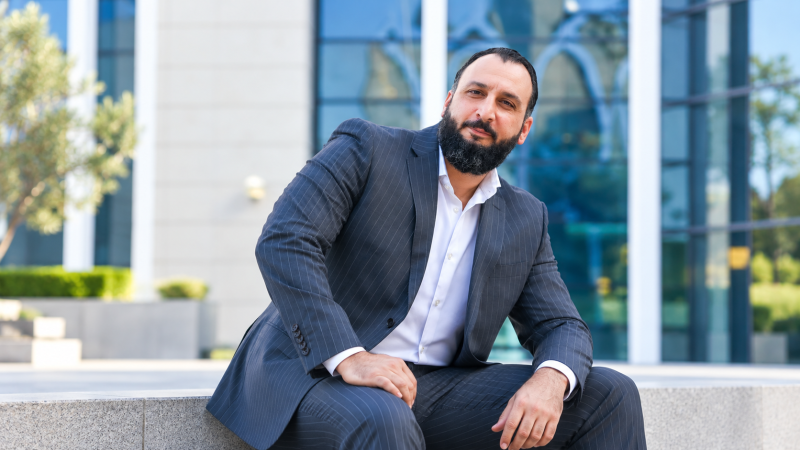
Layth Dwairi, CEO and Co-Founder
The technologies capable of addressing many of the region’s agricultural constraints already exist. Controlled-environment agriculture, hydroponics, vertical farming and AI-enabled monitoring are all commercially available today.
The harder question is why so little of that technology reaches the farm.
For Layth Dwairi, CEO and Co-Founder of Tathmeer Agri Tech, the answer is not technical. It is commercial. A grower is being asked to commit capital to a system they may never have seen operating on a crop like theirs, under conditions like theirs. Faced with that proposition, many decline, and the technology never makes it onto the farm.
That diagnosis is the foundation of the company’s latest move.
Tathmeer has launched what it describes as MENA’s first Integrated Agri-Tech Innovation Centre in partnership with Sharjah Research, Technology and Innovation Park (SPARK), to be established on a dedicated land plot within the park.
“Growers across this region are short of a way to test technology before committing capital to it,” Dwairi says. “That is what this centre changes.”
The centre is designed as a working environment rather than a showcase. Agricultural technologies will be demonstrated, tested and validated under real operating conditions before commercial deployment and scale-up.
It will bring together controlled-environment agriculture, hydroponics, vertical farming, automation, IoT and AI-enabled monitoring, alongside Tathmeer’s FarmBridge digital platform.
For founders in any sector where adoption requires a customer to take a significant capital risk, the principle travels well: demonstrate that a product works in the buyer’s own conditions before asking them to purchase it.
It removes an objection that no amount of marketing can fully overcome.
“Working with SPARK, we can put controlled-environment systems, vertical farming and AI-enabled monitoring in front of farmers under real operating conditions,” Dwairi explains.
Proof alone, however, does not change a grower’s economics.
A farmer who can see that a system works still needs a way to finance it, and a buyer at the end of the season.
Tathmeer’s model is built around what the company describes as three fundamental commercial questions: what to grow, how to grow and where to sell.
The FarmBridge Agri-Ecosystem is designed to connect farmers, technology companies, investors, government entities, entrepreneurs, SMEs, supply-chain operators and food and beverage businesses through a coordinated digital and physical platform.
“We connect what proves itself to financing through our platform, and to buyers through FarmBridge,” Dwairi says.
The proposition extends the centre beyond technology validation. If successful, the model creates a pathway from testing to financing and ultimately to market access, tackling several of the barriers that can prevent agricultural technologies from moving beyond pilot stage.
Tathmeer’s decision to build within SPARK also reflects a distinction that matters for any founder evaluating where to base a physical operation.
The park is contributing land, infrastructure, ecosystem access and facilitation — assets that capital alone cannot always replicate quickly.
For an innovation centre designed to connect technology providers, farmers, investors and public-sector stakeholders, access to that wider ecosystem can be as important as the physical infrastructure itself.
That ambition is also visible in Tathmeer’s partnership with Elevate Farms, a vertical farming technology company with operations in Canada, the United States and Switzerland.
The agreement is expected to strengthen the centre’s access to advanced vertical farming systems and support their demonstration, validation and potential deployment in the UAE and the wider region.
“Our partnership with Elevate Farms brings internationally proven vertical farming technology into that environment,” Dwairi says.
The sequencing is deliberate.
Systems developed for North American or European conditions are not automatically transferable to the Gulf. Climate, operating costs, crop requirements and market dynamics can all affect performance.
The centre is therefore intended to establish what works locally before technologies are deployed at scale.
Training and capacity building will form another component of the initiative, with planned certification, field-learning and skills-development programmes for farmers, agronomists, entrepreneurs and technology adopters.
It reflects a simple reality: equipment and capability are different problems.
A system can be installed in days. The expertise required to operate it, maintain it and ultimately make it profitable takes considerably longer to build.
Without that knowledge transfer, even promising deployments can struggle once the technology provider or installer steps away.
By combining infrastructure with training, Tathmeer is aiming to address not only whether agricultural technology works, but whether the people using it can continue operating it successfully over the long term.
For Dwairi, the ultimate test of the model is not the facility itself, but what changes on the farms around it.
“Success is reflected in farms being able to produce more with less water, and a clear route to market,” he says.
It is a relatively straightforward definition for an initiative positioned against a national priority. But it is also a fundamentally commercial one.
For a business built around encouraging growers to adopt technologies they may previously have considered too risky, the real measure of success will be whether innovation moves beyond demonstration and begins producing measurable results on the ground.
The technology already exists. Tathmeer’s bet is that adoption will accelerate when farmers are given the opportunity to see it work, understand how to finance it and know where their produce will ultimately be sold.