Five Hospitality Industry Leaders Share Insights On Sustainability Ahead Of The Future Hospitality Summit World 2024 In Dubai
The Future Hospitality Summit 2024 is set to take place from September 30 to October 2, 2024 at Madinat Jumeirah in Dubai.
From decarbonisation and data management to sustainability and staff training, environmental, social and governance (ESG) initiatives are at the top of the hospitality sector’s agenda. With People, Planet and Profit a key conference track at the upcoming Future Hospitality Summit (FHS) World, taking place from September 30-October 2, 2024 at Madinat Jumeirah in Dubai, leading hospitality leaders are all set to discuss what the industry is already doing –and what more can be achieved– to strike a balance between best practice and maintaining top-flight services, amenities and industry standards.
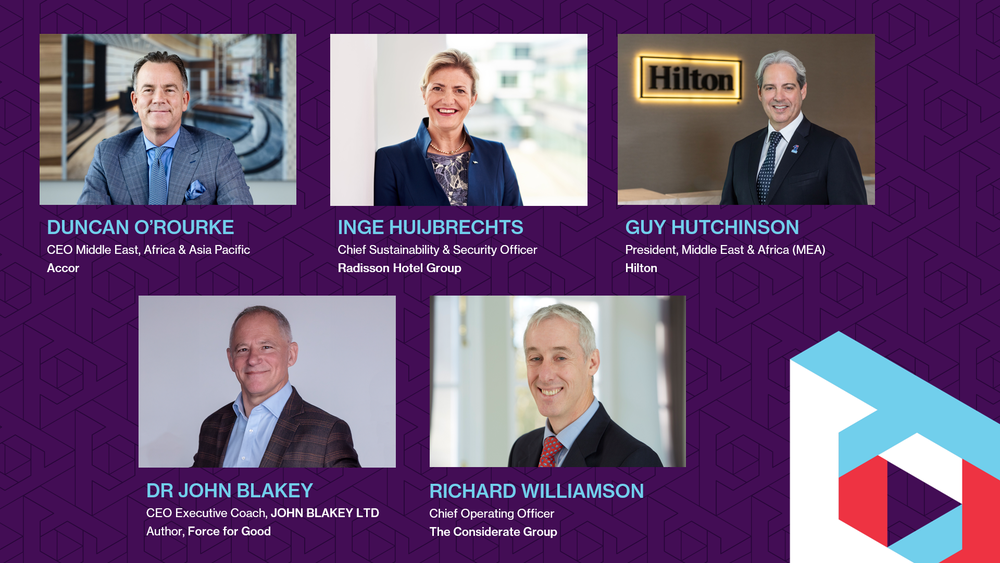
Ahead of the FHS World 2024’s proceedings, five industry specialists share their insights on how ESG and sustainability can be more seamlessly incorporated into the industry. The experts include Inge Huijbrechts, Chief Sustainability and Security Officer, Radisson Hotel Group; Duncan O’Rourke, Chief Executive Officer, Premium, Midscale and Economy Division Middle East, Africa and Asia Pacific, Accor; Richard Williamson, Chief Operating Officer (COO), Considerate Group; Guy Hutchinson, President, Middle East and Africa, Hilton, and Dr. John Blakey, CEO, Executive Coach and Founder, The Trusted Executive.
Among the many questions that have arisen on this topic is where does the industry start when it comes to decarbonisation and embarking on the pathway to net zero? According to Huijbrechts, the transition to a net zero and equitable hotel industry is essential. “Hotel groups need to use proven, transparent and verifiable methodologies to collect data and calculate their scope 1, 2 and 3 carbon footprints,” Huijbrechts adds. “The focus here is increasingly on auditability of the data and the decision processes, for example as prescribed in regulations such as CSRD. The next step is setting targets to move towards net zero, and report progress regularly. A widely recognized framework is SBTi – the Science Based Targets Initiative. Part of the data for any company will be a combination of accurate actuals and extrapolations. The trick is to get started and gradually decrease the extrapolated content.”
On his part, Accor’s O’Rourke said that doing “just enough” is not enough anymore, because sustainability is a growing expectation from all stakeholders, be they owners, clients, guests or team members. “The first step in any sustainability action is assessing your current position through data and benchmarking to help identify the most impactful measures to be taken as a region or group when it comes to decarbonisation and commitment to net zero,” he said. “At Accor, we operate over 1000 properties in MEA APAC with 282 properties across all brands in the Middle East as well as 111 properties in the pipeline including branded residences and immersive resorts. This requires us to consider our current portfolio, understand the projected growth and deploy energy efficiency measures alongside looking for green energy substitutes.”
Accor has clear objectives to reduce carbon emissions by 46% on scope 1&2 and 28% on scope 3 by 2030; eliminate single-use plastic; reinforce actions to reduce food waste in hotels; and continue to foster a culture of diversity and inclusion “Achieving these goals requires strong collaboration while understanding the unique nature and requirements of each property, country and region,” O’Rourke added.
Considerate Group has its own hospitality-specific data insights platform, Con-ServeTM, built by hospitality experts for the hospitality sector. COO Williamson believes that decarbonisation should be a data-driven exercise, best tackled at the asset level. By assessing energy, water and waste consumption, the exercise improves operational efficiency through actionable insight and targeted efficiency measures. “Accurate data measurement is critical,” he says. “Best practice requires a sector-specific, automated data monitoring platform that offers real-time tracking, integrates with existing hotel systems, is compliant with relevant certifications and aligns to global standards like the GHG Protocol/SBTi. In terms of platform, key considerations include auditable data, transparent methodologies and strong customer support.”
Hilton, which has led the way in the advancement of responsible travel and tourism globally, also feels that data is paramount in managing environmental impact. In 2018, the company introduced its 2030 Travel with Purpose Goals, becoming the first major hotel company to institute science-based carbon reduction targets. Hilton raised the bar in 2022, launching ambitious new targets, validated by the Science Based Targets initiative, for a more sustainable future and focus on the collective impact of its hotels and team members.
Hutchinson, who is the President, Middle East and Africa for Hilton, said: “We have reported externally on our Travel with Purpose strategy since 2012, with the aim of providing a transparent, credible account of progress towards our 2030 Goals, and to engage our stakeholders around the value of responsible travel. We measure our performance through LightStay, our proprietary ESG management system – a brand standard for all our hotels that allows us to measure, manage and report our environmental and social impact across our global portfolio – including our hotels in the Middle East.”
It’s widely acknowledged that the luxury hospitality sector must balance sustainable operations while maintaining top end services, amenities and industry standards. What are organizations doing to ensure ESG measures are taken and adhered to, and what impact – positive or negative – is this having on their business?
Accor’s O’Rourke said: “When sustainability is effectively implemented, it enhances the guest experience. Our established ESG practices are yielding increasingly positive responses as we adopt practical and straightforward measures in our hotels. In the MEA region, we have eliminated single-use plastics across 90% of our properties, championed sustainability with 50% of our hotels obtaining independent third-party certifications, and are committed to reaching 25% of vegetarian dishes on our menus by the end of 2024.With our continued efforts, we exemplify responsible hospitality, inspiring guests to leave a lasting, positive impact on destinations and ecosystems alike and we allow them to participate actively, making their stay even more rewarding. By this we build a model where we contribute more than we take.”
Luxury and sustainability are not necessarily contradictory ambitions, as some might believe, according to Considerate Group’s Williamson, who points out that sustainable luxury has been demonstrated in many different guises around the world, such as Heckfield Place, Six Senses and the Red Sea Project, where guests are engaged, enthused and taken on a journey by the hotel and brand. “What is essential is that this journey is genuine, with the guest experience, the brand and staff behaviour all aligned,” he said. “Clear ESG ambitions, transparent communication and effective staff training combine to enhance the brand and attract new guest constituencies. Although there are clear up-front costs to ESG initiatives, we would rather see investment as effective stewardship; future proofing the brand and business, through short-term investment to secure medium and long-term value.”
Sustainability continues to be a priority for Hilton, with initiatives across its portfolio. In addition to reducing water use, energy use and waste, Conrad Dubai and Conrad Abu Dhabi Etihad Towers both feature onsite hydroponic farms which enable them to grow fresh, local produce every day for their guests.The hotels also use artificial intelligence tools from Winnow to manage and mitigate food waste. “These initiatives align with the growing demand for sustainable travel, with 84% of UAE travelers saying that minimizing their environmental impact is important, according to our recent research,” said Hutchinson. “Integrating sustainability-focused practices ensures we meet the expectations of purpose-driven travelers while protecting our planet and preserving the beautiful destinations in which we operate for generations to come.”
The Trusted Executive’s Dr Blakey warns that the luxury hospitality sector must be wary of being accused of greenwashing: marketing gloss with no real substance behind it. “Organizations should seek an external verification of their ESG practices,” he said. “The most high-profile example is the B Corp accreditation offered by B Lab, an independent verification that has gained global coverage and respectability. The positive impact of B Corp accreditation is that many studies have shown that top talent and discerning consumers are attracted to organizations that are committed to playing a positive role in the world. On the other hand, with such visibility comes increased scrutiny.”
Successful ESG comes at a cost, so how can global brands effectively finance the transition to future-proof hospitality? Is part of the solution rethinking cultural alignment, and leveraging workforce and organizational culture to maintain a competitive advantage? Radisson’s Huijbrechts said: “The industry needs speed and scale in the urgent Net Zero transition of the industry. It is much cheaper to design and convert NetZero hotels than to retrofit to the same standards. I would argue there is an important revenue or profit margin opportunity in truthful and verifiable Net Zero actions, for example through the impact of reduced energy consumption or lower waste disposal costs, or of the increased attractiveness of conscious travelers who choose real sustainable hotels.”
“Sustainable development should no longer be thought of as a cost, as it’s proving to be an excellent opportunity for return on investment,” Huijbrechts continued. “While it’s true that the initial investment of time or resources does come at a cost, adopting the right solutions can lead to significant results. By leveraging green financing opportunities, we can strategically manage initial investment challenges, while forging long-term partnerships with the right providers to enhance property performance over time. Accor’s ESG strategies to support owners and investors include secure investment financing with low debt cost for ESG-linked loans; reduction of regulatory risk amid an onslaught of new regulations expected within the next five years; increased hotel revenue opportunities in meeting the sustainability expectations of 70% of business and leisure guests; enhanced profit margins with an average of 20% utility cost savings; and increases to asset values, with 10-15% premiums applied to green assets. Governments and cities are implementing myriad sustainability regulations that must be complied with, and banks and lenders are assessing borrowers through an ESG lens, so a sustainable approach is fast becoming essential to accessing credit.”
At Hilton, sustainability is a shared responsibility and an integral part of the culture. The company inspires teams by educating them about Travel with Purpose and the crucial role they can play. During Hilton’s Travel with Purpose week, team members around the world come together to make a positive impact in their communities. In addition, comprehensive training, such as our Travel with Purpose program at Hilton University, offers actionable steps for our teams. “Our owners and developers are also key partners in advancing a sustainable future for the hospitality industry, and we have developed a Sustainable Design Checklist to support them in making informed sustainability decisions,” Hutchinson added. “By integrating ESG considerations into our business framework, we not only ensure that we operate responsibly, but also drive positive change and long-term value for our shareholders and owners.”
Dr. Blakey, whose book “Force for Good – How to Thrive as a Purpose-Driven Leader” is designed to advise on this very top, believes the challenge is not about educating people on ESG, which is a technical task, but on harnessing the innate desire in all people to act as a ‘force for good’ and to be part of communities that are also a “force for good.” “People already know the big problems that exist in the world such as climate change, poverty, geopolitical wars and more local societal issues,” he added. “It’s good to assume that the majority of the workforce is already purpose-driven; they are simply waiting for leaders who have the bravery to step up to their existing expectations.”
Related: “Be The Change” Might Need A Change: A Rethink Is Needed In How We Go About Global Pleas For A More Sustainable Future