Startup WideBot Helps Users Build Chatbots That Speak The MENA Language
WideBot
Opinions expressed by Entrepreneur contributors are their own.
You're reading Entrepreneur Middle East, an international franchise of Entrepreneur Media.
A study from Juniper Research has forecasted that -particularly in the customer service industry- chatbots could save businesses up to US$8 billion annually by 2022, up from $20 million in 2017. Of course, as the benefits of bots grow (and improve), the market for them will also increase- but building chatbots requires specific skills, and one needs to invest time, effort and money to train the requisite AI engine and integrate it with the necessary services. But if this notion worries you, do not fear: Egyptian startup WideBot, a bot builder platform, aims to take the hassle out by letting users build chatbots- and no, you don’t need to have any special coding or technical skills to do that.
Founded by Mohammed Nabil and Ahmed Labib, the Cairo-based startup launched earlier this year after the duo came across bots on the Telegram app, and after market research, saw the potential of bot technology for businesses and consumers. The co-founders, who come from a software development background and also have previous startup experience, noticed the market value of bots when tech giants started to make inroads into this space. Facebook, for instance, allowed businesses to integrate and support chatbots on its Messenger platform last year, while Microsoft developed its own bot builder framework, and IBM launched Watson, a natural language processing (NLP) tool, which can build chatbots that understands natural language to integrate to various messaging platforms.
What makes WideBot particularly noteworthy is its focus on supporting AI in Arabic. Though the platform’s generated chatbots interact in both Arabic and English, Nabil says they wanted the enterprise to focus on Arabic to give them a competitive edge against rivals in this space. Considering the various Arabic dialects from Arab-speaking nations, it is indeed a challenge (and, to be fair, a feat for them) to tackle. Another USP that sets the company apart is that WideBot is an industry-specific bot builder- that is, instead of having a general platform for building bots for all industries, WideBot promises to ease the process by catering to specific sectors.

WideBot platform. Image credit: WideBot.
A nifty product under WideBot (where the framework’s capability shines) is Menu Maker, its bot builder platform for restaurants to automate the food ordering process by helping customers order food directly from the messenger and thereby lower costs too. Besides providing notifications for ready orders on the web, Android, or desktop app, the bot’s distinct advantage is its ability to interact in Arabic. At the time of writing, Menu Maker serves more than 10 restaurants, and brands are incentivized to try it out as they have a two-month free trial period to test functionality and features, with the team on hand to offer customer service.
WideBot also has a product targeted for the e-commerce sector under development, which the team plans to launch by the end of November this year, with their Arabic integration once again as its forte, as well as seamless integration with third-party services like Zapier, WordPress, Google and Json. Nabil notes that one of the hurdles during WideBot’s development phase was “finding the smoothest flow for data between the user, the backend and the bot.” Given the nascent space of chatbots, the team makes it a point to thoroughly test all functionality with users, and so far, the feedback has been positive. “We tracked and analyzed all [the] user testing we made so far, and created a predefined automated solution that tests our bots, and gets faster results with specific persona of people.”
Related: Messenger Chatbots: Why Your Business Needs To Have One
A common issue with chatbots is bot discovery and onboarding users, given that everyday consumers are not accustomed to the tech yet. To get past this, the team encourages brands to make their Facebook cover photo relate to their bots with a call to action, while also including testimonials of customer’s experience. They also advise to insert referral links in ad campaigns, and even use QR codes, which has worked out well for restaurants. Over on the tech side, the team looks out for conversations that take a longer-than-usual session time, and try to improve its UX design and reduce conversation steps to create smoother flow to the process and improve accuracy.
A “help” text is also available. Nabil describes the process as being a “guided experience for users, in which they learn how to use the bot, by using it.” Plus, to motivate users, the team has gamified the process, and user data is retained to improve retention and provide personalized offers and messages for each individual user. Regarding trends in the chatbot arena, Nabil says they’re looking to leverage their tech in the e-commerce and fintech industry, as they feel it’s these industries that maintain a relationship with customers based on trust, and the startup want to “take it to the next level” to help enterprises perform better and generate more user engagement and retention. They’re also considering providing white labeling to clients working in the telecom, banking and healthcare sectors.

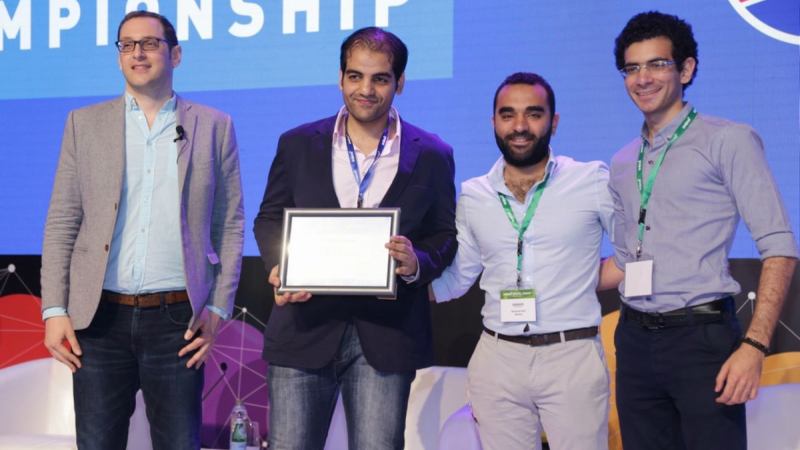
Widebot co-founder and CTO Ahmed Labib and co-founder and CEO Mohammed Nabil. Image credit: WideBot.
ArabNet Cairo’s Startup Battle 2017“TREP TALK
Mohamed Nabil, co-founder and CEO, WideBot, shares the lessons he learnt launching a tech startup in the Middle East
1. Know your market “The Middle East market is very big and has great opportunities. But before you start your business, you must study the market very well, and be sure that the market will accept your solution.”
2. Get the right people on board “The amazing human resources are available and very qualified, but you need to make extra effort to find them.”
3. Make use of a mentor “Every stage in your startup needs mentoring (idea, MVP, market fit or growth). Search hard for the right mentor, and accept the criticism.”
4. Treat your people well “I think that the most important lessons I learned so far are to accept our failure and mistakes and fix it very fast. Also, the startup = the team, not the founders. Our mission as founders is to make every person in our team feel that he owns WideBot, not just [as] an employee, [and] after that, he/ she will give WideBot amazing results.”
Related: AI Can’t Solve All Of Our Customer Service Problems (Yet)
A study from Juniper Research has forecasted that -particularly in the customer service industry- chatbots could save businesses up to US$8 billion annually by 2022, up from $20 million in 2017. Of course, as the benefits of bots grow (and improve), the market for them will also increase- but building chatbots requires specific skills, and one needs to invest time, effort and money to train the requisite AI engine and integrate it with the necessary services. But if this notion worries you, do not fear: Egyptian startup WideBot, a bot builder platform, aims to take the hassle out by letting users build chatbots- and no, you don’t need to have any special coding or technical skills to do that.
Founded by Mohammed Nabil and Ahmed Labib, the Cairo-based startup launched earlier this year after the duo came across bots on the Telegram app, and after market research, saw the potential of bot technology for businesses and consumers. The co-founders, who come from a software development background and also have previous startup experience, noticed the market value of bots when tech giants started to make inroads into this space. Facebook, for instance, allowed businesses to integrate and support chatbots on its Messenger platform last year, while Microsoft developed its own bot builder framework, and IBM launched Watson, a natural language processing (NLP) tool, which can build chatbots that understands natural language to integrate to various messaging platforms.
What makes WideBot particularly noteworthy is its focus on supporting AI in Arabic. Though the platform’s generated chatbots interact in both Arabic and English, Nabil says they wanted the enterprise to focus on Arabic to give them a competitive edge against rivals in this space. Considering the various Arabic dialects from Arab-speaking nations, it is indeed a challenge (and, to be fair, a feat for them) to tackle. Another USP that sets the company apart is that WideBot is an industry-specific bot builder- that is, instead of having a general platform for building bots for all industries, WideBot promises to ease the process by catering to specific sectors.

Pamella de Leon • Former Startup Section Editor, Entrepreneur Middle East
Pamella de Leon is a former Startup Section Editor at Entrepreneur Middle East.Now based in... Read more