The State of Fintech in 2024
The top five most valuable fintech companies are industry leaders in payments, digital banking, and blockchain, boasting multi-billion dollar valuations.

Shutterstock
Opinions expressed by Entrepreneur contributors are their own.
You're reading Entrepreneur Middle East, an international franchise of Entrepreneur Media.
The Financial Technology (Fintech) sector has transformed from a disruptive niche into a cornerstone of global finance. As of September 2024, the industry boasts a combined market capitalization of US $851.9 billion, marking a 41% rise since 2019. Despite recent market recalibrations, the sector’s long-term trajectory remains strong, underpinned by 576 Fintech unicorns collectively valued at US $2.2 trillion. Here we examine the key drivers behind Fintech’s rapid ascent, profiling the leading players, and analyze the evolving investment landscape that will shape its future trajectory from a global lens.
Rewiring Finance: Fintech’s Evolution and Market Power in 2024
Over the past two decades, the Fintech sector has evolved from a niche player into a disruptive force, fundamentally reshaping global financial services. Initially seen as an alternative to traditional banking, Fintech has now become integral to multiple areas of finance, including payments, lending, digital currencies, insurance, and wealth management. This transformation has been driven by rapid technological advancements, shifting customer preferences, and strong support from investors and regulators. As Fintechs continue to introduce innovative, customer-centric solutions, they are not only meeting the evolving demands of modern consumers but also setting new standards for efficiency, accessibility, and personalization in financial services.
As of September 2024, publicly traded Fintech companies hold a combined market capitalization of US $851.9 billion, a 41% increase since 2019. However, this marks a significant drop from the US $1.4 trillion peak achieved in 2021, reflecting a market correction primarily driven by the ‘new normal’ of a high-interest environment. Despite this setback, the industry’s long-term growth remains promising, with 576 Fintech unicorns globally, collectively valued at US $2.2 trillion—a threefold increase from five years ago when only 187 firms had reached unicorn status.
Top 5 Most Valued Global Fintechs in 2024
The top five most valuable fintech companies are industry leaders in payments, digital banking, and blockchain, boasting multi-billiondollar valuations. PayPal, the oldest among them, capitalized on the internet boom of the late 1990s and early 2000s. Over the past 25 years, PayPal has continuously innovated, establishing itself as a global leader in online payments, operating in most countries that support digital money transfers. Paypal IPOed in 2002.
Close behind is Stripe, founded in 2014, another major player in the payments space, with a valuation of US $70 billion as of September 2024. Stripe holds the distinction of being the highest-valued privately-owned Fintech in the world, having raised a total of US $8.7 billion in funding. It also ranks among the top five most valuable privately held companies globally. Stripe made headlines in January 2023 with speculation about its plans to go public. However, as of November 2024, the company has not confirmed any intention to do so. Instead of pursuing a public listing during an election year, Stripe opted to provide liquidity to its current and former employees. This was achieved through a US $694.2 million tender offer funded by existing investors and a stock buyback by the company itself.
In the third and fifth positions are two neobanks— Nubank and Revolut—which have emerged as compelling alternatives to traditional banks. These digital-first banks have experienced explosive growth, offering innovative financial services to millions of users worldwide, challenging the dominance of conventional banking institutions.
Ranking fourth is Binance, the world’s largest cryptocurrency exchange. Since its launch in 2017, Binance has leveraged the growing blockchain and cryptocurrency market to achieve a US $62 billion valuation, solidifying its position as a key player on the Fintech landscape.

Venture Capital’s Role in Fintech Growth
Venture Capital (VC) funding has played a crucial role in Fintech’s impressive growth trajectory, particularly from 2015 to 2021. Over this period, funding surged at a compound annual growth rate (CAGR) of 33.7%, climbing from US $24.1 billion in 2015 to a peak of US $137.7 billion in 2021. This rapid expansion was largely due to accelerated digital adoption during the COVID-19 pandemic and favorable economic conditions, where abundant liquidity and low interest rates encouraged investors to fund innovation.
However, the landscape has since shifted markedly. As global interest rates rose, a “VC Winter” set in, with funding becoming more conservative and selective. The shift in priorities has seen investors gravitating toward larger, established Fintechs to strengthen market consolidation rather than taking on the risk of funding numerous early-stage startups. By 2023, Fintech funding had fallen to US $43.7 billion. As of October 2024, the year-to-date funding stands at US $26.7 billion, reflecting a notable decline with a negative CAGR of –42.1% from the 2021 peak.
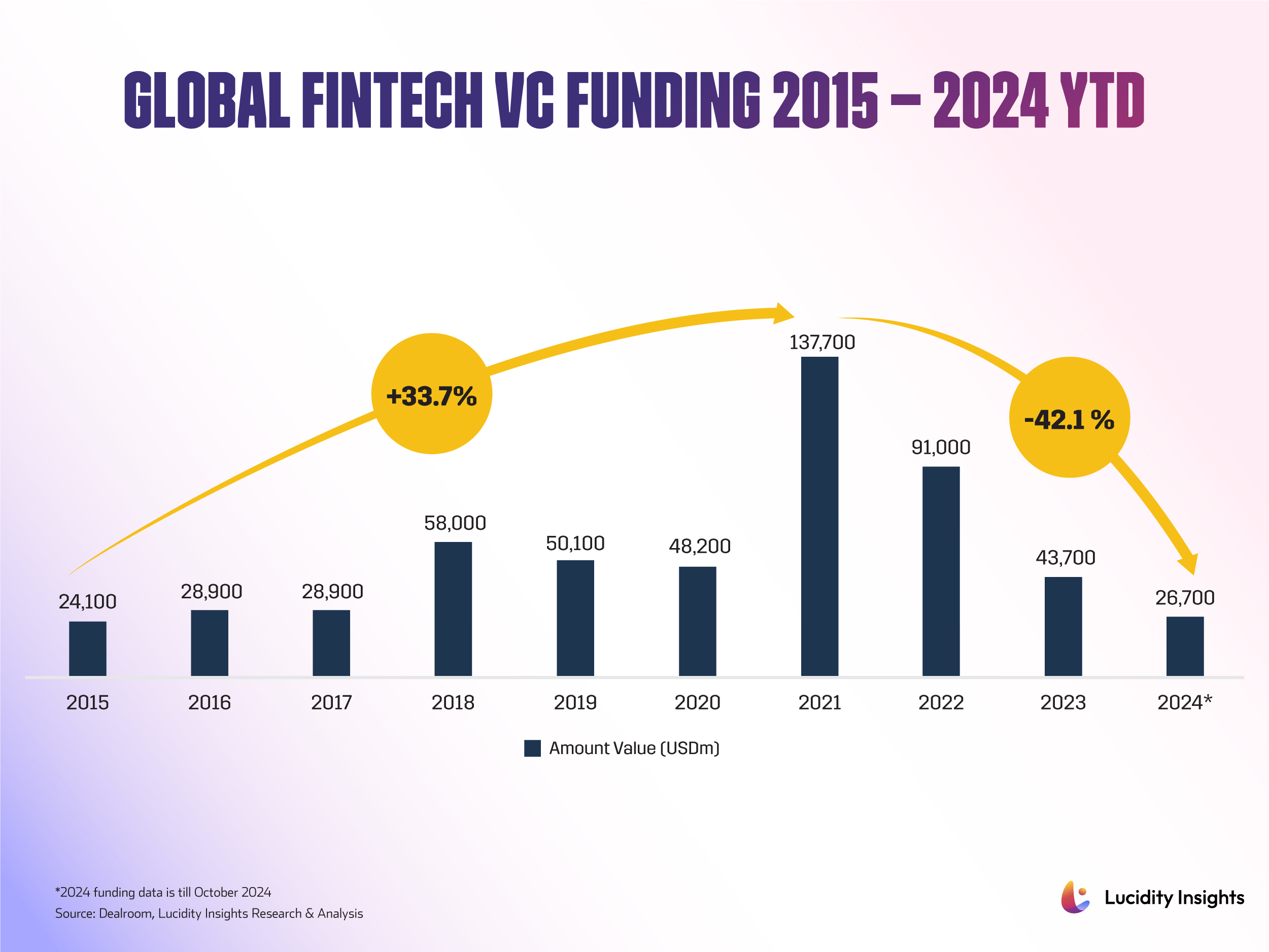
Despite the reduced funding levels, Fintech has maintained its position as one of the top three most funded startup sectors globally over the past decade behind health and enterprise software. This underscores the sector’s enduring relevance and the continuing investor interest, even amidst economic headwinds.
Fintech is now integral to the future of financial services, offering innovative solutions that address both consumer and enterprise needs. While payments, lending, and banking remain at the core of Fintech’s disruption, adjacent sectors like Insurance Technology (InsurTech), Regulatory Technology (RegTech), and wealth management are also undergoing significant transformation. Furthermore, the convergence of digital currencies, blockchain technologies, and Decentralized Finance (DeFi) underscores the expansive potential of Fintech, pushing it beyond the traditional boundaries of banking.
Key Subsector in Fintech

A key catalyst for Fintech’s growth has been its close correlation with the rise of e-commerce. As digital marketplaces have expanded, so has the demand for seamless payment systems, buynow-pay-later (BNPL) options, and accessible lending platforms. Fintech solutions serve as the infrastructure backbone for these services, facilitating frictionless transactions, cross-border payments, and consumer credit, particularly in regions where traditional banking systems have struggled to keep pace with the rapid digitization of commerce. This symbiotic relationship has propelled Fintech to become one of the most heavily funded sectors in tech across various regions. In many emerging markets, Fintech is often the first sector to produce unicorns, reflecting its critical role in driving economic innovation.
Future Prospects for Fintech
Despite recent market fluctuations, Fintech’s fundamentals remain robust. The sector sits at the intersection of several long-term shifts, including the ongoing digitization of financial services, the rise of embedded finance (integrating financial services into non-financial platforms), and greater regulatory openness to innovations like open banking and AI-driven financial products. These developments position Fintech for sustained growth, even in the post-pandemic environment where investors are more focused on sustainable, profitability-driven ventures.
McKinsey & Company projects that Fintech industry revenues will grow nearly three times faster than those of traditional banking from 2022 to 2028. While traditional banking revenues are expected to increase at an annual rate of 6%, Fintech is set to achieve an impressive 15% annual growth, potentially reaching a net revenue range of US $325 billion to $463 billion. This growth trajectory underscores Fintech’s rising influence and resilience within the shifting financial landscape.
Explore the transformative trends shaping the Middle East’s Fintech sector. Read or download your copy of “The State of Fintech in the Middle East” now.
This article was originally published on Lucidity Insights, a partner of Entrepreneur Middle East in developing special reports on the Middle East and Africa’s tech and entrepreneurial ecosystems.
The Financial Technology (Fintech) sector has transformed from a disruptive niche into a cornerstone of global finance. As of September 2024, the industry boasts a combined market capitalization of US $851.9 billion, marking a 41% rise since 2019. Despite recent market recalibrations, the sector’s long-term trajectory remains strong, underpinned by 576 Fintech unicorns collectively valued at US $2.2 trillion. Here we examine the key drivers behind Fintech’s rapid ascent, profiling the leading players, and analyze the evolving investment landscape that will shape its future trajectory from a global lens.
Rewiring Finance: Fintech’s Evolution and Market Power in 2024
Over the past two decades, the Fintech sector has evolved from a niche player into a disruptive force, fundamentally reshaping global financial services. Initially seen as an alternative to traditional banking, Fintech has now become integral to multiple areas of finance, including payments, lending, digital currencies, insurance, and wealth management. This transformation has been driven by rapid technological advancements, shifting customer preferences, and strong support from investors and regulators. As Fintechs continue to introduce innovative, customer-centric solutions, they are not only meeting the evolving demands of modern consumers but also setting new standards for efficiency, accessibility, and personalization in financial services.

Pierrick Ribes • Contributing Writer and Researcher, Lucidity Insights
Pierrick Ribes is a Contributing Writer and Researcher for Lucidity Insights. He is interested in... Read more