How Elie Habib Built World Monitor to Track Global Events in Real Time
“The regional escalations made World Monitor visible, not useful,” says the CEO behind Anghami, the MENA region’s first Nasdaq-listed music streaming platform, who is now helping millions understand major global developments in real time.
You're reading Entrepreneur Middle East, an international franchise of Entrepreneur Media.
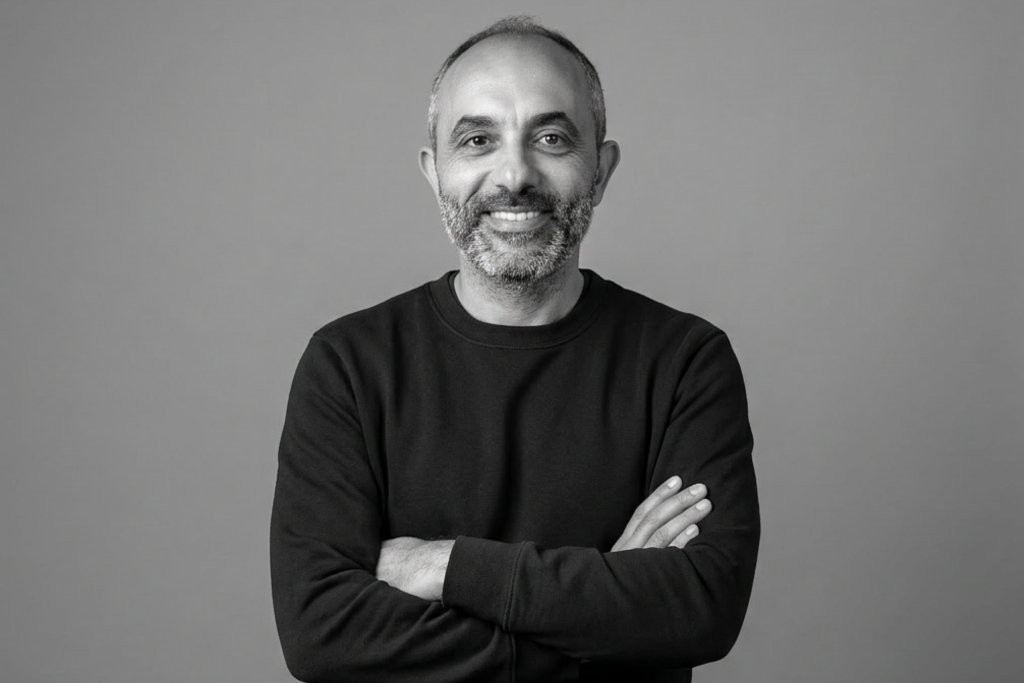
When Elie Habib last spoke to Entrepreneur Middle East, in 2024, he’d made something of a personal declaration: that he was committed to “embracing the title of a builder.” Two years later, in a quiet continuation of that sentiment —one that has primarily defined his entrepreneurial journey as the co-founder and CEO of music streaming platform Anghami— he engineered World Monitor; a platform that users would go on to label as “a Bloomberg Terminal for geopolitics.”
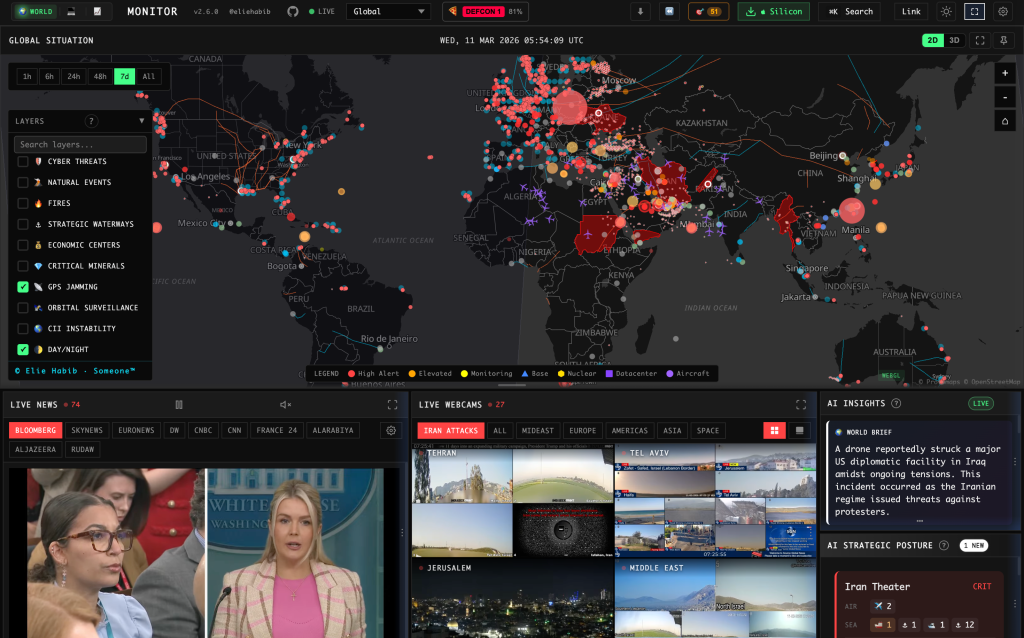
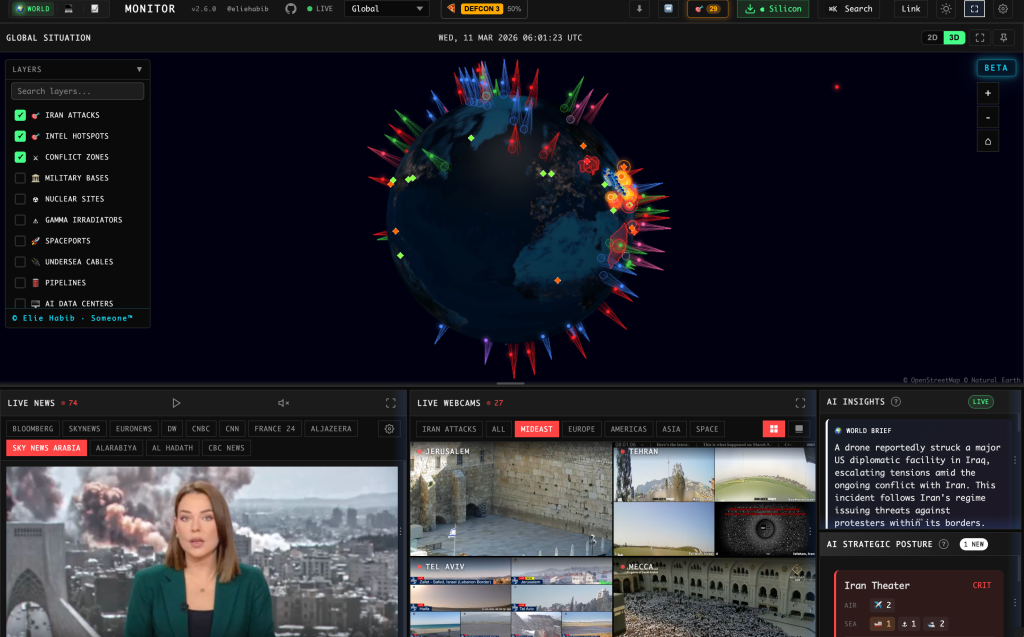
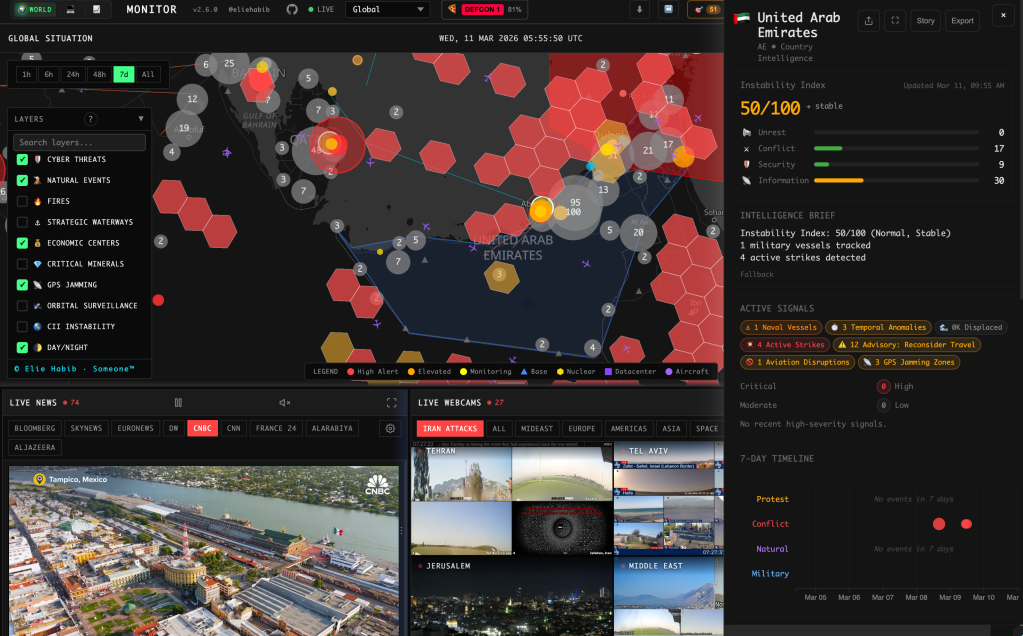
Created as a real-time dashboard that brings together information from a plethora of sources to help people understand what’s happening around the world, World Monitor tracks data like news reports, military activity, ships and aircraft movements, internet outages, infrastructure like pipelines and data centers, and natural events.
But Habib admits he didn’t expect a project that he’d “vibe-coded” over a weekend to take off at the rate that it did.
“I built World Monitor in a single day in early January 2026 as a personal learning exercise, posted once on LinkedIn, and then on Twitter on the same day, and then largely forgot about it,” Habib tells Entrepreneur Middle East today. “About 10 days later traffic exploded: 400,000 users in a week, which then kept climbing. The last 30 days reached over four million visitors, with 490,000 in a single day during the Iran strikes.”
Indeed, since the start of the regional escalation on February 28, 2026, World Monitor has become something of a digital staple for many across the world. But for Habib, it has meant iterating at a pace the platform had not originally been designed to handle. “Scaling under those conditions is a live engineering problem,” he says. “The core tension is refresh rate: real-time processing costs significantly more than five-minute intervals. During the Iran escalation I built a new incident-tracking map layer with severity badges, Telegram intelligence retrieval, real-time regional air raid siren alerts with Hebrew-to-English translation, GPS/GNSS jamming detection, airport cancellation feeds, embassy risk advisories, a strategic risk score, satellite tracking, and stock market tracking, all in a (another) single day. The platform was never designed for this volume. Every spike was both a stress test and a forcing function.
By thus combining all this data on one interactive map, the platform helps users spot patterns—such as when multiple reliable sources report the same development, when markets react before news breaks, or when unusual activity appears in a specific region. In layman’s terms, World Monitor helps people see how global events might be connected by putting many different signals in one place.
But given the platform decodes such a vast amount of information at any given time, Habib took an explicit decision early on while creating World Monitor: no human editors. “Credibility is structural, not editorial,” he adds.
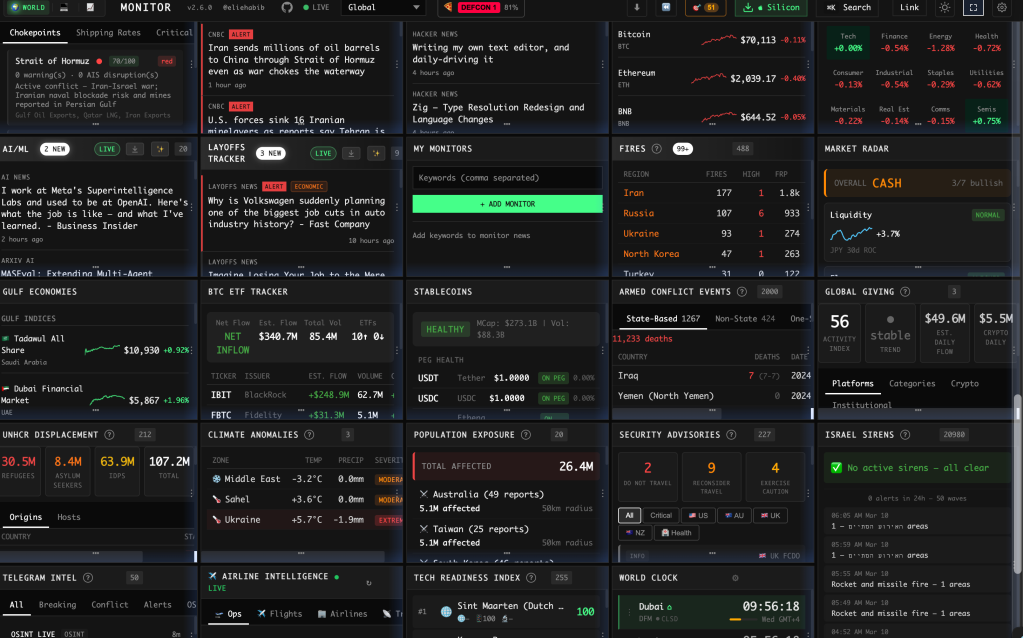
As such, every incoming article on World Monitor goes through three sequential classification passes. “A rules-based engine screens headlines against a severity hierarchy: major geopolitical events and nuclear events at the top, routine diplomacy at the bottom,” Habib explains. “Compound detection catches escalation patterns single keywords miss: a military strike scores high on its own, but when the target is geopolitically significant the system escalates automatically. A Large Language Model (LLM) then refines categorization asynchronously: users see results from the faster passes immediately, the LLM corrects in the background.”
The credibility of these data sources is tiered, adds Habib. “Wire services and official channels such as Reuters, AP, the Pentagon, and the United Nations sit at tier one,” he says. “BBC and Al Jazeera are tier two. Specialist outlets like Bellingcat follow. The system processes over 200 news feeds, representing more than 450 sources, with confidence scores weighted proportionally. A single niche blog triggers nothing. Breaking alerts require the article to be under fifteen minutes old, corroborated by at least two distinct sources, and pass deduplication. A thirty-minute cooldown per event prevents the same story flooding the feed.”
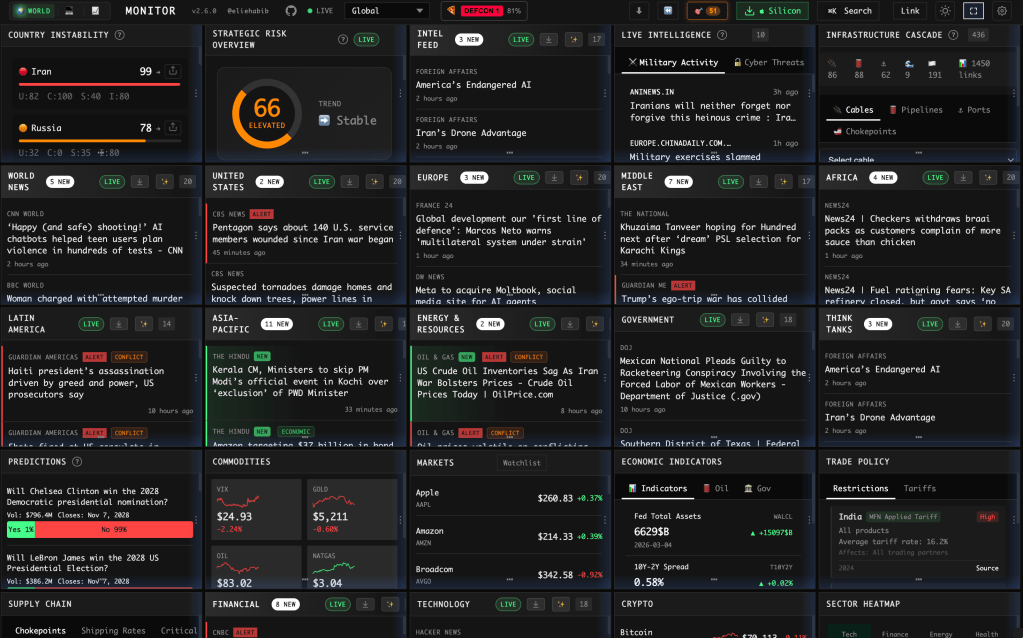
The final filter in this process of delivering information to the end user is what is known as the convergence layer. “The system triangulates eight independent signal types simultaneously: internet outages, military flight patterns, naval vessel movements, protest activity, shipping disruptions, satellite-detected fires, historical baseline deviations, and supply chain disruptions,” Habib explains. “When multiple signal types converge on the same geography, that convergence is what surfaces. A single-outlet claim generating no corresponding movement across those eight channels gets treated as noise. This is what allows the platform to generate breaking news automatically, without human intervention.”
But in the absence of human verification, and in an era when there is an unspoken onus on the reader to corroborate news validity, one could be slightly dubious about “fake news” trickling into the platform. Habib, however, offers an assuring response. “The architecture itself is the primary defense,” he asserts.
“Two independent tier-rated sources must agree before the system acts. That eliminates the vast majority of single-outlet fabrications. The convergence algorithm adds a second layer. Any text-based claim that generates no corresponding movement across the eight signal types gets suppressed automatically. A false report about a country entering a conflict that appears only in text feeds but shows nothing in military flight tracking, naval movements, or prediction markets gets treated as low-confidence noise. Now, no automated system fully resolves this in genuinely novel scenarios: an event with no historical baseline, or one specifically designed to exploit the corroboration logic. That remains an open architectural question. But ultimately the goal is to be significantly more reliable than undifferentiated news aggregation; not to claim perfect accuracy.”
Perhaps the most direct reflection of how trusted the platform has become lies in the diversity of its user base. “The geographic spread surprised me most,” Habib says. “The US accounts for roughly 13% of traffic, Europe 20%, MENA 18%, Asia 35% (Vietnam, Indonesia, Japan, Korea all at an unexpected scale), across 174 countries total.”
But equally striking has been the behavioral diversity of World Monitor’s users, Habib reveals. “Some users track commodity impact on maritime chokepoints. Others monitor military flight patterns or energy infrastructure. Finance professionals use it alongside market data. Six segments have emerged organically: journalists, security and risk analysts, traders, academic researchers, policy analysts, and the general public. The one I’m focused on is the segment that gets value from signal distillation rather than data accumulation: analysts and decision-makers who need to understand what matters, why, and what its impact is on them specifically.”
These demographics, however, aren’t by chance. Beyond the platform’s current major use to dissect geopolitical events, it offers insights that were intended right from the start. “The regional escalations made World Monitor visible, not useful,” Habib emphasizes. “The underlying function —aggregating and correlating open-source signals across 200+ countries in real time— is at least as valuable during stable periods, because that’s when early warning actually changes decisions. For investors, the most actionable use case is monitoring structural shifts that precede market-moving events: shifts in military posture, regulatory signals, commodity infrastructure changes, or political instability moving from low to elevated before it becomes headline news. The Country Instability Index is most useful precisely when scores are rising quietly, not after a conflict has started. For supply chain managers, the value is continuous monitoring of chokepoints, shipping routes, and port conditions, not reacting after a disruption. The platform works as ambient global awareness, not only as a reactive tool. That passive use case has the most untapped potential. The most interesting next step is separating signal from noise more precisely.”
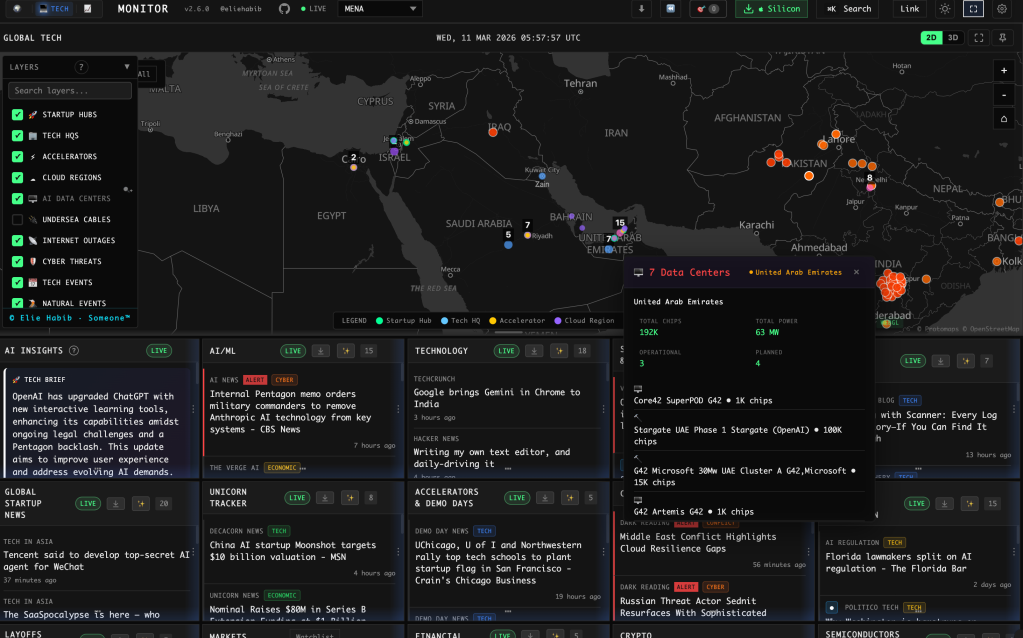
As such, Habib notes that a number of industries can benefit from real-time geopolitical signal tracking. “And that’s basically any organization whose operations, costs, or revenues are exposed to geography; that covers more industries than people assume,” he says. “Shipping and logistics companies track chokepoints and port risk in real time; a rerouting decision on a vessel can cost millions. Energy companies monitor pipeline integrity and political risk across producing regions. Financial institutions with exposure to Gulf FDI, emerging market equities, or commodities use geopolitical signals as leading indicators that precede price moves. Defence contractors need situational awareness as an operational baseline. Newsrooms use it for breaking event coverage. The category that interests me most is global supply chains: multinational manufacturers and retailers who assumed stability in their sourcing geography and are now discovering that assumption is expensive.”
But despite the economic potential World Monitor promises to unlock for businesses, the platform itself is not one that Habib intends to profit off of. “I have two constraints. The hard one: I will not monetize war-related content,” Habib says. “The platform reached millions of people during an active military escalation. Putting advertising or a paywall on that access is wrong.”
Habib’s second, “soft” constraint is his own time and attention. “I am the CEO of a company that’s thriving, and World Monitor will not become a second full-time job,” he says.
That said, Habib believes the platform could eventually offer additional tools for professionals who rely on geopolitical intelligence in their daily work. “Within those constraints, a Pro tier is the most coherent direction,” he says. “The features that create the most value for professional users are scheduled AI briefings via Slack, email, or WhatsApp; custom alert rules for specific countries, sectors, or threshold triggers; API access for organizations that want to integrate World Monitor data into their own tools; and advanced country intelligence briefs with deeper financial and security layers. The open-source community has absorbed a substantial portion of the development work: 36,000+ GitHub stars, 6,000 forks, 50+ code contributors, around 1,200 contributors across ideas and issues. The free tier stays free. The Pro tier funds the infrastructure that makes both possible. A venture-backed growth model does not fit this.”
But the broader shift that platforms like World Monitor point to extends beyond business models or product features. At its core the conversation leads to a deeper question about business and geopolitics today: can companies still afford to remain apolitical?
“Whether businesses can be apolitical is separate from whether they can afford to be geopolitically uninformed,” Habib discerns. “The latter is clearly no longer viable. The former is a values question I won’t resolve for anyone. What has changed is the cost of information. The tools that gave governments and large enterprises a structural information advantage were expensive because aggregating and correlating open-source signals at scale required significant human and technical infrastructure. AI closes that gap. A single person can now build a platform that does much of what expensive systems do. That’s a structural shift.The practical implication: the excuse of not knowing is gone. Real-time instability data, military movement tracking, prediction market signals, supply chain disruption indicators, all of it is accessible in a browser, free.”
“A company making sourcing, investment, or expansion decisions without this input is not apolitical. It’s uninformed. Those are different things,” Habib concludes.
Related: Why The Hardest Moments Often Shape The Strongest Founders
When Elie Habib last spoke to Entrepreneur Middle East, in 2024, he’d made something of a personal declaration: that he was committed to “embracing the title of a builder.” Two years later, in a quiet continuation of that sentiment —one that has primarily defined his entrepreneurial journey as the co-founder and CEO of music streaming platform Anghami— he engineered World Monitor; a platform that users would go on to label as “a Bloomberg Terminal for geopolitics.”
Created as a real-time dashboard that brings together information from a plethora of sources to help people understand what’s happening around the world, World Monitor tracks data like news reports, military activity, ships and aircraft movements, internet outages, infrastructure like pipelines and data centers, and natural events.
But Habib admits he didn’t expect a project that he’d “vibe-coded” over a weekend to take off at the rate that it did.

Aalia Mehreen Ahmed • Senior Features Editor, Entrepreneur Middle East
Entrepreneur Staff
Senior Features Editor at Entrepreneur Middle East and host of Anchored Echoes, with nearly seven... Read more