Istanbul Is Not a Footnote. Turkey’s US$31 Billion Unicorn Economy Demands Your Full Attention.
The State of Unicorns: Turkey 2026 Report, developed and published by Lucidity Insights and Entrepreneur Middle East, covers the global unicorn landscape as context, Turkey’s structural advantages and constraints, full company profiles and milestone timelines for all eight unicorns, the female founder data, the cautionary tales of Getir and Papara told fully and fairly, and a chapter on the earlier generation of Turkish startups — GittiGidiyor, Yemeksepeti, Gram Games — that paved the way.
Opinions expressed by Entrepreneur contributors are their own.
You're reading Entrepreneur Middle East, an international franchise of Entrepreneur Media.

Let me tell you what we found when we set out to map Turkey’s unicorn economy.
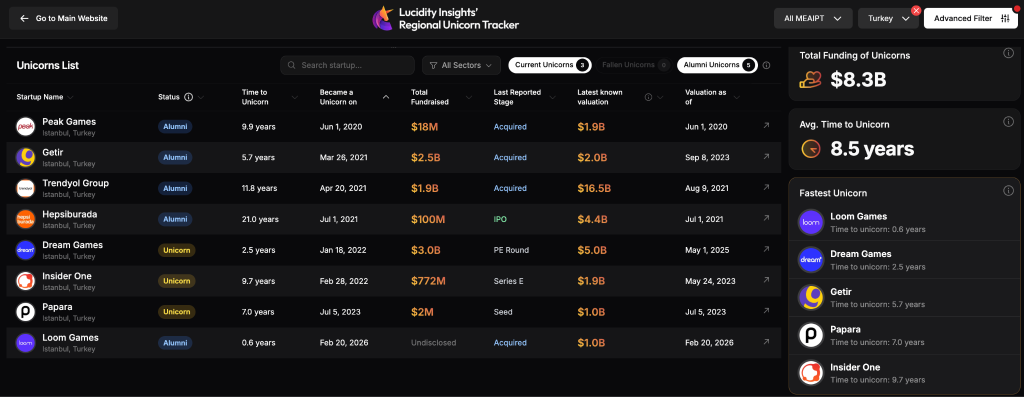
We found eight companies that collectively raised US$8.3 billion in venture capital and represent over US$31 billion in combined enterprise value. We found a gaming ecosystem so deep that Istanbul is now the world’s second-largest gaming hub by studio density, behind only London. We found a Harvard dropout who built a US$16.5 billion superapp from her kitchen table. We found a fintech that reached unicorn status on just US$2 million in seed funding — and then watched its founder get arrested. We found a 20-person studio that went from zero to US$1 billion in seven months. And we found that more than half of Turkey’s unicorns were built by women — and those companies proved dramatically more durable than the rest.
You can find all this mapped out in detail, in The State of Unicorns: Turkey report, produced and published by Lucidity Insights and Entrepreneur Middle East. It is one of the most complex, instructive, and frankly fascinating startup ecosystems my team and I have had the privilege of researching.
Why This Story Matters Now
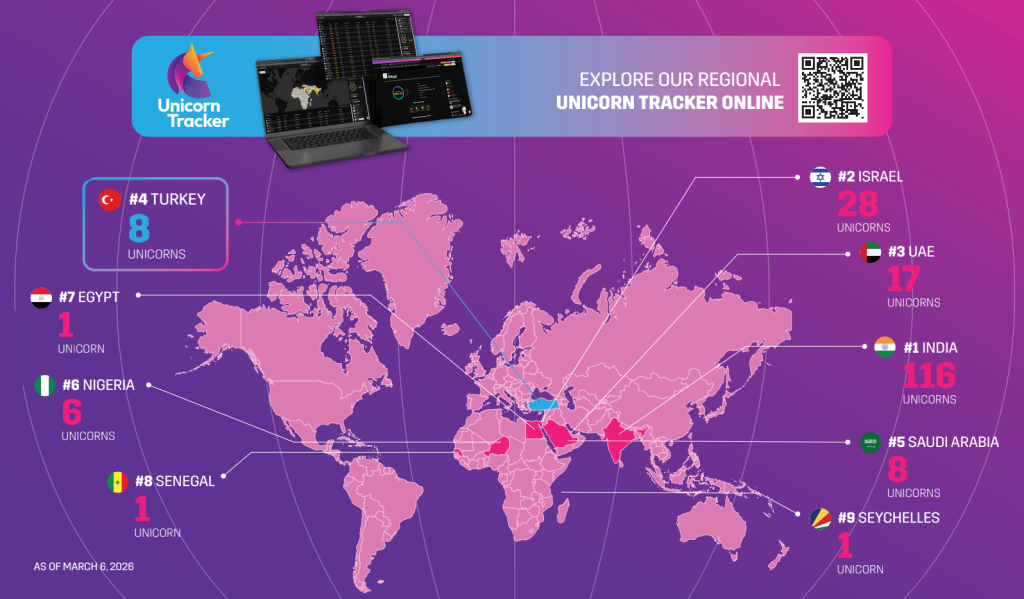
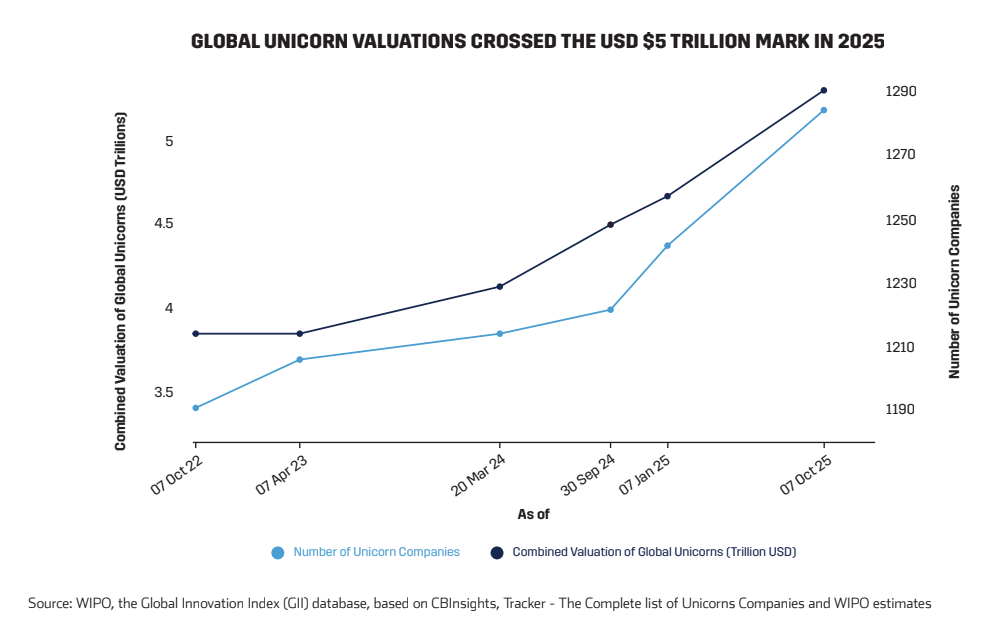
There was a time — not long ago — when the word “unicorn” referred almost exclusively to Silicon Valley. That time is over. Today, more than 1,330 privately held startups globally are valued at over US$1 billion, collectively worth nearly US$7 trillion – rising US$1.8 trillion in value since October 2025, largely to the burgeoning AI players. (Bloomberg reported this week that Anthropic was currently attempting to raise another round at a US$900 million valuation). The next generation of these companies is not being built exclusively in San Francisco or London. They are being built in Istanbul, Dubai, Lagos, Riyadh, and Mumbai — in markets that global venture capital spent decades largely overlooking.
Turkey is one of the clearest proof points of this shift. It has a population of over 85 million with a median age just over 33. Internet penetration sits at 87%. The country has produced a world-class engineering talent base that is, frankly, still underappreciated by most Western investors. Banking infrastructure is in place, but just a decade ago in 2015, when fintech unicorn Papara was established, 63% of Turkish adults were unbanked, largely due to a mistrust in the local banking system. Today, Turkey has overcome much of that and the adult banking population sits at 87%.
But here’s what really struck me about Turkey when we dug into the data: these 8 companies that would become unicorns weren’t built in ideal conditions. The Turkish lira lost 88% of its value against the US dollar in eight years. Inflation peaked at 72.3% in 2022; this led to the talent pool bleeding to Europe and the Gulf. And yet, unicorn after unicorn was built anyway — often with striking capital discipline, often by teams who had no choice but to think globally from day one.
Source: Lucidity Insights Regional Unicorn Tracker
The Stories That Will Stop You
Every company we profiled in this report has a story worth telling on its own. Peak Games raised just US$18 million across a decade, built two mobile games generating US$40 million a month in revenue, and sold to Zynga for US$1.8 billion — a roughly 100x return on capital. That US$1.8 billion exit then seeded an entire generation of gaming founders: over 20 studios have been founded by former Peak employees, including Dream Games, whose Royal Match dethroned Candy Crush as the world’s #1 puzzle game and was valued at US$5 billion in May 2025. A Peak Games mafia, if you like, with similar implications to the Paypal mafia often referred to as a major catalyst of Silicon Valley’s growth.
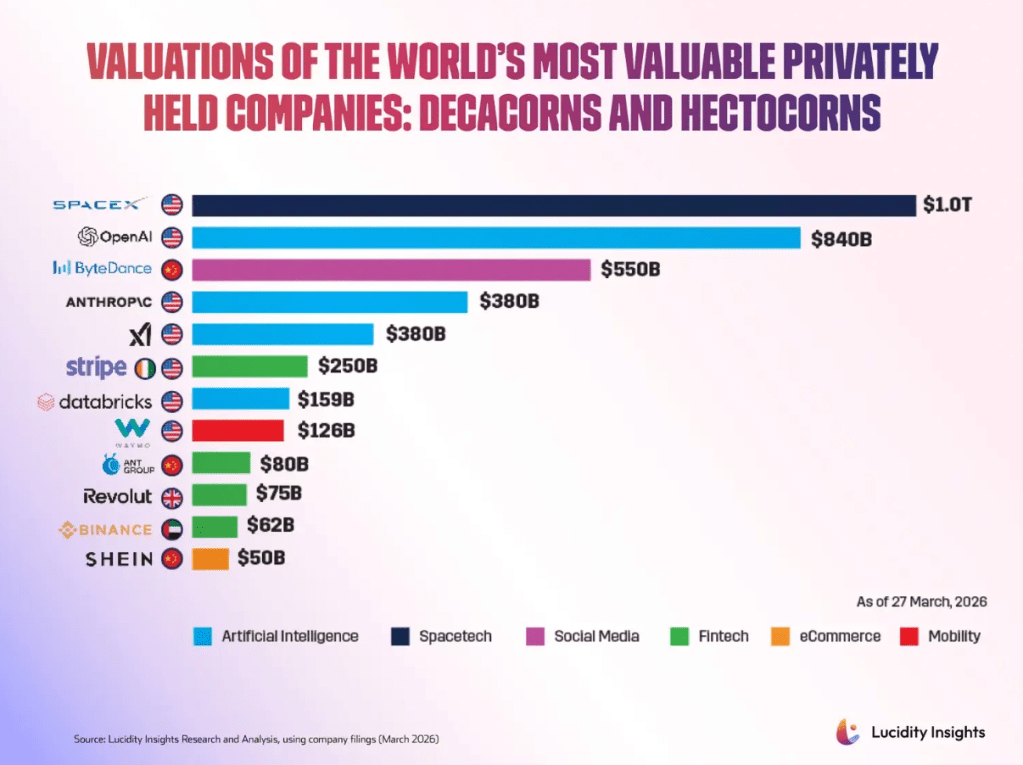
Trendyol, founded by Demet Mutlu after she dropped out of Harvard Business School with US$300,000 in personal savings, became Turkey’s first decacorn and is now delivering 2.5 million packages a day across 35 countries, with Saudi Arabia emerging as its second-largest market globally. In May 2025, Uber paid US$700 million for 85% of just one of its verticals — Trendyol Go — its largest international bet in years.
And then there is Loom Games. Co-founded by Kübra Gündoğan and Emre Çelik in July 2025, the studio launched its first game, Pixel Flow!, in August and by February 2026 had been acquired by Scopely at a valuation exceeding US$1 billion. Seven months. What the headlines don’t show is the six years of 70-prototype iteration that came before it.
Getir is the ecosystem’s most instructive cautionary tale — and we tell it fully. Founded in 2015, Getir invented quick commerce before the world had a name for it, generating US$120 million in revenue bootstrapped, with zero institutional capital, before Sequoia and Tiger Global came knocking. It reached a peak valuation of US$11.8 billion in 2022 — one of Europe’s most valuable private tech companies at the time. Then came the overexpansion: nine countries, US$2.4 billion raised, a US$1.25 billion acquisition of rival Gorillas, and unit economics that simply didn’t hold outside Turkey. By 2026, Uber had acquired its delivery operations for US$435 million — a collapse of more than 97% from peak. The core Turkish business, stripped of its international overreach, remained genuinely strong — posting US$1 billion in gross bookings in 2025, growing 50% year-on-year. The model was never broken. It was applied somewhere it couldn’t work at the pace investors demanded.
And then there is e-commerce giant Hepsiburada — the company that quietly did something no Turkish tech company had ever done before or since: it listed on Nasdaq. Founded by Hanzade Doğan Boyner in 2000, Hepsiburada spent fifteen years reaching its first million annual deliveries, building consumer trust in a market that wasn’t sure online shopping could be trusted at all. Patience, not blitzscaling, was the strategy. In July 2021, the IPO raised US$681 million at a US$3.9 billion valuation — and with it, Turkey’s consumer internet became globally investable for the first time. The company today sits inside Kazakhstan’s Kaspi.kz ecosystem — a US$20 billion+ super-app that acquired a 65.4% controlling stake in January 2025 — with 101,000 merchants, 12 million customers, and a platform that has quietly become national commerce infrastructure. It remains the only Turkish tech company to have listed on a US exchange. That milestone still stands.
The Female Founder Signal
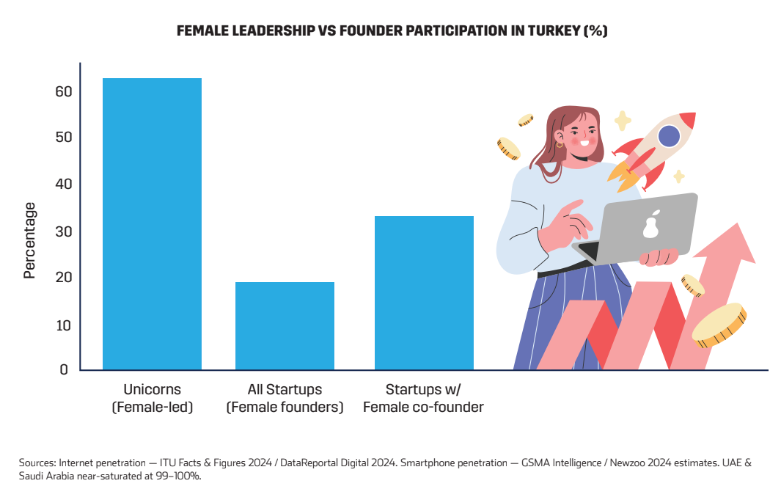
I will be direct about something that deserves more than a sidebar: five of Turkey’s eight unicorns were founded or co-founded by women. That ratio — 62.5% — does not exist anywhere else in the world at this scale, in this asset class. Globally, female founders receive somewhere between 2% and 5% of total venture capital. In Turkey’s unicorn cohort, they built the majority of the portfolio.
What makes it even more striking is the durability question. The female-led companies — Trendyol, Hepsiburada, Peak Games, Insider One, Loom Games — largely held, scaled, and sustained. The male-led ones, with the exception of Dream Games, did not. Getir peaked at US$11.8 billion and sold pieces to Uber for US$435 million. Papara reached unicorn status and then had its founder arrested on money laundering allegations.
This is not a diversity story. It is a capital efficiency story. A resilience story. And it is one of the most data-rich arguments I have encountered for why the narrow pipeline that produces female founders in Turkey may be selecting for a different — and more durable — kind of builder.
What You’ll Find in the Full Report
The State of Unicorns: Turkey 2026 Report, developed and published by Lucidity Insights and Entrepreneur Middle East, is an 89-page deep dive into the full picture. It covers the global unicorn landscape as context, Turkey’s structural advantages and constraints, full company profiles and milestone timelines for all eight unicorns, the female founder data, the cautionary tales of Getir and Papara told fully and fairly, and a chapter on the earlier generation of Turkish startups — GittiGidiyor, Yemeksepeti, Gram Games — that paved the way.
It is also the first report to use data from the Lucidity Insights Regional Unicorn Tracker — the only live database tracking billion-dollar startups across the Middle East, Africa, India, Pakistan, and Turkey, covering 150+ companies and US$500 billion in combined value.
If you are a founder, investor, or operator paying attention to emerging markets — and at this point, you should be — this is the report that tells you not just what Turkey built, but how, and what it signals for the decade ahead.
Let me tell you what we found when we set out to map Turkey’s unicorn economy.
We found eight companies that collectively raised US$8.3 billion in venture capital and represent over US$31 billion in combined enterprise value. We found a gaming ecosystem so deep that Istanbul is now the world’s second-largest gaming hub by studio density, behind only London. We found a Harvard dropout who built a US$16.5 billion superapp from her kitchen table. We found a fintech that reached unicorn status on just US$2 million in seed funding — and then watched its founder get arrested. We found a 20-person studio that went from zero to US$1 billion in seven months. And we found that more than half of Turkey’s unicorns were built by women — and those companies proved dramatically more durable than the rest.
You can find all this mapped out in detail, in The State of Unicorns: Turkey report, produced and published by Lucidity Insights and Entrepreneur Middle East. It is one of the most complex, instructive, and frankly fascinating startup ecosystems my team and I have had the privilege of researching.

Erika Masako Welch • Chief Content Officer, Lucidity Insights
Erika Masako Welch is the Chief Content Officer of Lucidity Insights.