Why Checkout Deserves a Place in Every Growth Strategy
By the time shoppers reach checkout, businesses have already invested in attracting them, helping them discover the right product and building confidence in their brand. Every additional click, repeated action or moment of uncertainty creates another opportunity for a potential sale to become an abandoned cart.
Opinions expressed by Entrepreneur contributors are their own.
You're reading Entrepreneur Middle East, an international franchise of Entrepreneur Media.

Retailers have transformed almost every aspect of online shopping over the past decade. Search is more intuitive, product recommendations are more relevant, delivery is faster, and loyalty programs are more sophisticated than ever. Yet the final stage of the purchase often feels like it belongs to an earlier era.
For many consumers, checkout still means searching for a wallet, entering long card numbers, switching to another app to retrieve a one-time passcode, or deciding whether they are comfortable saving payment details on another website. None of these steps is particularly difficult in isolation. Together, however, they interrupt momentum at the point where customers have already made the decision to buy.
By the time shoppers reach checkout, businesses have already invested in attracting them, helping them discover the right product and building confidence in their brand. Every additional click, repeated action or moment of uncertainty creates another opportunity for a potential sale to become an abandoned cart.
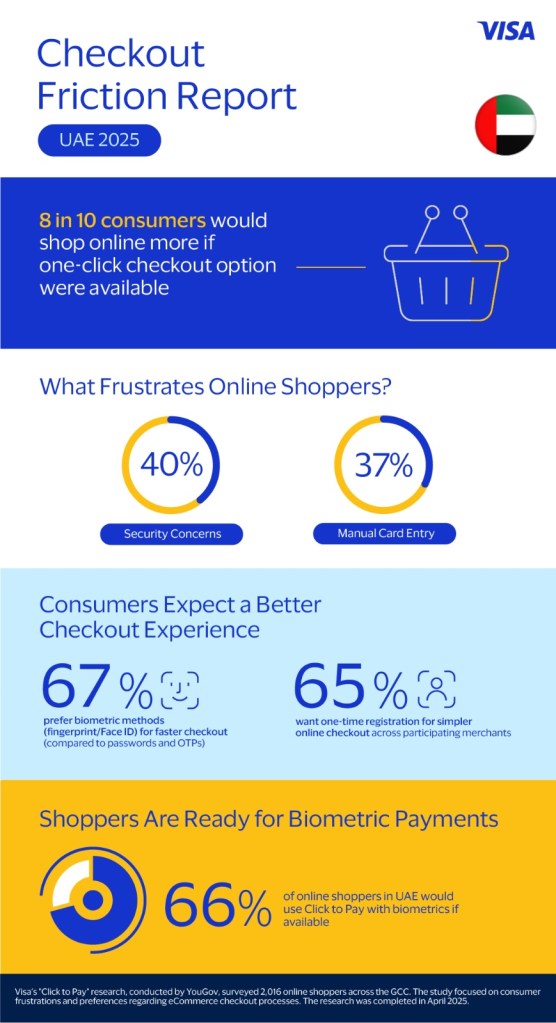
Visa’s latest Checkout Friction Report shows that these challenges remain widespread in the UAE. Four in ten consumers identify security concerns as their biggest frustration when shopping online, while 37% cite the need to enter card details manually. More than half worry about storing payment credentials across multiple websites, and 42% report having experienced fraud or another security breach.
These findings have direct commercial implications. Customer acquisition has become increasingly competitive and expensive. Businesses invest heavily in marketing, personalized shopping experiences, promotions and loyalty programs to attract customers and encourage purchases. When shoppers leave at checkout, the impact extends beyond the value of a single transaction. It also reduces the return on every investment that brought customers to that point and makes repeat business harder to earn.
The expectations customers bring to checkout have also changed. Unlocking a phone with a fingerprint, approving a bank transfer with facial recognition or completing everyday digital tasks in seconds has become routine. Re-entering payment details or moving through multiple authentication steps feels increasingly out of step with the rest of their digital lives.
This is why I believe checkout deserves far more strategic attention than it often receives. Businesses review marketing performance, pricing strategies and fulfilment operations because each influences commercial performance. Checkout should be viewed through the same lens. It is one of the few interactions that directly affects conversion, customer confidence and the likelihood of repeat purchases.
That starts with understanding where customers hesitate. Many businesses monitor website traffic and overall conversion rates but spend less time analyzing how customers move through the payment process itself. Reviewing where customers abandon purchases, how checkout performs on mobile devices and whether unnecessary fields or repeated data entry create friction can uncover opportunities that are relatively straightforward to address.
It also requires recognizing that convenience and security should reinforce one another rather than compete. Consumers want confidence that their payment information is protected, but they increasingly expect that protection to be built into the experience rather than achieved through additional complexity. Businesses that remove unnecessary effort while maintaining robust security standards are more likely to earn customers’ trust.
Related: 85% of UAE Consumers Use AI for Online Shopping, Visa Study Finds
The payments industry has been investing heavily in technologies that support this shift. Tokenization replaces sensitive card information with secure digital credentials, reducing the need for merchants to store payment data. Biometric authentication allows consumers to approve purchases using technologies they already rely on every day, making authentication both faster and more intuitive.
Visa’s research suggests consumers are ready for these changes. 65% of respondents said they would welcome a single registration process that works across participating online merchants. Two-thirds said they trust biometric authentication more than traditional passwords or one-time passcodes, while 82% said they would be more likely to shop online and complete purchases if one-click checkout options were available. Two-thirds also indicated they would be likely to use a Click to Pay solution with biometrics if it were offered by online retailers.
For businesses, the next step is translating those expectations into practical action. Adopting checkout solutions that reduce manual steps without compromising security is one of the most effective ways to improve the payment experience. At Visa, we see this as one of the biggest opportunities to strengthen digital commerce because the benefits extend to both businesses and consumers.
Visa’s Click to Pay was designed with exactly that objective in mind. By combining tokenization with device-based biometric authentication where available, it enables customers to complete purchases using securely stored payment credentials without repeatedly entering card details across participating merchants. The result is a checkout experience that reflects how consumers already prefer to interact with digital services while giving businesses a practical way to reduce friction, improve conversion and reinforce customer confidence.
Every improvement businesses make to checkout has a cumulative effect. Individually, each change may seem incremental, but together, they can reshape how customers perceive a brand and how consistently they choose to return.
As digital commerce becomes increasingly competitive, businesses that treat checkout as a strategic part of their customer experience – rather than simply a payment process – will be better positioned to strengthen customer relationships, improve conversion and build long-term loyalty. Solutions such as Click to Pay are one practical example of how businesses can reduce friction while meeting evolving consumer expectations for both convenience and security.
Related: How Dubai’s Identity Lives Through Its Homegrown Businesses
Retailers have transformed almost every aspect of online shopping over the past decade. Search is more intuitive, product recommendations are more relevant, delivery is faster, and loyalty programs are more sophisticated than ever. Yet the final stage of the purchase often feels like it belongs to an earlier era.
For many consumers, checkout still means searching for a wallet, entering long card numbers, switching to another app to retrieve a one-time passcode, or deciding whether they are comfortable saving payment details on another website. None of these steps is particularly difficult in isolation. Together, however, they interrupt momentum at the point where customers have already made the decision to buy.
By the time shoppers reach checkout, businesses have already invested in attracting them, helping them discover the right product and building confidence in their brand. Every additional click, repeated action or moment of uncertainty creates another opportunity for a potential sale to become an abandoned cart.

Salima Gutieva • Vice President and Country Manager - UAE, Visa
Salima Gutieva is the Vice President and Country Manager for Visa in the UAE.