The Evolution Of Trade
Insights from a special report built by DP World Group in partnership with Entrepreneur Middle East and Lucidity Insights.
Shutterstock.com
Opinions expressed by Entrepreneur contributors are their own.
You're reading Entrepreneur Middle East, an international franchise of Entrepreneur Media.
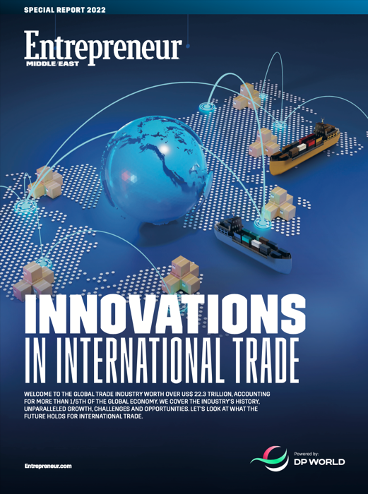
In 2022, DP World Group partnered with Entrepreneur Middle East and Lucidity Insights to publish Innovations in International Trade, a special report analyzing innovations in international trade.
The report covers multiple features of international trade, from its evolution, to the role it plays in uplifting societies and economies, and its future developments. It also covers the role technology has played in international trade, and what is expected going forward, given the impact of the fourth industrial revolution.
Last but not least, sustainability is a global topic piquing interest across different industries, with international trade being a significant contributor to greenhouse gas (GHG) emissions. Accordingly, this report also briefly explores initiatives that the industry is taking to address the sustainability challenge.
The history of maritime trade shows the first major trade activity around Egypt in 3200 BCE, and it had increased as far as Sumatra (in Indonesia) by 1200 BCE. Thereafter, trade routes were established regionally across the South China Sea and the Indian Ocean, and then between the Middle East and Asia. By the 16th century, it was the European colonial powers of England, Spain, Portugal, France, and the Netherlands who dominated via well-established global maritime trade networks.
However, the first revolutionary technology which transformed maritime trade was the introduction of steamships. By the 1830s, steamships were regularly crossing the Atlantic Ocean, and another 20 years later, regular service to South Africa had also begun. The opening of the Suez Canal in 1869 created an important shortcut to Asian markets as well. While maritime trade had started to boom, one other breakthrough was in railways, which made trade more efficient and cost-effective over land. Worldwide railway lines increased from 191,000km in 1870 to nearly 1 million kilometers by 1913.
While technological shifts had made economics of trade more attractive, communication technologies began to improve with time. The internet is to the late 20th century what the telegraph was in the 19th century with the introduction of instantaneous communication. It is estimated that trade nearly quintupled between 1870 to 1913, right before the First World War. While trade was not disrupted, technological advancements in both transport and communication continued. Diesel and oil-based engines replaced coal-based ones which improved efficiencies and by 1939, a quarter of global sea trade was being fueled by diesel.

The next breakthrough in freight movement was through containerization, which occurred first in 1956. It did not get standardized and was not widely adopted until the 1970s, when 20% of all cargo was transported through containers- containerized cargo now accounts for 60% of all cargo worldwide. As container ships are only growing, this number is expected to increase even further. As economies opened and multilateral governing agencies came into place, the global value chain became more prominent, and steadily brought us to the fourth industrial revolution, which is being led by digital technologies such as 5G, artificial intelligence, blockchain, internet of things, and 3D printing.
Sustainable trade is the next big topic which the industry is tackling, and, accordingly, various stakeholders in the industry are participating with various initiatives. Transportation accounts for 16% of GHG emissions (as of 2016), trade accounts for 7% of the 16%, as majority of the GHG emissions within transportation is road transport, with passenger cars accounting for a significant portion.

However, this is expected to reduce going forward. Besides reduction in GHG emissions, stakeholders are also focusing on ensuring food security, free trade zones (FTZ), and de-risking of supply chains. Plurilateralism is a trend that is expected to remain, as the number of regional trade agreements (RTA) has increased significantly, from 1958 when the first major RTA was established.
Check out our full report on Innovations in International Trade by clicking here.
In 2022, DP World Group partnered with Entrepreneur Middle East and Lucidity Insights to publish Innovations in International Trade, a special report analyzing innovations in international trade.
The report covers multiple features of international trade, from its evolution, to the role it plays in uplifting societies and economies, and its future developments. It also covers the role technology has played in international trade, and what is expected going forward, given the impact of the fourth industrial revolution.
Last but not least, sustainability is a global topic piquing interest across different industries, with international trade being a significant contributor to greenhouse gas (GHG) emissions. Accordingly, this report also briefly explores initiatives that the industry is taking to address the sustainability challenge.

Erika Masako Welch • Chief Content Officer, Lucidity Insights
Erika Masako Welch is the Chief Content Officer of Lucidity Insights.