Pushing The Envelope: How ‘Turbulence’ Author Hafsa Lodi Built a Writing Career Around Faith, Feminism, and Muslim Women’s Voices
‘Turbulence’ is an unadulterated deep dive into how faith and feminism intersect in the lives of Muslim women, and the complexities that arise when both are defined from a cultural lens. But beyond Lodi’s writing prowess lies an honest tale of what it takes to choose to become a creative entrepreneur.
You're reading Entrepreneur Middle East, an international franchise of Entrepreneur Media.
In January 2023, Hafsa Lodi wrote a piece titled “This is what Andrew Tate means for Muslim women like me” for British newspaper The Independent. The piece—an honest and personal take on how the Internet personality’s flagrant and flamboyant views had, at the time, garnered a rabid, mostly male following—was soon met with negative feedback from said followers on social media platform X. But to Lodi’s dismay, most of the comments came from men who, just like herself, identified as Muslim. “I woke up to so much hate,” she recalls. “There were hundreds of messages. It was so, so disheartening. People were saying things like, “Who is this? She’s not even Muslim. Look at her, her hair is uncovered.” Someone even said, “Oh, I found this picture from her Facebook.” And again, what I had written wasn’t some huge exposé — it was just an opinion piece. I was really shocked that people could be so disgusting. But then my publisher got threats. I even remember my dad saying, “Maybe you should write under a fake name. Maybe you shouldn’t be writing under your own name. You have to think of your safety. You have kids.” My husband was also shocked.”
For Lodi, a mother of two, to have stepped back after such a brutal experience would have been understandable. “For a few days, I was just very disheartened,” she adds. But it only bolstered her resolve to continue walking down a path she had chosen long before Internet trolls and influencers had anything to do with her work. “I kept thinking: how can there be such hatred? And it was especially sad because these were Muslim men. I wouldn’t have cared as much if they were Islamophobic or racist trolls, you know? But these were men from the same community that I see myself as part of. So it showed me how important it is to keep writing stories that address these misconceptions and misguided notions of faith and religion. I never really thought of it as positioning or building a brand. It just felt like: this is what I want to write about, so I’ll continue writing about it.”
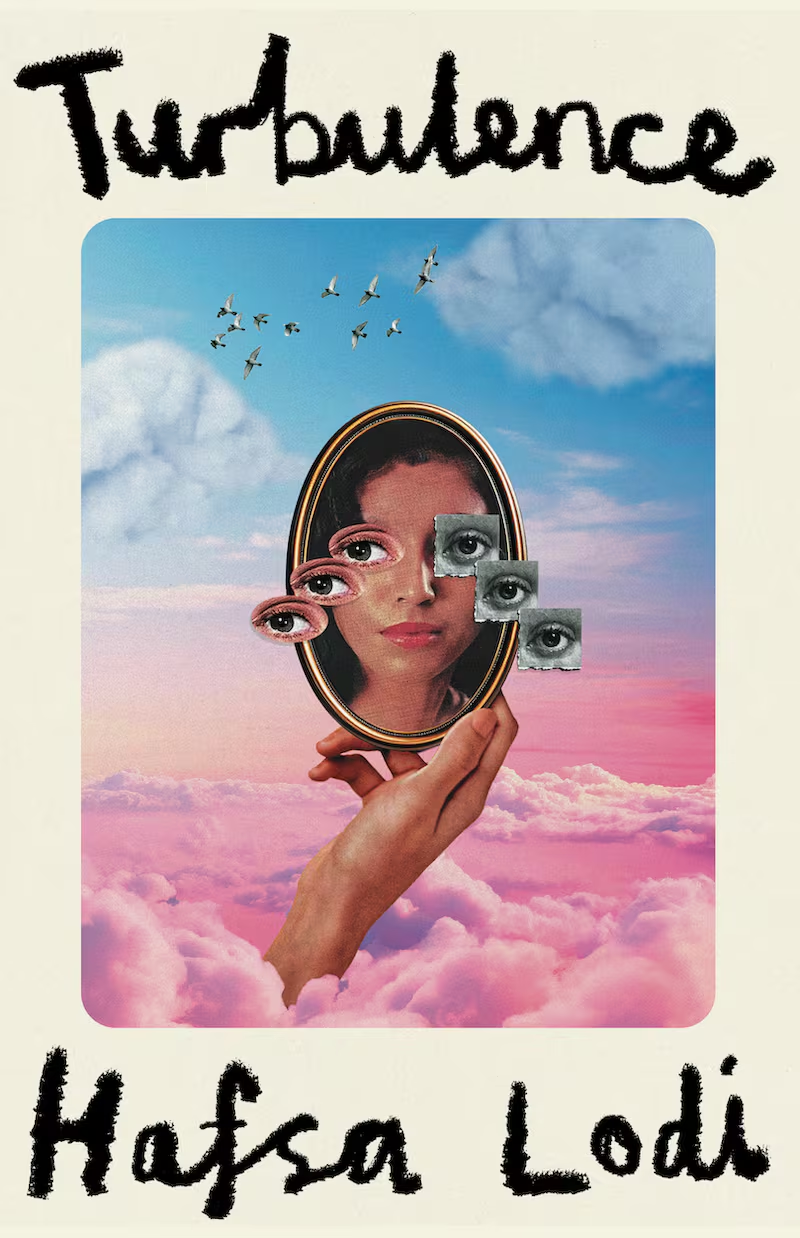
And write she did. In February this year, Lodi’s first fiction novel, Turbulence, hit the shelves. Set in the Middle East, it tells the story of aspiring documentary-maker Dunya Dawood who reaches a life-changing epiphany in the middle of a long plane journey (the title of the book a metaphorical and literal nod to what the character experiences during the flight). At the heart of it, the story explores how the balance between culture, faith, ambition and feminism manifests in the life of a modern Muslim woman.
But Lodi’s journey into this niche topic began at the tender age of 14, when she was still in high school and doing an after-school internship at a local media publishing house. With an inclination towards complex political and cultural topics, Lodi went on to study journalism in Toronto. “One of my major stories in university, towards the end of my degree, was about honor killings occurring within South Asian Muslim communities in Canada. It actually became the cover story of my university’s magazine. My whole angle with that piece was that this was not a Muslim issue. In the Canadian media, honor killings were being framed as something inherently tied to Islam, and I wanted to argue that it was not a Muslim practice and not something Islam condones.”
“But at the time, though, I remember thinking: I’m just this 22-year-old journalist. People could easily dismiss me by saying, “She’s just trying to defend her religion. What does she really know about Islam?” So I decided to study Islamic law for my master’s degree in London, so I would have some kind of academic grounding when writing about stories related to religion. That became the niche I was moving toward, I guess — women’s issues, faith-centered stories, and Islam-focused journalism.”
But for a while, Lodi’s path eventually led towards a staff writer’s job at local UAE newspaper The National’s lifestyle section. “It was completely the opposite of what I had been doing… I was writing a lot about fashion, food, parenting, relationships, and things like that,” she adds with a wry smile.
But between 2016 and 2017, with the boom of the modest fashion industry, Lodi found an opportunity to weave her way back into writing about topics closer to her scope of personal interest. “We had a hijabi model on major runways for the first time in 2017 — Somali-American, Halima Aden. And because I was the only Muslim woman journalist on the lifestyle desk, those stories naturally came to me to write. I remember one story I did called “Is Modest Modeling an Oxymoron?” Because for me, growing up, I had never seen a hijabi model modeling fashion. It seemed contradictory to modesty, and that was what a lot of people were thinking at the time as well. But when you spoke to Muslim women who were modest fashion influencers, they had a completely different perspective. I thought it was really interesting to explore that tension in a story. That became my first story about modest fashion. After that, any new hijab brands, abaya brands, or modest swimwear brands naturally ended up coming my way, and I found myself writing about all of these things.”
In a fortunate twist, one of Lodi’s pieces on modestwear was picked by a publisher in London. A trip to the English city while being pregnant, some back-and-forth conversations, and a signed contract later, Lodi —who, by then had quit her post at The National and was a freelance writer— was able to release her first non-fiction book, Modesty: A Fashion Paradox, in June 2020.
But a release in the midst of the COVID-19 pandemic meant unprecedented hurdles were added to Lodi’s book publishing journey. “It was a tough release period. I had book tours in the UK and the US, but they got canceled, obviously, because of the lockdown. But through that period, I realized I wanted to write something else, but this time I wanted to try fiction. I thought there’s something about non-fiction that not everybody will pick up. Not everybody wants to learn. But fiction is…well, there’s more fun, there’s more flexibility.”
But while attempting to fictionalize her perspectives and experiences allowed Lodi the kind of creative liberty she couldn’t afford in her non-fiction work, it came with a unique creative challenge: staying true to her personal experiences and viewpoints while honoring the faith she practises. “I had some doubts about that throughout the writing process,” she admits. “At first, I just wrote everything that came to me, and then I kept editing and editing. I also asked for the opinions of people I trusted. There’s a female Muslim scholar, Dr. Sofia Rehman, whose book club I’ve been part of for about six years now. There’s actually a scene in the book that was inspired by one of her book club sessions. I even asked her at one point, “Am I being respectful here?” I don’t want to give away too much, but there’s one part where the protagonist basically has a dream involving someone from the Prophet Muhammad’s family and has a conversation with them. In that sense, I was fictionalizing someone from history, which made me cautious. But it was all very vague, rooted in positive lessons, and never intended to be disrespectful in any way. That would be the last thing I’d want to do with this work! I’m writing as a Muslim woman, as a woman of faith, and as someone who deeply reveres these figures. So it was definitely a difficult balance to strike.”
Adding to such a complex creative process was also the fact that her female protagonist, like Lodi herself, is a South Asian woman — a collective culture spanning the Indian subcontinent with different, and often convoluted, perceptions of the very topics Turbulence dissects. This too was a reality Lodi was aware of while writing the book, which reflects in the characters of the book. “I wanted to bring some nuance to that idea,” she says. “The main character, Dunya, has a mother who is not a typical South Asian mother at all. She had an arranged marriage and — this isn’t a spoiler, it’s revealed very early on — her husband was abusive. She eventually left him and raised Dunya as a single mother. Her own parents cut her off because of that decision, so she no longer has a relationship with them. That entire experience leaves her deeply disillusioned with both culture and religion. The mistake she makes, though, is conflating culture with religion. Because of that, she doesn’t teach her daughter anything about Islam. It’s not necessarily that she doesn’t believe in it completely, but she wants nothing to do with what she sees as religion shaped and distorted by culture. So Dunya ends up seeking faith on her own. She feels drawn to the message herself and begins exploring it on her own terms.”
But in showing that the female protagonist, despite not having a conservative upbringing, chooses a life that is, Lodi hopes to show the true spectrum of what faith-led feminism entails. “I wanted to explore why someone might genuinely want that kind of life, even when it’s not being forced upon them. Because it’s not always about coercion. There are aspects of that lifestyle that can feel meaningful, grounding, and fulfilling to some women. I wanted to show what might draw a young Muslim woman toward that path on her own terms. And I think that’s something many people misunderstand about feminism. It’s not that one choice is inherently right and another is wrong. The important thing is that the decision itself belongs to the woman.”
In writing such multidimensional characters, Lodi hopes to contribute towards a wider creative movement wherein Muslim authors are pushing the envelope in terms of representation. “I think the literary industry has already started moving away from that monolithic view of the ‘Muslim character,’” Lodi says. “With Turbulence, that was something I really wanted to do as well. I knew I wanted a clearly Muslim female protagonist, but I didn’t want her to become a stereotype. I didn’t want her to be conventionally religious or perfectly pious. I wanted her to have doubts about her faith, to question things, and to arrive at her own understanding through learning and reflection. At the same time, I wanted faith to remain a positive and grounding part of her identity throughout the book. She goes through highs and lows, dips and peaks in her relationship with faith, but ultimately it becomes something meaningful and stabilizing for her. I also wanted to clearly separate culture from religion, because I think that’s a major issue in Islam today — we often conflate the two. I wanted her journey to involve untangling those things in a very real way and learning to recognize the difference between them.”
In the midst of all this, Lodi faced a new set of struggles in getting her book published. “My first publisher, Neem Tree Press, was initially set to publish Turbulence as well. But in early 2025, after merging with a larger publisher, Unbound, the company was liquidated. Suddenly, everything fell apart,” she reveals. “All the [book] rights reverted to me, and I was left with this finished manuscript of Turbulence. At that point, the book had already gone through edits, had a completely different cover, and only needed one final round of editing.”
Lodi, who at the time was working as a full-time journalist at Vogue Arabia, says having to pitch the book from scratch was not an idea she was ready to entertain.
“I just didn’t have the energy for it either,” she says. “Even before signing with Neem Tree Press, I had already sent around 60 emails to literary agents and publishers in New York and London. I know 60 emails may not sound like a huge number, and technically I could have sent many more, but I was working full-time and honestly, there just wasn’t much interest in this kind of book in the West at the time. So when the Neem Tree deal collapsed, I reached out to Kira, founder and CEO of The Dreamwork Collective, a publishing house here in Dubai. I had written about some of their authors before and knew she was a respected publisher. I’m honestly so grateful she believed in the book. She accepted it largely as it was, we did one final edit, and we changed the cover (which I was actually happy about because I never really loved the original one anyway!) It felt like such a blessing to have that support from her, because otherwise I genuinely don’t think the book would have ever been published. But publishing is a very difficult journey. It really isn’t for everyone.”
It is that final sentiment Lodi hopes to pass on to any budding or upcoming authors in the UAE and beyond. “Don’t expect to make money from your book,” she says. “If you want to write a book, do it because you love writing, you’re passionate about the craft, and you genuinely want your story to exist in the world. Financial success is not guaranteed; that was definitely a lesson I learned with my first book.”
“Right now, although there’s no real profit coming to me from this work, I think I’ve started looking at it from a more spiritual or holistic perspective instead,” she continues. “My mindset now is: do what your soul feels called toward. Do what feels meaningful and fulfilling to you. If your intentions are sincere and your heart is in the right place, then hopefully the reward — financial or otherwise — will come eventually, InshaAllah… That’s where I am with it right now!”
In January 2023, Hafsa Lodi wrote a piece titled “This is what Andrew Tate means for Muslim women like me” for British newspaper The Independent. The piece—an honest and personal take on how the Internet personality’s flagrant and flamboyant views had, at the time, garnered a rabid, mostly male following—was soon met with negative feedback from said followers on social media platform X. But to Lodi’s dismay, most of the comments came from men who, just like herself, identified as Muslim. “I woke up to so much hate,” she recalls. “There were hundreds of messages. It was so, so disheartening. People were saying things like, “Who is this? She’s not even Muslim. Look at her, her hair is uncovered.” Someone even said, “Oh, I found this picture from her Facebook.” And again, what I had written wasn’t some huge exposé — it was just an opinion piece. I was really shocked that people could be so disgusting. But then my publisher got threats. I even remember my dad saying, “Maybe you should write under a fake name. Maybe you shouldn’t be writing under your own name. You have to think of your safety. You have kids.” My husband was also shocked.”
For Lodi, a mother of two, to have stepped back after such a brutal experience would have been understandable. “For a few days, I was just very disheartened,” she adds. But it only bolstered her resolve to continue walking down a path she had chosen long before Internet trolls and influencers had anything to do with her work. “I kept thinking: how can there be such hatred? And it was especially sad because these were Muslim men. I wouldn’t have cared as much if they were Islamophobic or racist trolls, you know? But these were men from the same community that I see myself as part of. So it showed me how important it is to keep writing stories that address these misconceptions and misguided notions of faith and religion. I never really thought of it as positioning or building a brand. It just felt like: this is what I want to write about, so I’ll continue writing about it.”
And write she did. In February this year, Lodi’s first fiction novel, Turbulence, hit the shelves. Set in the Middle East, it tells the story of aspiring documentary-maker Dunya Dawood who reaches a life-changing epiphany in the middle of a long plane journey (the title of the book a metaphorical and literal nod to what the character experiences during the flight). At the heart of it, the story explores how the balance between culture, faith, ambition and feminism manifests in the life of a modern Muslim woman.

Aalia Mehreen Ahmed • Senior Features Editor, Entrepreneur Middle East
Entrepreneur Staff
Senior Features Editor at Entrepreneur Middle East and host of Anchored Echoes, with nearly seven... Read more