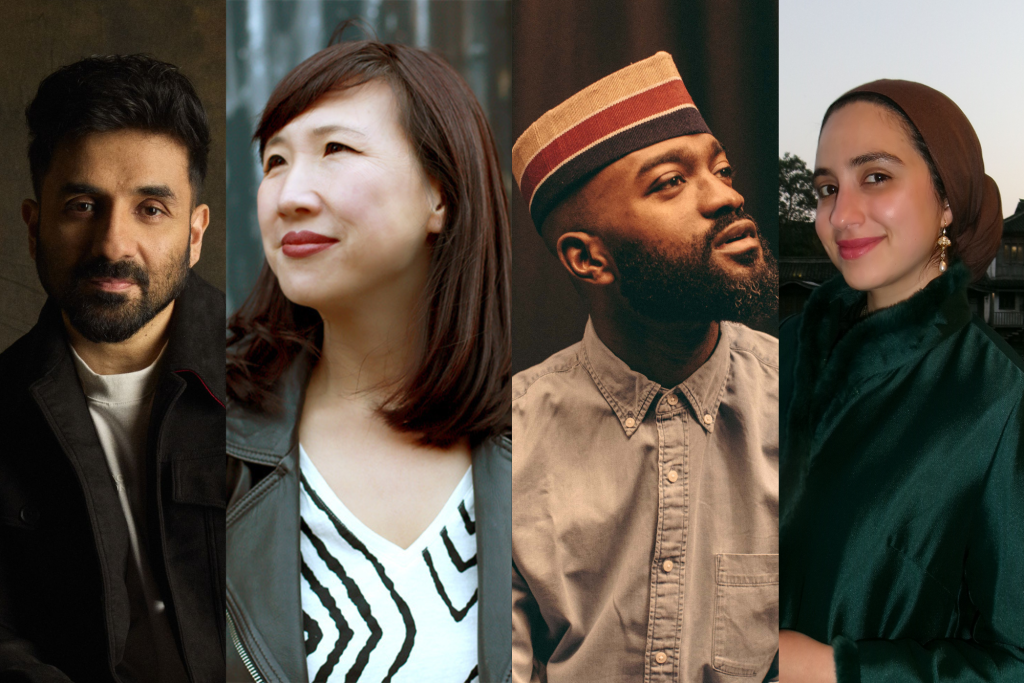
Vir Das, Sharon King-Chai, Inua Ellams and Jennah Fakhouri on Authenticity in the Algorithm Age
As businesses race to keep up with algorithms, saturated markets, and dwindling attention spans, four creative entrepreneurs reflect on how staying rooted in identity, morals, and community has helped them grow without losing authenticity (and why that may be the most scalable strategy of all).
You're reading Entrepreneur Middle East, an international franchise of Entrepreneur Media.
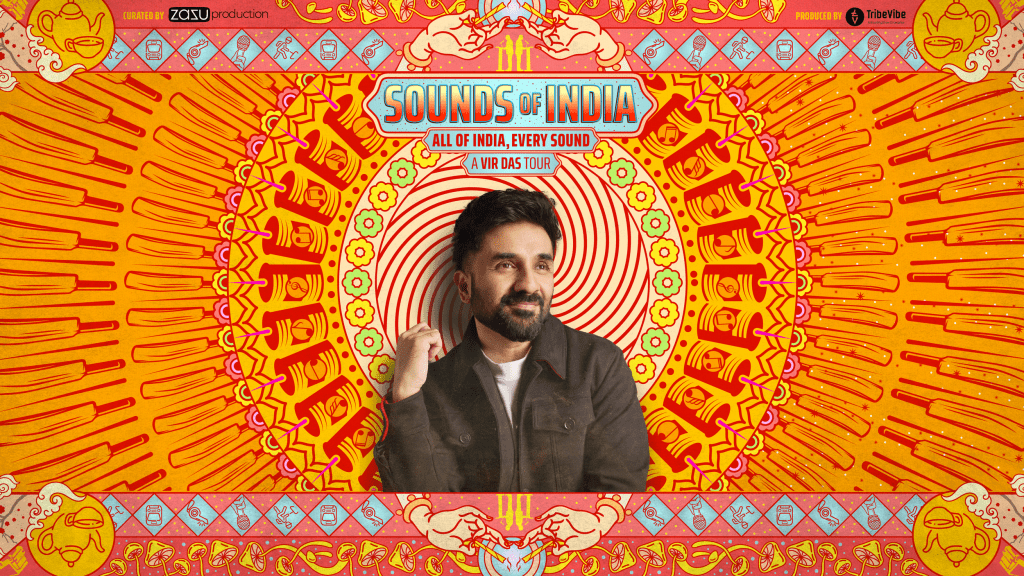
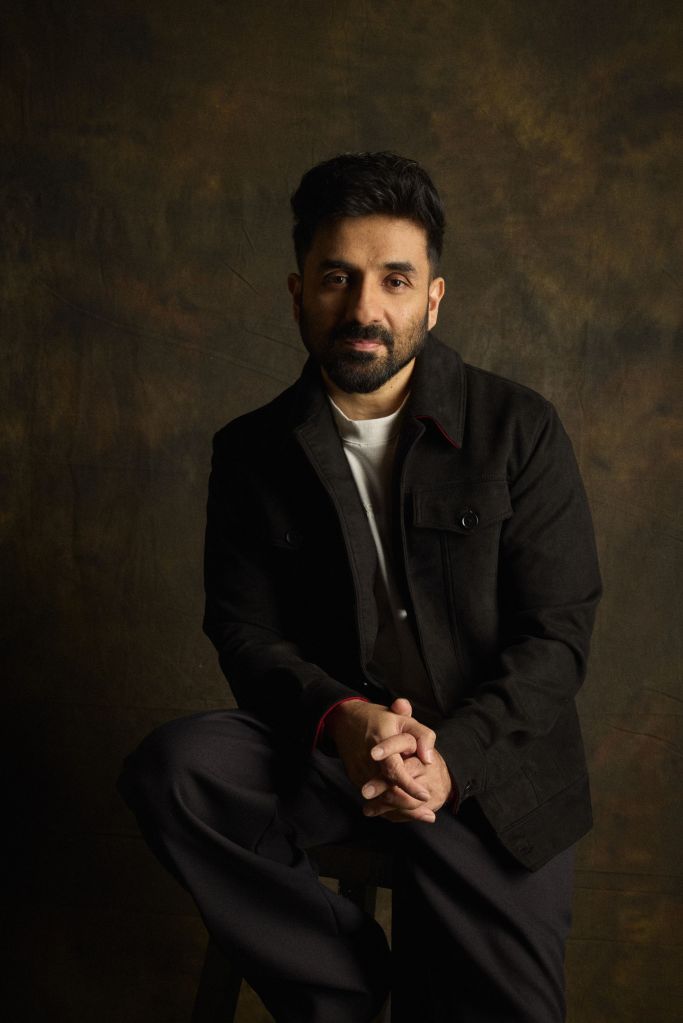
“I think the mission for every artist is that whether you see 30 seconds of me or you see one hour of me, you should know me,” says Vir Das, an Emmy Award-winning standup comedian, actor and director, when asked if viral social media clips of his hours-long performances nibble away at the nuance of his craft. After all, over the course of his career so far, he has released five Netflix comedy specials, completed multiple standup tours in India and other parts of the world, as well as a handful of Bollywood films and TV shows. When I speak with Das on the sidelines of the Emirates Airline Festival of Literature in Dubai, he’s hours away from leading a session spotlighting his newly released book, The Outsider: A Memoir for Misfits. “In an hour of a stand-up comedy show, there will be some personal things. There will be some topical things. There will be, hopefully, a plateau. There will be two uncomfortable silences. A stand-up show is like a movie in that sense. There is a climax, a fight in the second act, and a reunion of romance. There is all of that stuff. So if you take a section of that, in the very best-case scenario, it should still showcase who you are as a human being.”
Das’ insights offer a timely reminder to creative entrepreneurs across the globe who leverage social media as a tool for visibility and reach. In August 2025, research by the news and data analysis platform SQ Magazine showed that “visibility now hinges on behavior, likes, watch time, comments, video pauses, and feed-ranking systems.” But while it may be easy to superficially view this as a cycle of engagement and virality defined solely by algorithms, a quiet shift is taking place. In June 2025, marketing platform Stack Influence released a study showing that “micro-creators often see much higher engagement rates than big celebrities,” citing their authenticity and tight-knit communities as the major driving factors.
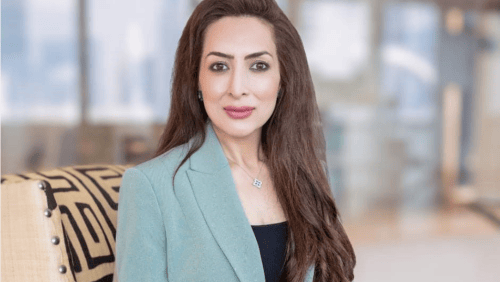
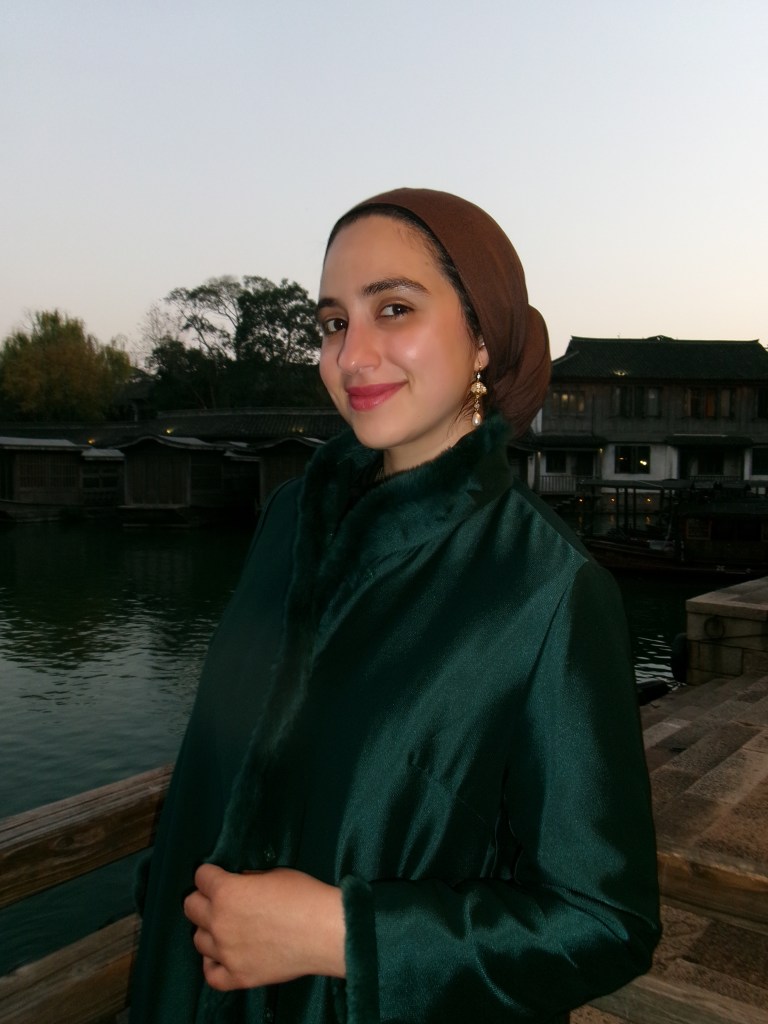
One individual who has proven the latter statement true is Jennah Fakhouri, a Palestinian poet who’d been declared as one of the winners of the 2026 ELF Seddiqi Writers’ Fellowship, a creative writing program by the Emirates Literature Foundation, just the night before this interview. To extend her love for creativity to the wider community, Fakhouri has also founded UAE-based literary platform Zajal to celebrate art and culture through literature. “I started this project by putting people on ‘blind dates’ with Palestinian books that enabled them to get access to all of these different stories they wouldn’t otherwise be exposed to,” she explains. “Then that expanded as a concept and I realized, ‘You know what? There is a genuine gap for intellectual conversations and for third spaces beyond the screen!’ So then I utilized having a platform online, and all the trends that define it, to create a safe space offline where we could actually explore different cultures every single month through our book club. And I have a beautiful community of people that are genuinely culturally curious. And that was only possible because I was authentic to myself.”
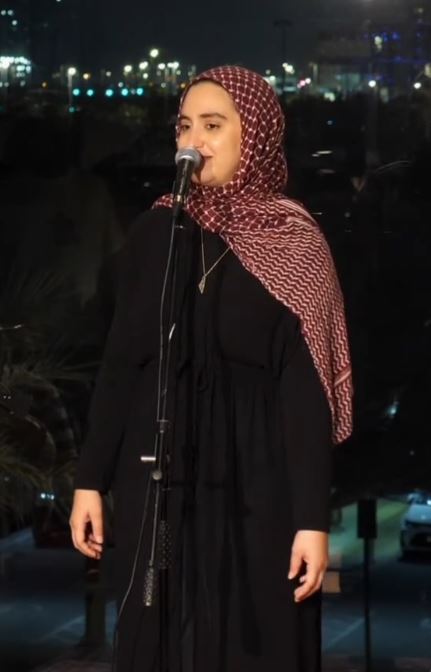
However, for Fakhouri, dismissing the idea of algorithm-aligned content is a decision that transcends online branding strategies and is more deeply rooted in honoring her heritage. “I can obviously create content for an algorithm, and perhaps that may outperform—but the stuff that really connects people and draws them into your community and into the brand that you’re trying to sustain is going to be the work that authentically feels like you,” she says. “I also am very cognizant of the fact that I have a platform and I have this voice that God gave me. So it’s my job then to amplify voices that are not being heard, especially as a Palestinian. I tend to draw upon the stories and the narratives that I’m seeing coming out of Gaza and the West Bank and, of course, Jerusalem as well. And I translate that into powerful poetry that can really connect with people beyond the sound bites and beyond the news headlines.”
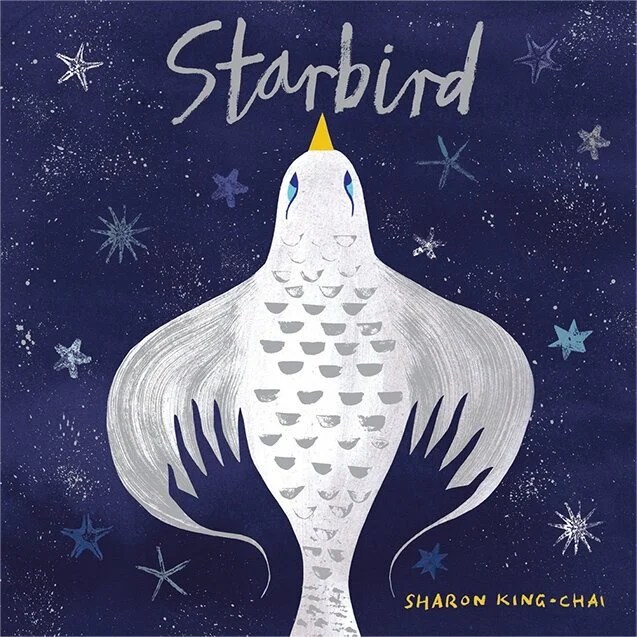
But operating in a creative space that has, so far, been largely insulated from digital trends is Sharon King-Chai, a designer and illustrator who works primarily on children’s books. Among the plethora of awards she’s clinched over the years has been her win for Best Children’s Book Cover by the Academy of British Cover Design for her book Starbird. As such, King-Chai offers insights into how creative entrepreneurship untouched by the fast pace and immediate gratification of the virtual world can look. “I take a long time to do my books, and I have to really feel invested in the story and feel like it’s worth that time,” she says. “I don’t want to go and produce lots and lots of books with a huge output—I want to do things that feel worthy and important, where I can find meaning in the story. As a mother now, and as I’m finding more experiences in life, I do want to go deeper. That means digging more into my own personal stories. Different parts of my career have tapped into different parts of the story—when I started as an illustrator, it was more about creating characters. But as I’ve become a bit older and have more life behind me, I bring the focus more onto myself.”

King-Chai’s creative approach brings forth a broader dilemma: whether online visibility reduces the ability to be vulnerable in one’s creative process. Offering his insights on the matter is our final voice of creative entrepreneurship in this piece: Inua Ellams, an award-winning poet, playwright, and curator, a Fellow of the Royal Society of Literature and an MBE for services to the arts in the King’s Birthday Honours. “When I think of my brand, I think of myself as a living, breathing human being who is full of contradictions and full of mistakes and who constantly evolves. I see that in the sweep of my work,” he says. “What I wrote and how I wrote, I don’t know, 15 years ago, isn’t how I write now. I’m embarrassed by those things because the style is terrible, it’s overwritten, it’s long. But what I try to do is embrace all of that, even when I’m embarrassed about it…. So I think on social media, that’s also what I try to do. I never try to filter myself. I try to embrace all my flaws.
Yet beneath the discourse around authenticity, vulnerability, and belonging lies a quieter, perhaps equally concerning, topic: the need for creative work to be able to monetarily sustain itself. For a line of work that inherently places passion over profits, it is a thin line that modern-day creative entrepreneurs have to tread— especially when “easy” monetization strategies can seem enticing.
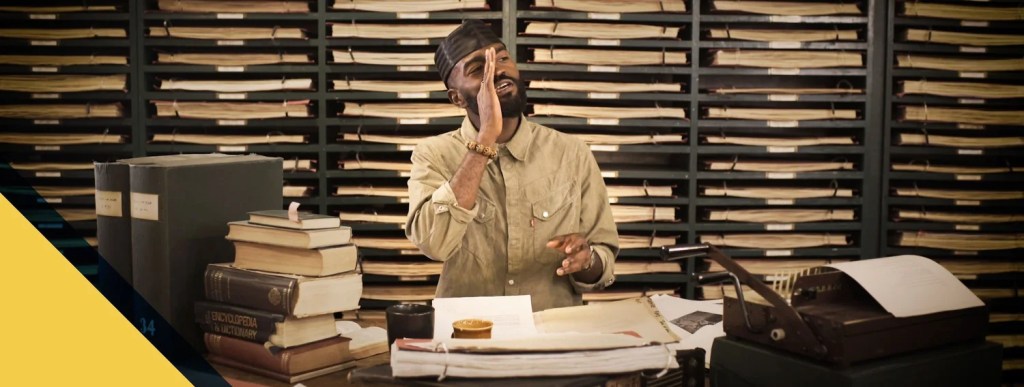
“I don’t think you go into writing poetry for money,” says Ellams. “Which means trying to create a quote-unquote product that is sales-driven and reacts to the present is a pointless task. It is, by design, unpoetic. So much of the work required to write poetry—or any art that is of value and that lasts—requires deep thought and time spent thinking and structuring. To present just an iota of it does a disservice to the amount of time you’ve spent creating the work. I also encourage my students and colleagues not to work that way. Feel free to share an excerpt of your work [online], but I think of that excerpt as coming from the side, not the top. The top tends to be the most explosive, the most emotive. Algorithms are primed to exploit human emotion, often bringing out the worst parts of us. If I share anything, it’s from the side—as opposed to the top.”
Ellams then recalls how he once consulted a social media branding specialist who offered detailed advice on how to better monetise his presence online. “Everything she said was completely correct,” he says. “But I didn’t care. And I still haven’t changed the way that I use it.”
Das exhibits a similar resistance to jumping on the latest trending strategies when asked about the key to balancing creativity and revenue. “I have a social media agency that we hired about three months ago,” he says. “And these are kids who keep telling me, ‘It’s uncool. You write text on black, this thing. You’re putting all your feelings out there. Let’s do some cool transitions and this and that,’ et cetera, et cetera. So I tried a few. Never worked. Text on a black background, if it’s the right kind of feeling for my particular audience, goes much further. I don’t think I have any other choice. Suddenly, if I hired the best editor in the world and used whatever trending song was on Instagram, it would reek of inauthenticity. And I also think that, as opposed to film or television or OTT, stand-up and music really have to have authenticity at their core. Inauthentic music and inauthentic stand-up stick out like a sore thumb and are immediately rejected.”
Jokingly, he then adds that he doesn’t see himself as much of a creative entrepreneur. “If anything, I’m creative and I’m an entrepreneurial failure. I will die penniless, but hopefully having written good things.”
But while Das and Ellams offer perspectives on monetary returns from a purely creative lens, Fakhouri brings one shaped by her vantage point as both a social startup founder and a creative individual. “When something is a passion project and you see people getting really excited about it, but you also start to notice that certain things are pricing people out, it’s hard to stay in a business mindset and say, ‘I’m not going to give this to you for free. You actually have to pay for my service, because it’s my time and my effort,’” she says. “For me, it’s about separating the fact that I am excited to create something from the fact that this is also my business. There’s Jennah the business founder, and then there’s Jennah the poet. I get to bring my creative side to the forefront because she’s funded by my founder side. Managing that separation is how I’m able to run a business that still feels really valuable to the community. I also think that market research is super important. You have to understand what already exists, what people are willing to pay for, and what makes you unique and how you communicate that. I’m very clear about what my unique selling point with Zajal is, and that’s what helps drive my business and bring new people in every single time we run sessions and events.”
Now, while all the other creative entrepreneurs in this piece largely cater to the teenage to adult audiences, King-Chai’s challenge lies in balancing her commercial opportunities with the unique responsibility of shaping the imagination of young minds through her illustrations. But King-Chai says that she avoids concerning herself with the weight of such a conundrum. “I don’t really think about it consciously when I’m creating,” she says. “I do it almost for myself, asking what means something to me and how I feel about it—and I trust that, if it’s honest, it will eventually resonate with others too. I’m not consciously thinking about responsibility or audience when I’m creating. I’m asking myself what means something to me and how I feel about it, and I make sure I feel good about what I’m doing.”

Adopting what she calls an “open-minded” approach has helped King-Chai stay true to her creative vision, she says. “At the moment, I’m entirely freelance. It’s nice to work as a designer and be employed by different companies, but now I go where my heart takes me and choose projects, different mediums, and curiosity.”

While King-Chai, Das, Fakhouri, and Ellams continue to forge their own creative paths in 2026, it appears that human-centered content can remain sustainable despite the algorithm race—and despite not amassing the scale of audiences viral content promises to deliver.
Das puts it best when he says: “I do think that, at some point, if you’re not craving beyond a certain level of acceptance, you reach escape velocity. I think I’ve found my people. There might never be more people than this, and maybe that’s okay. But with this audience—my current audience—I’m free. Beyond that, I wouldn’t be. So I think I’ve found my people.”
So, in an oversimplified sense, does it all come down to quality versus quantity, I ask him as a final question. “The audience will decide whether it’s quality or not,” he says. “But at least it’s authentic.”
“I think the mission for every artist is that whether you see 30 seconds of me or you see one hour of me, you should know me,” says Vir Das, an Emmy Award-winning standup comedian, actor and director, when asked if viral social media clips of his hours-long performances nibble away at the nuance of his craft. After all, over the course of his career so far, he has released five Netflix comedy specials, completed multiple standup tours in India and other parts of the world, as well as a handful of Bollywood films and TV shows. When I speak with Das on the sidelines of the Emirates Airline Festival of Literature in Dubai, he’s hours away from leading a session spotlighting his newly released book, The Outsider: A Memoir for Misfits. “In an hour of a stand-up comedy show, there will be some personal things. There will be some topical things. There will be, hopefully, a plateau. There will be two uncomfortable silences. A stand-up show is like a movie in that sense. There is a climax, a fight in the second act, and a reunion of romance. There is all of that stuff. So if you take a section of that, in the very best-case scenario, it should still showcase who you are as a human being.”
Das’ insights offer a timely reminder to creative entrepreneurs across the globe who leverage social media as a tool for visibility and reach. In August 2025, research by the news and data analysis platform SQ Magazine showed that “visibility now hinges on behavior, likes, watch time, comments, video pauses, and feed-ranking systems.” But while it may be easy to superficially view this as a cycle of engagement and virality defined solely by algorithms, a quiet shift is taking place. In June 2025, marketing platform Stack Influence released a study showing that “micro-creators often see much higher engagement rates than big celebrities,” citing their authenticity and tight-knit communities as the major driving factors.
One individual who has proven the latter statement true is Jennah Fakhouri, a Palestinian poet who’d been declared as one of the winners of the 2026 ELF Seddiqi Writers’ Fellowship, a creative writing program by the Emirates Literature Foundation, just the night before this interview. To extend her love for creativity to the wider community, Fakhouri has also founded UAE-based literary platform Zajal to celebrate art and culture through literature. “I started this project by putting people on ‘blind dates’ with Palestinian books that enabled them to get access to all of these different stories they wouldn’t otherwise be exposed to,” she explains. “Then that expanded as a concept and I realized, ‘You know what? There is a genuine gap for intellectual conversations and for third spaces beyond the screen!’ So then I utilized having a platform online, and all the trends that define it, to create a safe space offline where we could actually explore different cultures every single month through our book club. And I have a beautiful community of people that are genuinely culturally curious. And that was only possible because I was authentic to myself.”

Aalia Mehreen Ahmed • Senior Features Editor, Entrepreneur Middle East
Entrepreneur Staff
Senior Features Editor at Entrepreneur Middle East and host of Anchored Echoes, with nearly seven... Read more