AI Is Influencing How Wealth Is Created. Anna Namit Believes the Future of Wealth Will Be Written in Both Brushstrokes and Code
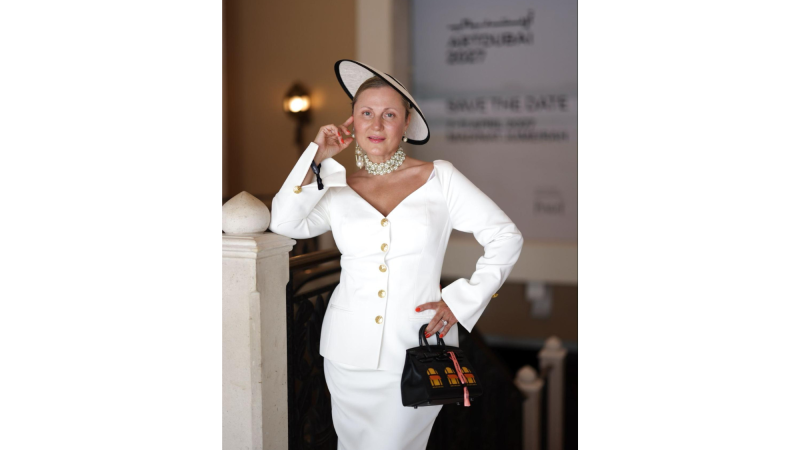
Anna Namit
You're reading Entrepreneur Middle East, an international franchise of Entrepreneur Media.
After more than 25 years advising collectors and investing across the global art market, art advisor and investor Anna Namit believes the future of wealth will be shaped by both innovation and timeless value.
“Many entrepreneurs feel they are living through one of the most significant periods of wealth creation in modern history,” Namit says.
Over the past quarter century, the world has experienced the rise of the internet economy, cryptocurrencies, artificial intelligence, digital platforms and new financial instruments that have reshaped not only how businesses are built, but also how wealth is created. Global private wealth has grown substantially during this period, alongside the emergence of new industries and technologies.
To Namit, however, these developments all point toward a surprisingly longstanding principle.
After spending more than 25 years advising collectors, curating museum exhibitions and building investment-grade art collections across Europe, the Middle East, Asia and the United States, she has come to believe that entrepreneurs sometimes overlook one of the most important principles of long-term wealth.
“Money continues to multiply,” she says. “Masterpieces do not.”
It is an observation that has become central to her investment philosophy and one she believes is increasingly relevant today.
Understanding Art Market Scarcity
Entrepreneurs often spend their careers building scalable businesses, expanding into new markets and creating products that can reach millions of people. Success is frequently measured by growth—the ability to innovate, scale and continually create new value.
Museum-quality art, by contrast, follows a very different economic dynamic.
“I often tell people that oil can be extracted, gold can be mined and money can be printed,” Namit says. “But no one will ever create another authentic masterpiece by Leonardo da Vinci, Pablo Picasso or Claude Monet.”
That distinction, she argues, makes fine art different from many other investment categories.
Public companies can issue additional shares. Cities continue to build real estate. Manufacturers increase production. Even many digital assets exist within systems that continue to evolve.
The greatest works of art exist outside that cycle.
Their supply has already been determined by history.
“When discussing museum-quality works of art,” Namit explains, “supply is practically nonexistent.”
Many of history’s most celebrated masterpieces are finite in number. They simply change hands, often privately and infrequently, after years of relationship-building and negotiation.
“Masterpieces are not created again,” she says. “They simply change ownership from time to time.”
For Namit, scarcity is more than a defining characteristic of the art market—it is one of the most enduring economic principles investors can study.
The Immortality Indicator
Few industries provide exposure to global wealth quite like the art market.
Throughout her career, Namit has worked with collectors whose decisions are often shaped not by quarterly earnings or short-term market sentiment, but by decades—and sometimes generations—of thinking.
Along the way, she has witnessed financial crises, geopolitical uncertainty, the COVID-19 pandemic, inflationary pressures and rapid technological change.
Each time, she says, predictions emerged that the art market was about to collapse.
Instead, she often observed a different pattern.
“Nobody trades masterpieces for bread.”
The phrase has become one of her preferred ways of describing the psychology of many of the world’s most sophisticated collectors.
For Namit, the observation helps explain collector behavior better than many market reports.
During periods of financial uncertainty or currency volatility, many major collectors tend to become more selective rather than rushing to sell exceptional works of art. Transactions may become quieter, competition more discreet, and advisors often focus on identifying the highest-quality works available before confidence returns.
In Namit’s view, periods of uncertainty do not necessarily eliminate demand—they can shift attention toward the rarest and most sought-after works.
She believes that museum-quality art often behaves differently from many traditional asset classes.
Companies can issue additional shares. Governments can print more money. Factories can increase production. But economic cycles cannot increase the supply of works by artists such as Leonardo, Picasso or Monet.
That is why, in Namit’s view, great art can serve as what she calls an “Immortality Indicator”—an asset whose long-term appeal is closely tied to its permanent scarcity rather than short-term market cycles.
Owners of exceptional works are also rarely motivated to sell quickly. The finest paintings typically enter the market only under unusual circumstances.
“The old rule still applies,” Namit says. “Death. Divorce. Debt.”
Occasionally, she notes, there is a fourth.
“Desire.”
Sometimes, she says, an offer simply becomes too compelling to refuse.
Namit believes this dynamic helps explain why the highest end of the art market can behave differently during periods of uncertainty.
“Crisis destroys value in some financial markets,” she says. “In the art market, it often redistributes quality.”
As investors become more selective, demand may increasingly concentrate around museum-quality works. Rather than weakening the highest end of the market, uncertainty can reinforce the importance of rarity and provenance.
Why the Best Investors Don’t Chase Hidden Gems
Image credit: Anna Namit
One of the most persistent myths in art investing, according to Namit, is the belief that success comes from discovering an overlooked genius before everyone else does.
It is a mindset she recognizes from the startup world, where entrepreneurs often seek tomorrow’s breakthrough before the broader market does.
But art, she argues, tends to reward a different kind of discipline.
“One of the most common mistakes aspiring art investors make is searching for an undiscovered masterpiece,” she says.
“In reality, undiscovered masterpieces are the exception rather than the rule.”
The works that command the world’s highest prices have generally earned their reputations over decades—or centuries. They have been exhibited, studied, published and authenticated. Their provenance is understood, and their historical significance has been tested through scholarship as well as the market.
“The objective is not to discover an unknown artist,” Namit says. “The objective is to acquire the best among the known.”
It is advice she believes extends beyond collecting. While entrepreneurs often celebrate disruption, lasting value can also come from recognizing enduring quality rather than constantly pursuing the next new idea.
The Meta-Renaissance
Namit describes today’s moment as the beginning of what she calls the “Meta-Renaissance.”
Artificial intelligence is transforming industries. Digital platforms continue to create new business models. Blockchain, virtual reality and other emerging technologies are opening new opportunities for founders, investors and entrepreneurs around the world.
Yet for all that innovation, one variable remains unchanged.
The number of great masterpieces in the world today is the same as it was yesterday.
“The world has changed dramatically,” Namit says. “We’ve witnessed cryptocurrencies, artificial intelligence, digital platforms, the metaverse and entirely new financial instruments. But one thing remains unchanged.”
“The number of truly great masterpieces does not increase.”
For her, the widening gap between expanding global wealth and permanently finite cultural assets may become an increasingly important theme in the art market.
“There is more money than masterpieces.”
She believes that equation is becoming increasingly relevant.
According to industry estimates, the global art market asset class is valued at approximately $1.7 trillion, yet it remains one of the least institutionalized asset classes of its size—a gap that Namit believes presents both challenges and opportunities.
Where Technology and Tradition Meet
Perhaps the most surprising aspect of Namit’s philosophy is that it does not reject innovation.
Alongside her work in the international art market, she also invests in artificial intelligence and virtual reality companies, believing these technologies will continue reshaping industries and creating significant economic opportunities.
Rather than viewing technology and fine art as competing ideas, she sees them as complementary.
“Innovation can create wealth,” she says. “Scarcity can help preserve value.”
In her view, as technology enables the creation of new businesses and new fortunes, interest in genuinely finite assets may also continue to grow.
One reflects abundance. The other reflects scarcity.
The Next Architecture of Capital
Image credit: Anna Namit
Many of the most important investment innovations have not created entirely new assets—they have created new ways to access existing ones.
Joint-stock companies, stock exchanges, index funds, and ETFs did not change the underlying assets themselves. They changed how investors could participate in them.
Anna Namit believes the next stage of investment innovation may follow a similar pattern.
While blockchain is often associated with cryptocurrencies, she believes one of its most promising long-term applications could be the tokenization of Real-World Assets (RWAs), offering new ways to own interests in some of the world’s rarest tangible assets.
“It isn’t simply a technological innovation,” Namit says. “It’s also a financial one.”
A Leonardo remains a Leonardo. A Picasso remains a Picasso. The artwork itself does not change. What may evolve is the way ownership is structured.
But she believes tokenization alone is only part of the equation.
According to Namit, museum-quality art still lacks something many major asset classes already possess: an institutional benchmark.
Stocks have the S&P 500. Private equity, real estate and digital assets all have widely recognized indices.
Museum-quality art has no universally adopted equivalent.
Namit’s proposed solution is the Art Index—a benchmark focused exclusively on museum-quality masterpieces.
“It isn’t another financial product,” she says. “It’s a financial language.”
Without common standards, tokenization may improve liquidity.
With institutional standards, she believes it has the potential to help create a more mature market.
As AI continues to accelerate innovation and private capital remains strong, Namit believes some investors will increasingly look for assets they view as enduring over the long term.
For her, many of those qualities are found in the rarest works history has already produced.
A Lesson That Extends Far Beyond Art
Although Namit’s career has centered on masterpieces, she believes the broader lesson applies just as readily to entrepreneurship.
Many enduring businesses create value by developing qualities that are difficult to replicate.
Trust cannot be manufactured overnight. Reputation cannot be mass-produced. Exceptional leadership, talent and authenticity remain relatively scarce, regardless of how quickly technology evolves.
The world’s greatest works of art, she believes, simply represent one of the clearest examples of that principle.
Looking back across more than two decades of advising collectors through economic booms, recessions, technological revolutions and the creation of substantial new wealth, Namit says much has changed.
Markets have evolved.
Innovation has accelerated.
New fortunes have been created in industries that barely existed a generation ago.
Yet one observation continues to shape her perspective.
“Money continues to multiply,” she says. “Masterpieces do not.”
For entrepreneurs navigating an economy increasingly defined by innovation and rapid change, Namit believes that may remain one of the most enduring lessons about long-term value.
The information provided in this article is for general informational and educational purposes only. It is not intended as legal, financial, or professional advice. Readers should not rely solely on the content of this article and are encouraged to seek professional advice tailored to their specific circumstances. We disclaim any liability for any loss or damage arising directly or indirectly from the use of, or reliance on, the information presented.
After more than 25 years advising collectors and investing across the global art market, art advisor and investor Anna Namit believes the future of wealth will be shaped by both innovation and timeless value.
“Many entrepreneurs feel they are living through one of the most significant periods of wealth creation in modern history,” Namit says.
Over the past quarter century, the world has experienced the rise of the internet economy, cryptocurrencies, artificial intelligence, digital platforms and new financial instruments that have reshaped not only how businesses are built, but also how wealth is created. Global private wealth has grown substantially during this period, alongside the emergence of new industries and technologies.

Entrepreneur Middle East Staff
Entrepreneur Staff