How Technology Affects International Trade
Technology has played a role across each of the paths in the value chain with an aim to achieve both speed and efficiency.
Shutterstock.com
Opinions expressed by Entrepreneur contributors are their own.
You're reading Entrepreneur Middle East, an international franchise of Entrepreneur Media.
In 2022, DP World Group partnered with Entrepreneur Middle East and Lucidity Insights to publish Innovations in International Trade, a special report analyzing innovations in international trade.
The report covers multiple features of international trade, from its evolution, to the role it plays in uplifting societies and economies, and its future developments. It also covers the role technology has played in international trade, and what is expected going forward, given the impact of the fourth industrial revolution.
Last but not least, sustainability is a global topic piquing interest across different industries, with international trade being a significant contributor to greenhouse gas (GHG) emissions. Accordingly, this report also briefly explores initiatives that the industry is taking to address the sustainability challenge.

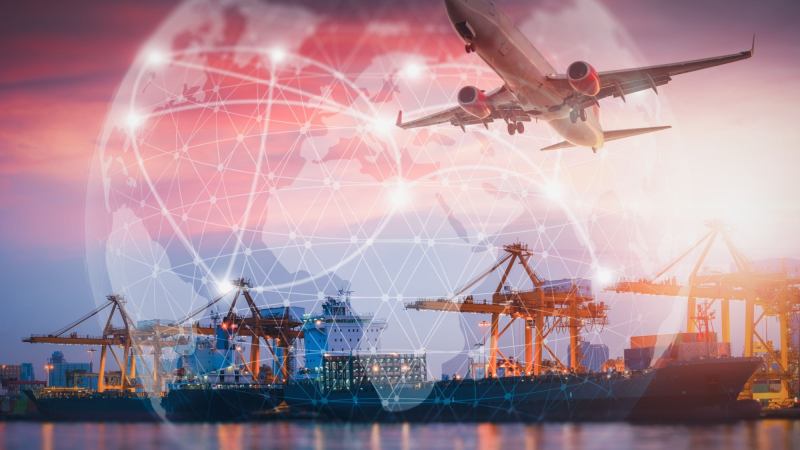
A typical supply chain consists of suppliers and/or manufacturers of raw material, road or rail transporters to an origin seaport in case that maritime transportation is required, which is then followed by the goods reaching a destination port, and eventually being transported to a customer (business or individual).
Technology has played a role across each of the paths in the value chain with an aim to achieve both speed and efficiency. Starting from the suppliers, their access to raw materials, and thereafter, production quality determines who they serve. At the port, the size of the port and efficiency of the operations at the port determines how much handling can be done. The size and speed of maritime transport also determine how quickly it is received at the destination port.

A lot of the innovations intersect across varying stages within a supply chain network. One common underlying enabler is that computing power has increased over time, and the resulting outcome is better efficiency, higher safety, better sustainability, higher productivity, predictive maintenance and breakdowns, lesser wastage, and yield improvements.

While it is at multiple levels, the impact of technology on international trade shows that in addition to lower costs coupled with higher speed, it has also enabled trading in new products and services, resulted in positive environmental outcomes, reduced transactional costs resulting in increased volumes, and inclusion of smaller players in the trade ecosystem.
Check out our full report on Innovations in International Trade by clicking here.
In 2022, DP World Group partnered with Entrepreneur Middle East and Lucidity Insights to publish Innovations in International Trade, a special report analyzing innovations in international trade.
The report covers multiple features of international trade, from its evolution, to the role it plays in uplifting societies and economies, and its future developments. It also covers the role technology has played in international trade, and what is expected going forward, given the impact of the fourth industrial revolution.
Last but not least, sustainability is a global topic piquing interest across different industries, with international trade being a significant contributor to greenhouse gas (GHG) emissions. Accordingly, this report also briefly explores initiatives that the industry is taking to address the sustainability challenge.

Erika Masako Welch • Chief Content Officer, Lucidity Insights
Erika Masako Welch is the Chief Content Officer of Lucidity Insights.