The Linen Road
Artist Jet Le Parti Is Painting New Routes for Gulf Capital

Sibyl
You're reading Entrepreneur Middle East, an international franchise of Entrepreneur Media.
Jet Le Parti is notorious for refusing sales, collaborations, gallery representations and formal showings. Despite the lack of institutional approval, his works have gained a strong following in the secondary market, establishing him as a highly sought-after artist.
Le Parti, 27, built his practice by saying no. No formal representation. No public inventory. No open inquiries. He self-funded exhibitions through Base 36, the initiative he founded in 2020. His own dealer from the start. The dealer for the artists around him.
“I never made art with an intention to sell it. I’ve only ever sold as a means of survival — to take care of the artists around me, to fund what came next. If conditions were different, none of it would have left. But the few I trusted with the work seemed to see something before the market validated it. Those relationships became Sibyl.”
 Sibyl
Sibyl
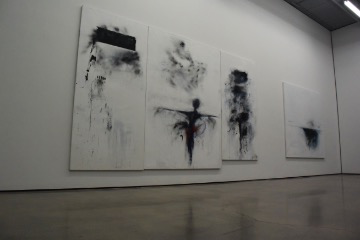
The model emerged from what was already happening. Le Parti’s paintings had entered a private collection through an introduction at a warehouse space in Los Angeles. His work was installed alongside holdings that would become the nucleus of something larger. The relationship grew. Trust came first, then structure. By the time Sibyl formalized as a private collection and cultural intelligence office, Le Parti was already inside it.
Today he leads contemporary strategy across North America, Europe, the Gulf, and Asia-Pacific.
Sibyl maintains private storage in Los Angeles with viewing capacity. Collectors visit by appointment. There is no public inventory. Intake is seasonal, routed through referral.
The partners share a profile — not an industry, but a disposition. People who’ve built things without permission. Who’ve calculated risks others wouldn’t take. Who recognize quality before consensus catches up. Different backgrounds: some from entertainment, some from athletics, some from venture, some from generational capital. A few came from poker — people who trust their read, understand variance, hold through the noise, and know when to realize max value.
Alongside Sibyl, Le Parti is developing Haven — infrastructure for custody, provenance, and capital movement across cultural assets. The instinct that drove him to retain his own work, to build his own exhibitions, to protect what he made — that same instinct now shapes infrastructure for others navigating opaque markets.
The timing matters. Global auction sales fell roughly 25% in 2024. Public sales are down; private transactions are up. Meanwhile, over $124 trillion will transfer from baby boomers to younger generations by 2048. The asset class is shifting. Most models haven’t adjusted.
When Sibyl bridged to Gulf-based collectors, the gap was cultural. Everything there moves on relationship. Asia-Pacific developed through its own sequence: China first, then Singapore. Different markets, same principle — but the principle has to be lived, not performed.
For a Southern-state native jumping borders, there’s a natural uneasiness. Every market carries its own norms, its own formalities with capital. Styles of collections, profiles of collectors, intents and interests. The barrier is communicating respect across all of it.
“People can tell authenticity in any language. After clearing customs, we’re no longer clients. We’re partners.”
Le Parti grew up in Columbus, Georgia, a military town far from any art center. He studied cognitive neuroscience and philosophy at the University of Pennsylvania and spent time at the Royal College of Art before building Base 36 out of Brooklyn warehouses — a hybrid gallery and publishing initiative that operated between Berlin, London, and Los Angeles. The infrastructure wasn’t coming. So he built it.
Most artists sell work to fund their lives. Le Parti built a life to protect his work.
“Fortunately, things are easier when you don’t need anything.”
The corridor is still being drawn. The work continues.
www.sibyl.art
Jet Le Parti is notorious for refusing sales, collaborations, gallery representations and formal showings. Despite the lack of institutional approval, his works have gained a strong following in the secondary market, establishing him as a highly sought-after artist.
Le Parti, 27, built his practice by saying no. No formal representation. No public inventory. No open inquiries. He self-funded exhibitions through Base 36, the initiative he founded in 2020. His own dealer from the start. The dealer for the artists around him.
“I never made art with an intention to sell it. I’ve only ever sold as a means of survival — to take care of the artists around me, to fund what came next. If conditions were different, none of it would have left. But the few I trusted with the work seemed to see something before the market validated it. Those relationships became Sibyl.”

Entrepreneur Middle East Staff
Entrepreneur Staff