What The UAE’s AI Education Revolution Could Mean for the Future of Classroom Activities: Insights from a Young Entrepreneur
AI will soon make it hard to distinguish between firmware and finger painting in UAE classrooms.
Shutterstock
Opinions expressed by Entrepreneur contributors are their own.
You're reading Entrepreneur Middle East, an international franchise of Entrepreneur Media.
When my younger brother proudly builds his own artificial intelligence chatbot at the age of seven, teaching it to respond to his questions about the cosmos and galaxy, I came to the realization that we are allowing children to create technology rather than merely teaching them how to use it.
Finger painting and firmware will coexist in UAE classrooms of the future, and our youngest innovators will develop not only a command of code but also a command of creativity, ethics, and identification. Greetings from the generation that, one algorithm at a time, will change our future.
What happens if your kindergartener is given a customized coding task at the conclusion of their play-dough session? AI will soon make it harder to distinguish between firmware and finger painting in UAE classrooms.
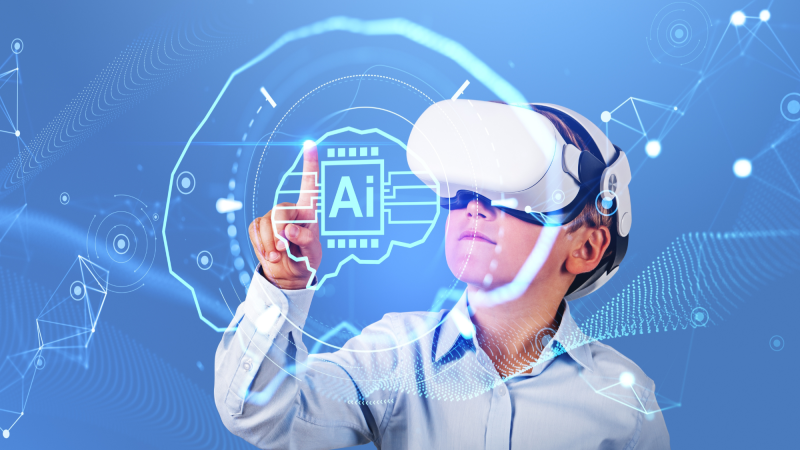
Early AI exposure has significant benefits. In kindergarten, children develop computational thinking skills by creating and debugging block-based code, which progresses to basic neural-network experiments by third grade.
Asking questions like “Why might this app misidentify my friend?” and incorporating ethics from the outset helps students see AI as a human tool with actual responsibilities rather than a mysterious Machine.
I see a huge possibility in education sector that can spark new businesses and makes a huge movement. Imagine a learning app that adjusts to each student’s speed and interests, a mobile tool that lets kids explore marine life data in real time, or a simple program where they design “smart” fabrics. These ideas can help students master skills they love and stay excited to learn.
With hands-on projects, students will connect automatically with community partners, designing chatbots or programming an application to guide museum visitors, creating predictive models for local food banks, or building sustainability dashboards for school gardens.
These real-world collaborations remind children that technology’s greatest gift is its power to serve others, while fostering critical thinking, creativity, collaboration and coding skills long before they enter the workforce.
Yet the road had holds challenges. Techniques teachers require executive up skiing to translate abstract AI contact and to play for lessons, without robust, ongoing professional development, some may struggle to engage very young leaders.
As screens and sensors flourish, we risk size lining tactile play and face-to-face collaboration, making it vital to balance digital experiments with hands on activities like gardening, art and support. Private institutions may pilot new tools faster, risking equality gaps…unless strategic investments ensure every school has an AI lab and trained staff.
To navigate these trade-offs educators must champion AI pedagogy workshops, co-develop curricula with industry mentors, and embed ethics checkpoints into every project.
Parents can turn to many AI labs that come with voice assistance, free coding apps and family photo pattern analysis, all while fostering dinner table debates on data privacy and algorithmic fairness.
Policymakers should prioritise equitable funding for AI infrastructure, under resource school commission longitude studies on learning outcomes and social well-being, and host public events that bring students, families and teach leaders together. Children are poised to enter a renaissance where lines could follow us really as lines in a storybook, and where empathy and ethics are woven into every algorithm.
By embracing AI early, yet to mindfully addressing risks, we can cultivate a generation that doesn’t just adapt to change but architects it, with curiosity, humanity and compassion.
When my younger brother proudly builds his own artificial intelligence chatbot at the age of seven, teaching it to respond to his questions about the cosmos and galaxy, I came to the realization that we are allowing children to create technology rather than merely teaching them how to use it.
Finger painting and firmware will coexist in UAE classrooms of the future, and our youngest innovators will develop not only a command of code but also a command of creativity, ethics, and identification. Greetings from the generation that, one algorithm at a time, will change our future.
What happens if your kindergartener is given a customized coding task at the conclusion of their play-dough session? AI will soon make it harder to distinguish between firmware and finger painting in UAE classrooms.

AlDhabi AlMheiri • Founder, Rainbow Chimney
AlDhabi AlMheiri is a young Emirati columnist, entrepreneur, and publisher as well as a Guinness... Read more