Witness to Power: Hadley Gamble’s Career Offers Lessons in Leadership and Media Strategy
Hadley Gamble
You're reading Entrepreneur Middle East, an international franchise of Entrepreneur Media.
In a career defined by high-stakes interviews and global turning points, Hadley Gamble reflects on resilience, authenticity, and the discipline required to lead — both on screen and beyond it.
Pinning Hadley Gamble down required a fair amount of patience.
We met at the 1 Billion Followers Summit in Dubai in early January, exchanged messages, and made a plan. That plan nearly dissolved during her time in Davos for WEF 2026, resurfaced briefly through a few hurried emails from the World Government Summit, and finally came together when she appeared on Zoom from the sidelines of the Microsoft AI Tour in Riyadh, Saudi Arabia – from there, she was preparing to fly to the Munich Security Conference.
“I’ll sometimes have two weeks in one place, but after about two weeks, I start to feel restless. I joke that I’m a bit of a Bedouin now, I need to move,” she says.
In her 20-year career as a broadcast journalist, Gamble’s dynamic and entrepreneurial character has rarely been suited to confinement within a television studio. Once, she spent four years in the anchor chair of a daily show- and ultimately found it limiting. “There’s something inherently inauthentic about a studio, everyone is perfectly made up, fixed in place,” she says. “I always wanted to be on the road, to be moving. Being in person, on location, has always been better.”
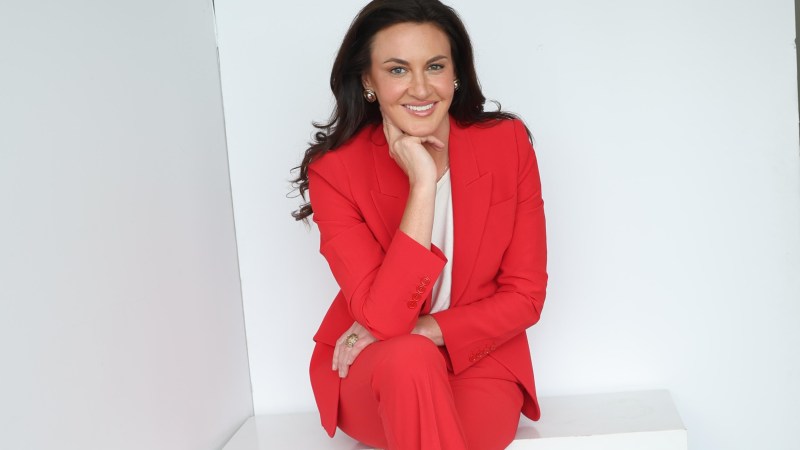
Gamble is currently Chief International Anchor at Abu Dhabi-based IMI, where she leads the development of high-profile interviews and original features across the group’s portfolio of media brands. The position represents a defining chapter in a career that began at ABC News and Fox News in Washington, DC, where she covered the 2008 US presidential debates, election night, and the inauguration of President Barack Obama, before being fundamentally redefined by her move to the Gulf in 2009.
“The turning point for me was leaving Washington and coming to the region,” she says. “It was career-making and defining. It simply was.” Her colleagues in Washington questioned her decision to move, with one senior editor suggesting the Gulf was not the “real” Middle East. Yet, the then 27-year-old Gamble saw it differently, viewing Abu Dhabi, Riyadh, and Doha as emerging centers of power.
“In the early years, there was the whole narrative about when we would hit peak oil, green energy, and who was going to control that. And I just thought it was funny, like never count the Gulf out,” she says. “First of all, they controlled the energy of the world for a century, and now they’re investing in green energy, green hydrogen, and all these new technologies as well. The data centers are an extension of their ability to be farsighted enough not only to survive, but to thrive. So they own the energy of now, and they’ll own the energy of the future. I find that rather brilliant.”
The UAE, particularly Dubai and Abu Dhabi, has positioned itself as a regional media hub, with broadcast journalism becoming a fiercely competitive, multinational arena. Within that landscape, Gamble distinguished herself by focusing on the intersection of energy, geopoli- tics, financial markets, and global business, examining how political and economic forces shape both regional and global outcomes. “Business leaders often prefer to stay away from politics. They don’t want controversy or complications with governments, and it’s understandable,” Gamble says. “But in recent years, geopolitics has moved to the top of the crisis-management agenda for CEOs and corporations. The intersection of energy, politics, trade wars, and government policy has become central to business strategy, and it has always interested me.”
Gamble adds that while programming demands often shape coverage priorities, she consistently advocated for editorial focus on the interdependence between geopolitical decisions and market outcomes. “I’ve fought to pursue those stories because they have longevity, they have longer legs,” she says. “They also allow you to build deeper relationships with people in government and business. Over time, they recognize your genuine interest in the subject, and that leads to better conversations and more meaningful interviews. It happens naturally when the passion is real.”
Here, Gamble underscores that cultivating credibility through face-to-face engagement in the GCC carried particular significance as it influenced not only her editorial access and outcomes, but also contributed to shaping broader media narratives about the region. “In the early years in the Gulf, many leaders were advised never to speak to the press. I don’t think that was the right approach. If you have nothing to say, then don’t do an interview—that’s fair. But if you are a business or a government entity with a message, you should be able to articulate who you are, what you do, and what you stand for,” she says.
“Over time, there’s been a shift. Leaders in the region are now much more open to interviews and more accepting of critical questioning. They understand that constructive pushback is not a personal attack. There’s a clear difference between thoughtful, critical journalism and hostile attacks.”
Therefore, Gamble advises leaders to avoid being “overly media- trained,” arguing that “it is a shame that, in an era that rewards authenticity, governments and businesses pay for advice that directly contravenes this.” She adds, “The region has a strong story to tell. It’s not perfect, but it’s significant. And if you have a story, you should tell it yourself. No one else should define your narrative for you.”
Now, Gamble is well positioned to offer guidance not only to leaders and their communications teams, but also to journalists — sharing insights into the craft behind her meaningful reporting. “Read everything, talk to everybody, ask people what they want to know from these people,’ she says. “Also, simple questions usually get the most telling answers. They are the story, how they think, feel, look, speak. Don’t get in the way of that – amplify it.”
Another — and, in her view, even more important — piece of advice is simple: “Keep talking, keep moving.”
She says, “Sometimes, someone will say something so egregious or outrageous that you can’t quite believe it, so you try to keep your composure. Occasionally you’ll laugh, because it’s human. And I think, thankfully, audiences are looking for authenticity now, rather than a very wooden, dry, down-the-middle broadcast. That style is fading, and it’s much more interesting to watch something that feels real.
“It’s your job to get as much out of them as you can in a very limited amount of time. You never know how long the interview will be, and it’s not guaranteed you’ll get anything usable. So you have to be laser-focused and keep moving. Otherwise, you miss the opportunity, and it doesn’t come around again.”
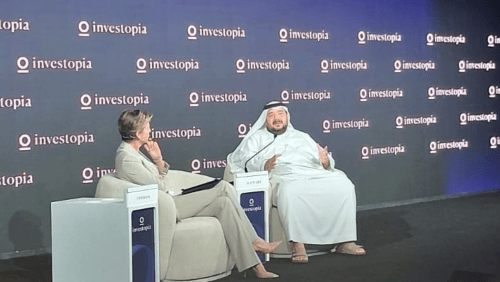
Hadley frequently hosts high-level international panels with some of the most influential figures in politics and business, including at the previously mentioned World Economic Forum in Davos and the Munich Security Conference. Career highlights also include opening the 2022 NATO Summit in Madrid with an interview with NATO Secretary General Jens Stoltenberg and moderating Saudi Arabia’s first women’s business forum.
Central to her mastery in moderating panels, she explains, is the ability to bring the audience along with her — a skill that depends on understanding who they are and what resonates with them. “A World Government Summit audience is completely different from an ADIPEC audience in oil and gas,” Gamble explains. “All that the latter wants to know is how the global situation is going to impact their product and their profit. Whereas at the World Government Summit, it’s more big-picture and esoteric — what’s going to drive the next green revolution, the next big idea, OpenAI, or whatever comes next.”
No account of Gamble’s career to date would be complete without reference to her widely covered panel with Russian President Vladimir Putin at Russian Energy Week in Moscow. It effectively made Gamble, then an anchor at CNBC, the last Western journalist to interview him before the outbreak of the war in Ukraine. Putin firmly denied that Russia was using energy as a political weapon amid Europe’s mounting gas crisis. “It was in October 2021 which made it a particularly interesting moment,” Gamble recalls. “Russians had already started restricting the amount of gas allowed through the pipelines to Europe, and European gas prices were spiking. There was still some question over whether he would invade Ukraine, but the 90,000 troops hadn’t yet been positioned at the border, so the focus was more on gas prices at the time.”
“In those days before the invasion, many people, including me, still didn’t think he would go through with it,” she continues. “I assumed the economic cost of leaving the global financial system would be too high. Why accelerate becoming economically dependent elsewhere? But I think many underestimated his determination around NATO expansion and his belief that his concerns weren’t being taken seriously.”
In the months leading up to the invasion of Ukraine, Gamble immersed herself in the story, cultivating close relationships with Ukrainian sources and reporting extensively from the ground. “I actually flew myself to a meeting between the Ukrainian Foreign Minister and the NATO Secretary General, whom I had known and interviewed for years,” she says. “Most people had already gone on Christmas break, the management wasn’t particularly interested in the interview, but I insisted on going. I paid to fly there myself, and they rented basic equipment for me.”
“I secured two interviews that I did at 5:30 in the morning in a poor hotel setup, with mismatched cameras,” Gamble recalls. “One was with the Ukrainian Foreign Minister Dmitro Kuleba who warned that Ukraine would end up fighting Europe’s war on its own territory which, of course, is what happened. The interview turned out to be incredibly prescient. What he described unfolded almost exactly as he said it would.”
She continued to report on the Russia-Ukraine conflict, including a high-profile interview with NATO Secretary General Jens Stoltenberg. However, despite the time she had invested on the ground in Ukraine prior to the invasion, CNBC ultimately chose not to assign her to cover the outbreak of the war. “I was told, quite bluntly, ‘We don’t send business journalists to cover wars.’”
By that stage, after months on the road, she had chosen to briefly step back. Yet when the invasion began, she was immediately on the phone with Ukraine’s Foreign Minister in what became the first interview with a Ukrainian official on Western media following the outbreak of the war. “The channel started taking me live across various programs. I called my boss to ask to go to Russia. For some reason, it didn’t fully register that Russia might be just as dangerous, if not more so, given press freedom concerns. But I didn’t care about that. I just wanted to be where the story was unfolding.”
She boarded one of the last flights into Russia before the airspace closed and proceeded to report live for two consecutive weeks across US programming and international broadcasts. “It was a fragile atmosphere in Moscow. US companies were announcing their exits, and people were cautious about what they said. At one point, I was broadcasting from Moscow while the Ukrainian foreign minister was speaking from an undisclosed location in Ukraine. In television terms, those are the moments when you feel completely inside the story,” Gamble says.
“But after about ten days, the pressure intensified. There were instructions not to call it a war or to avoid using certain words. I said we wouldn’t conduct interviews if we couldn’t use real words. Ultimately, we decided to pull out. It was an intense and extraordinary period.”
With this track record of high-impact television journalism, Gamble is well positioned to assess the state of today’s media landscape. In her view, audiences now expect a multiplatform, on-demand experience — and while traditional television in its old form may be fading, the appetite for quality-driven content remains strong. She adds, “I think diversity of voices has to be actively pushed. In traditional media, simply having people from different places doesn’t automatically mean you’re getting different perspectives. If everyone was trained in the same institutions and thinks in the same way, the narrative won’t necessarily change. True diversity is about diversity of thought and worldview, not just background.”
Drawing on her experience, Gamble believes that success in television starts with authenticity. ”The networks have a tendency to produce presenters who look the same, sound the same, and are inter- changeable,” she says. “From a management perspective, that can feel efficient: if one person leaves, another can step in and replicate the same style. But that uniformity doesn’t necessarily resonate with audiences. Over the past decade or more, what has truly connected with people are distinct personalities. Whether audiences agree or disagree with them, those are the individuals who stay with you. They feel memorable because they’re not interchangeable.”
But, Gamble adds, success in television ultimately rests on hard work. “I was never going to be the prettiest or the smartest, but I worked the hardest,” she says. “If you do that, even in corporate media, that’s hard to take away from you. Be the one who works the hardest and stays until the job is done. Even if you’re not the favored reporter, people recognize reliability. These days, that matters even more. Newsrooms are smaller. There aren’t enough people to do the work. You can’t just be a figurehead—you have to show up and deliver.”
Her future plans include On the Record interviews, which are traditional, high-level conversations with major CEOs and global newsmakers that will run across all IMI platforms, as well as the Reality Check with Hadley Gamble podcast, featuring exclusive, in-depth discussions.
In conclusion, Gamble reflects on her career with a sense of grounded clarity about what she has built so far.
“I know who I am as a journalist. I don’t feel the need to want someone else’s career or trajectory,” Gamble says. “Part of that comes with age, of course, but it’s also experience. Once you’ve put in the work and achieved what you set out to do, there’s a stabilizing feeling that comes with it. Accomplishment isn’t external — it’s internal. You know when you’ve earned it.
“Especially for women, I think that confidence changes how decisions are made,” she adds. “They become more balanced, more grounded. You operate from a position of strength rather than comparison. You can appreciate what others are doing without feeling diminished by it.
“Moving to the GCC region was part of that evolution for me,” Gamble concludes. “I’ve been fortunate to work across different markets and environments, and I believe growth and reinvention are healthy. Progress and evolution are good for all of us.”
In a career defined by high-stakes interviews and global turning points, Hadley Gamble reflects on resilience, authenticity, and the discipline required to lead — both on screen and beyond it.
Pinning Hadley Gamble down required a fair amount of patience.
We met at the 1 Billion Followers Summit in Dubai in early January, exchanged messages, and made a plan. That plan nearly dissolved during her time in Davos for WEF 2026, resurfaced briefly through a few hurried emails from the World Government Summit, and finally came together when she appeared on Zoom from the sidelines of the Microsoft AI Tour in Riyadh, Saudi Arabia – from there, she was preparing to fly to the Munich Security Conference.
“I’ll sometimes have two weeks in one place, but after about two weeks, I start to feel restless. I joke that I’m a bit of a Bedouin now, I need to move,” she says.
In her 20-year career as a broadcast journalist, Gamble’s dynamic and entrepreneurial character has rarely been suited to confinement within a television studio. Once, she spent four years in the anchor chair of a daily show- and ultimately found it limiting. “There’s something inherently inauthentic about a studio, everyone is perfectly made up, fixed in place,” she says. “I always wanted to be on the road, to be moving. Being in person, on location, has always been better.”
Gamble is currently Chief International Anchor at Abu Dhabi-based IMI, where she leads the development of high-profile interviews and original features across the group’s portfolio of media brands. The position represents a defining chapter in a career that began at ABC News and Fox News in Washington, DC, where she covered the 2008 US presidential debates, election night, and the inauguration of President Barack Obama, before being fundamentally redefined by her move to the Gulf in 2009.

Tamara Pupic • Editor in Chief, Entrepreneur Middle East
Entrepreneur Staff
Tamara Pupic is the Editor in Chief of Entrepreneur Middle East.