Inside VentureOne: How Abu Dhabi’s Venture Builder Is Advancing Purpose-Driven Deep Tech
Reda Nidhakou, CEO of Abu Dhabi-based venture builder VentureOne, says the deep technology solutions that will stand the test of time are not necessarily those built on novelty and perfection, but something much simpler.
You're reading Entrepreneur Middle East, an international franchise of Entrepreneur Media.

There is a word that often appears when leaders and entrepreneurs in technology share their visions: innovation. Yet when Reda Nidhakou discusses the operations of VentureOne, the venture building arm of the Abu Dhabi government’s Advanced Technology Research Council (ATRC), he uses the word sparingly. As the CEO of an entity that helps transform tech research and development (R&D) into scalable companies, Nidhakou’s measured usage of the word becomes even more significant when reports like that of GitNux’s Market Data Report 2026 show that “nations are racing to out-innovate each other, with over two and a half trillion dollars funneled into global R&D last year alone.”
“Technology cannot advance purely on the strength of its science,” Nidhakou says. “A lot of research fails to go to market not from lack of brilliance, but from a gap between technical excellence and real-world deployment. Something that is truly market-ready starts with a validated problem: Research that begins by examining a genuine, costly, unmet need – rather than chasing technological novelty – is far more likely to find customers. Technology must also survive the last mile to market. Even when it meets a clear need, deployment is complex, and prototypes often quietly fail at this stage. At ATRC and VentureOne, we address this by co-developing solutions alongside real clients from day one, stress-testing them in operational conditions, and refining them through real-time feedback. Technology solutions are also engineered to scale from the start. Modular, adaptable solutions that can extend across sectors, geographies, and platforms are built very differently from those designed for a single use case. We prioritize technologies with broad ambition.”
Nidhakou’s approach, and indeed that of VentureOne, are aligned with what the current statistics promise. According to StartUS Insights’ Deep Tech Market Report 2026, Europe alone could generate up to US$1 trillion in deep tech enterprise value and create as many as one million jobs — but only “if research intensity can be translated into scalable companies.” With similar potential in the deep-tech ecosystem, it is in the latter half of that statistic where VentureOne operates. “Not every research project succeeds, and not every successful project becomes competitive enough to build a company around,” Nidhakou says. “Our role is to identify the technologies that can become viable ventures: Products that work outside the lab and solve pressing industry problems, that have the right cost structure, and that can scale internationally. Part of this process is studying our right to win, the competitive landscape, and the scalability of a solution beyond one client or one country.”

“Our methodology is not about creating as many ventures as possible,” he adds. “It is about solving the right problems, by turning technology into solutions, and only then deciding whether they should become companies. Rather than launching 20 ventures for the sake of numbers, we’ve deliberately focused on a smaller number of ventures with real impact.”
Currently, four different ventures born out of VentureOne offer prime examples of the entity’s vision: ai71, a company that develops AI-powered enterprise productivity solutions; SteerAI, which is powering the offroad autonomy transition; QuantumGate, a cybersecurity venture that helps organizations protect their data assets for the post-quantum world; and Nabat, a climate tech venture that enables scalable, data-driven ecosystem conservation and restoration.

“For us, success means leaving an impact in the sectors we enter while building businesses that can stand on their own,” Nidhakou explains. “Our vision is to use game-changing deep tech to transform industries and make a tangible positive impact. As I mentioned, VentureOne is part of ATRC, which is designed to operate as a single, integrated system to accelerate deep tech.”
ASPIRE, ATRC’s business development arm, sources real-world industry challenges from end users. The Technology Innovation Institute (TII), ATRC’s applied research arm, develops tech solutions in close collaboration with those users. VentureOne then takes those solutions to market as products and companies.
“This model ensures we are building from validated demand, which significantly reduces the gap between development and deployment,” he says.
He adds that VentureOne’s holistic approach sets the entity apart from conventional venture capital (VC) investors and startup incubators. “In our case, we don’t start with startups; we start with problems. We look at what the UAE needs, determine what challenges we can solve, and then build solutions around those. That’s a much more intentional process. It’s not about identifying a good idea and supporting it. We aim to design the right solution from the ground up.”

“One of the structural advantages of the VentureOne model is access to early-stage government-backed funding through ATRC,” Nidhakou adds. “This initial funding gives each startup the runway to validate its technology, hire the right people quickly, and iterate. This is done without the distraction and dilution that typically defines the early stages of a startup. This approach is particularly well-suited to deep tech. These technologies require time, coordination, and clear direction. By aligning industry challenges, research, funding, and execution from the outset, we’re able to build ventures with a stronger foundation and a clearer path to scale.”
The proof, of course, speaks for itself. The clearest validation of VentureOne’s model appears in how the aforementioned four ventures have grown. “Our ventures are showing strong real-world adoption signals so far,” Nidhakou says. “ai71’s talent has grown from 40 to over 200 and has made agreements with several clients. QuantumGate solutions are actively being deployed national across critical infrastructure projects. SteerAI has signed a handful of local partnerships and already added to their product lineup. Nabat has partnered with the Environment Agency – Abu Dhabi (EAD) on a multi-year contract as part of the Abu Dhabi Mangrove Initiative.”
Nidhakou got the opportunity to observe a different side of the tech industry when he also took on the role of CEO at Nabat in 2025. “This has given me a different vantage point on the UAE’s AI ecosystem,” he says. “What strikes me is how much genuine appetite exists at the government and institutional level for AI to be applied to real environmental and societal challenges and not just productivity or efficiency gains. Nabat’s partnership with EAD reflects serious national commitment to using advanced technology in service of long-term climate resilience. That combination of government mandate and technical ambition creates ideal conditions for powerful AI deployment.”

Such deep experience has allowed the VentureOne team to better observe the pitfalls in scaling deep-tech ventures. “The challenges that derail deep-tech ventures at scale tend to be organizational and relational rather than technical, and yet they often aren’t addressed with the same rigor as the tech itself,” Nidhakou says. “Three key challenges stand out: The first is client inertia at the integration layer: enterprises and governments are often convinced by the technology, but challenged by the operational complexity of embedding it. The second is talent continuity under growth pressure as scaling quickly creates a temptation to hire quickly, but the wrong people in small, high-stakes teams can cause disproportionate damage. The third is the credibility gap between proof-of-concept and procurement. Government buyers in particular require extensive validation before moving from trial to contract.”
Unsurprisingly, the VentureOne and ATRC teams have taken considerable measures to address these three hindrances. “The ATRC ecosystem’s stable early funding removes the survival anxiety that forces premature commercialization decisions, buying ventures the runway to get integration right,” Nidhakou says. “And national alignment functions as a credibility accelerant: A venture operating inside a government program arrives at procurement conversations with institutional endorsement already established. Additionally, having engineering teams work directly with clients through the deployment phase helps dissolve the integration inertia problem.”

Amid all the nitty gritty of deep tech scaling, however, there is one inherent quality of the industry that can sometimes supersede all other efforts: the pace of change. But for this too, VentureOne has incorporated relevant measures. “Technology will always move quickly,” says Nidhakou. “VentureOne ensures our ventures are designed to evolve and scale through a multifaceted approach: First, we start with problems, not tech capabilities, co-designing solutions with partners to ensure that we’re addressing real-world problems. We also ensure our solutions are modular. If you build a large, fixed system, it becomes outdated by the time it’s deployed. We build solutions with components that are designed to evolve, extend, and adapt over time. A good example of this is CoreX, SteerAI’s autonomous driving system, which is designed to integrate into existing vehicles, meaning users can deploy autonomy gradually, without replacing entire fleets.”
Nidhakou makes what may be the most profound statement in this interview when he talks about the role of a leader turning technology in the lab into a scalable, market-ready company. “Good tech leaders can build, but exceptional ones can translate: between the rigor of research and the complexity of a real customer; between what the technology can do and what the market needs right now; and between a team of brilliant specialists and a coherent organization moving in one direction. That translation capacity, more than any domain expertise, determines whether technology leaves the lab,” he says.
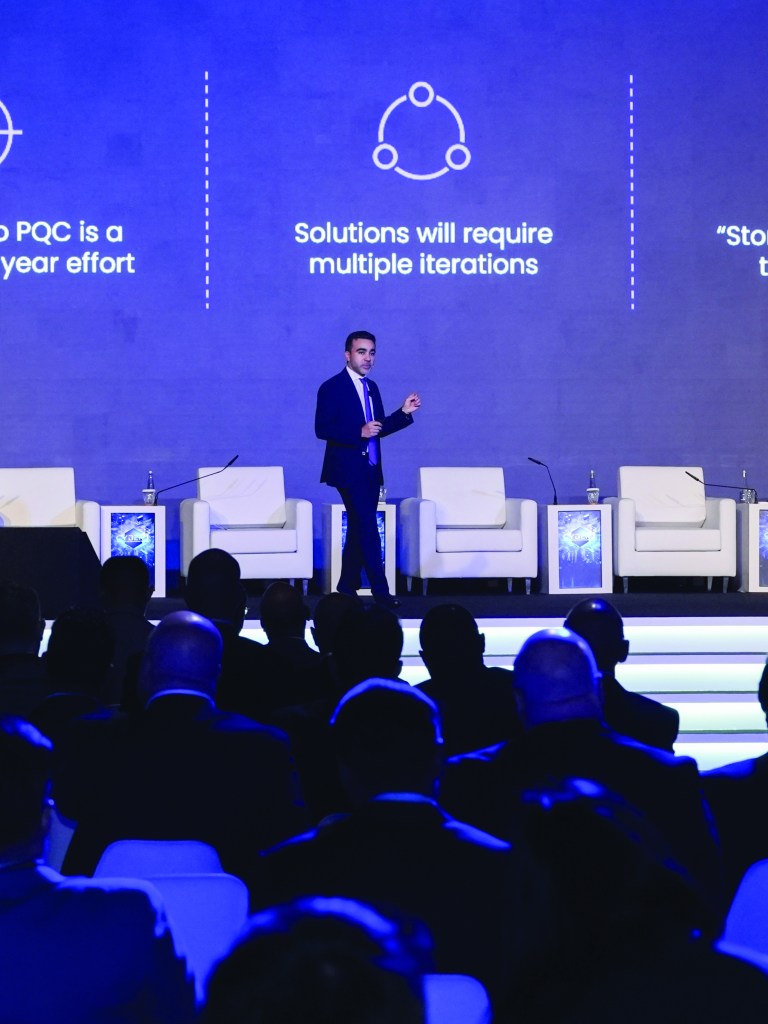
There is some poignance when he adds that shifting an idea from research to market is also fundamentally an act of repeated letting go.
“It’s letting go of perfection in favor of feedback, of the instinct to solve a problem completely before sharing the solution, and of the assumption that a solution’s technical merit is obvious. The leaders who navigate this well tend to have developed a high tolerance for ambiguity while maintaining standards. Operating across multiple ventures creates constant exposure to how others navigate the realities of deployment, customer pressure, and commercialization. Our leaders are learning from each other in real time, which accelerates growth, building business judgment and technical expertise in parallel.”
As Nidhakou and his team now prepare for the rest of 2026, the CEO shares that the VentureOne fundamentals will remain unchanged. “In the near term, the focus is on continuing to build in a disciplined way,” he says. “We’ve started with over 100 opportunities and narrowed to about five venture candidates that we are now pursuing at full speed.”
He explains that upcoming ventures will take on productivity and safety challenges in logistics, lack of transparency in financial transactions, water security, and other issues. He says their goal is to focus on the right ventures—the ones solving real problems and that have the potential to scale internationally—rather than build as many as possible. VentureOne is also continuing to grow the ventures they have already launched, working closely with partners, and expanding into new markets.
“Our ambition is for VentureOne to consistently launch high-impact technology businesses, export Abu Dhabi tech to the world, and deliver real, measurable impact.”

‘TREP TALK: Reda Nidhakou, CEO of VentureOne, shares three lessons he’s learnt about incubating deep-tech companies from early-stage research to real-world deployment
LESSON #1 “The distance between an excellent tech innovation and a deployable product is not a gap you can engineer your way across. It requires sustained proximity to the people who will actually use what you’ve built – their operational realities, their institutional constraints, and their definition of success, which is often not the same as yours. Every venture we’ve built has been shaped as much by that ongoing client relationship as any internal roadmap.”
LESSON #2 “The importance of pace. In deep tech, often the instinct is to wait until something is ready before showing it. We actively resist that instinct. Showing something real and imperfect with the end user early builds a fundamentally different relationship than presenting a finished system. It creates co-ownership, and it surfaces the misalignments that would otherwise become expensive to fix six months later.”
LESSON #3 “Then there’s talent. Not just attracting it, but protecting it through the hard phases. The period between proof-of-concept and the first real contract is when the pressure to deliver is the highest. The teams that hold together through that phase do so through a shared sense of purpose and vision, which I would say is a condition for survival.”
There is a word that often appears when leaders and entrepreneurs in technology share their visions: innovation. Yet when Reda Nidhakou discusses the operations of VentureOne, the venture building arm of the Abu Dhabi government’s Advanced Technology Research Council (ATRC), he uses the word sparingly. As the CEO of an entity that helps transform tech research and development (R&D) into scalable companies, Nidhakou’s measured usage of the word becomes even more significant when reports like that of GitNux’s Market Data Report 2026 show that “nations are racing to out-innovate each other, with over two and a half trillion dollars funneled into global R&D last year alone.”
“Technology cannot advance purely on the strength of its science,” Nidhakou says. “A lot of research fails to go to market not from lack of brilliance, but from a gap between technical excellence and real-world deployment. Something that is truly market-ready starts with a validated problem: Research that begins by examining a genuine, costly, unmet need – rather than chasing technological novelty – is far more likely to find customers. Technology must also survive the last mile to market. Even when it meets a clear need, deployment is complex, and prototypes often quietly fail at this stage. At ATRC and VentureOne, we address this by co-developing solutions alongside real clients from day one, stress-testing them in operational conditions, and refining them through real-time feedback. Technology solutions are also engineered to scale from the start. Modular, adaptable solutions that can extend across sectors, geographies, and platforms are built very differently from those designed for a single use case. We prioritize technologies with broad ambition.”
Nidhakou’s approach, and indeed that of VentureOne, are aligned with what the current statistics promise. According to StartUS Insights’ Deep Tech Market Report 2026, Europe alone could generate up to US$1 trillion in deep tech enterprise value and create as many as one million jobs — but only “if research intensity can be translated into scalable companies.” With similar potential in the deep-tech ecosystem, it is in the latter half of that statistic where VentureOne operates. “Not every research project succeeds, and not every successful project becomes competitive enough to build a company around,” Nidhakou says. “Our role is to identify the technologies that can become viable ventures: Products that work outside the lab and solve pressing industry problems, that have the right cost structure, and that can scale internationally. Part of this process is studying our right to win, the competitive landscape, and the scalability of a solution beyond one client or one country.”

Aalia Mehreen Ahmed • Senior Features Editor, Entrepreneur Middle East
Entrepreneur Staff
Aalia Mehreen Ahmed is the Senior Features Editor at Entrepreneur Middle East. She is an... Read more