Position of Strength: How Abbas Sajwani Became One of the Youngest Billionaires in Global Real Estate
Abbas Sajwani built AHS Properties into one of Dubai’s most formidable ultra-luxury developers in less than five years. As the region navigates through a period of geopolitical tension, the youngest billionaire in global real estate has a clear vision for international investors: the window you are waiting for doesn’t exist.
You're reading Entrepreneur Middle East, an international franchise of Entrepreneur Media.
This article is part of the cover story for the Entrepreneur Real Estate Leaders May 2026 Edition.
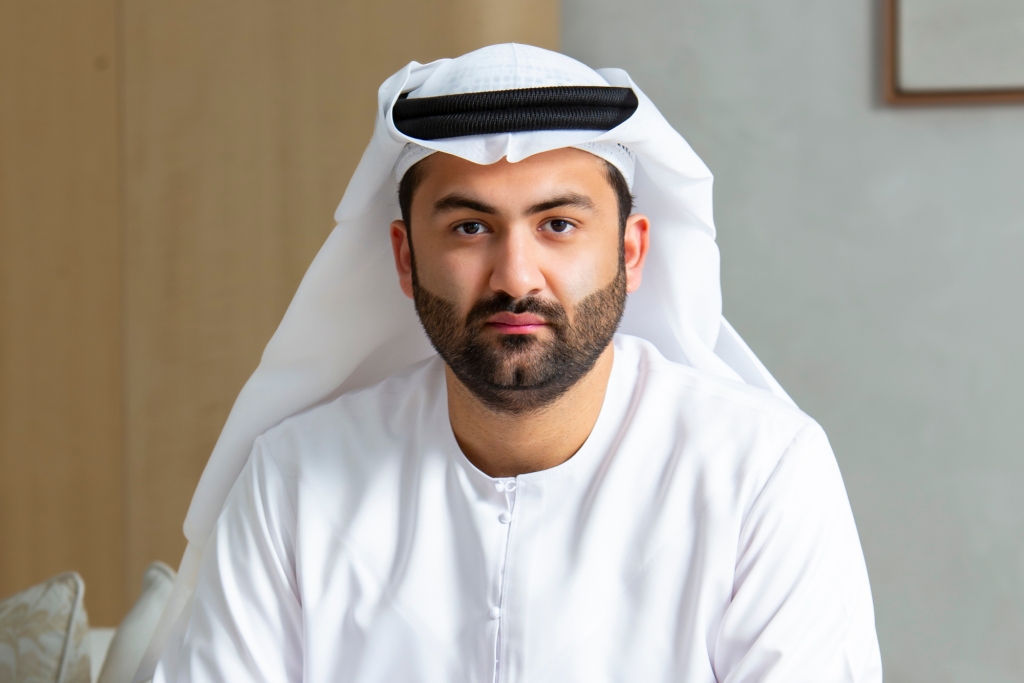
There is a particular kind of confidence that only comes from having seen a market perform under pressure. Abbas Sajwani, the 26-year-old Founder and CEO of AHS Properties, has that confidence in abundance – and the numbers to back it up. In a city that recorded AED 917 billion in real estate transactions in 2025 alone, where residential sales prices surged by 20 per cent in a single year and where 130,000 new investors entered the market – up 55 per cent year-on-year – Sajwani has managed to carve out a position at the very apex of the market.
Founded in 2021, AHS Properties has grown its gross development value to more than $3.3 billion in less than five years, with a portfolio that stretches across the most coveted addresses in Dubai: Palm Jumeirah, Emirates Hills Sheikh Zayed Road, and the Dubai Water Canal. Projects such as One Crescent – a $250 million development that sold out within a week of launch – and Casa Canal with interiors by Fendi Casa, an $850 million statement of intent that shifted 80 per cent of its units within days, has made AHS Properties one of the most talked about names in ultra-luxury real estate globally. Sajwani has also just sold out AHS Tower, a Grade-A commercial building on Sheikh Zayed Road, marking the company’s expansion beyond the residential segment. Not bad for a development company only five years in operation.
But Dubai’s record-breaking run has not been without its tests. The recent period of regional geopolitical tension sent tremors through global markets, prompting some investors to pause, reassess and, in some cases, look elsewhere. For a market that has built much of its momentum on the confidence of international capital – Europeans have been among AHS Properties’ biggest buyers in recent years, relocating to Dubai full-time rather than treating it as a secondary home – the question of how the market responds to external factors is not merely academic. It is existential.
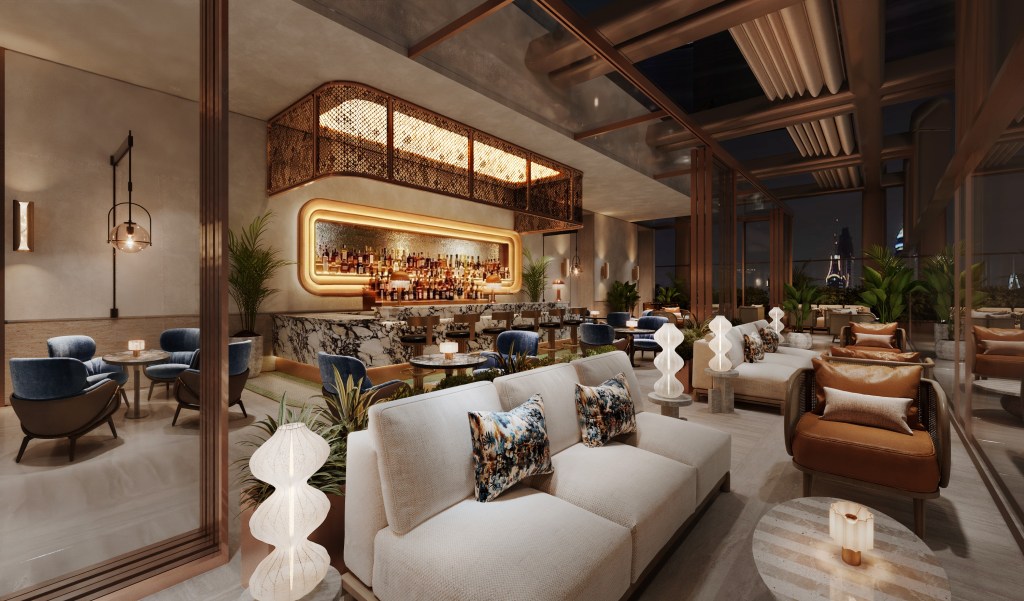
For Sajwani, the answer has been written not in commentary but in completed transactions. Seated in the AHS Sales Gallery at City Walk – a carefully curated space designed to embody the developer’s ethos of quality and refinement – he is characteristically measured in his assessment of recent events. But the conviction beneath the calm is unmistakable.
“The UAE today is not only resilient, it is structurally more mature than in previous cycles,” he says. “In previous downturns, Dubai was still proving itself. Today, it’s already proven. What you’re seeing now is how it behaves under pressure.”
It is a view rooted in a decade of watching Dubai transform from a market that was still earning its credibility into one of the world’s most closely watched investment destinations. The numbers tell that story with unusual clarity. In the first half of 2025 alone, Dubai’s real estate sector recorded AED 431 billion in transactions – a 25 per cent increase on the same period in 2024 – attracting close to 95,000 investors and welcoming 59,000 first-time entrants into the market. Residential sales prices climbed a further 16.6 per cent year-on-year. The city’s population has now reached 3.97 million, growing at 5.5 per cent annually, and 8.68 million overnight visitors arrived in just the first five months of 2025. On almost every metric that matters, the trajectory has been one of acceleration, not retreat.
What makes Sajwani’s perspective particularly valuable is that he operates at the segment of the market most exposed to sentiment – and least dependent on it. Ultraluxury real estate is, by its nature, driven by allocation decisions made by high-net-worth individuals who have already made up their minds about Dubai as a jurisdiction. When markets wobble, the question is not whether they still want to be here; it is whether they’ll still act. And the answer, he says, was unambiguous.
“It proved something simple: the top of the market doesn’t flinch,” he says. “We didn’t see panic. We saw continuity. Deals still closed, conversations didn’t stop, and serious buyers stayed engaged. That tells you demand isn’t momentum-driven – it’s allocation-driven. The difference is important. Momentum disappears quickly. Allocation doesn’t.”
This distinction matters enormously for understanding the current moment. Dubai has, at various points in its history, been accused of being a market built on narrative – of hype and speculation rather than genuine structural foundations. That accusation has become harder and harder to sustain. The Dubai 2040 Urban Master Plan provides a clear 20-year framework for the city’s development. The D33 Economic Agenda targets doubling the size of the economy by 2033. Infrastructure investment is accelerating. The regulatory environment is becoming more transparent.
For Sajwani, those fundamentals are the story. Not the headlines. “Nothing changed … and that’s the point,” he says plainly. “Population is growing. Capital is entering. Policy is consistent. Infrastructure is accelerating. If you strip away the headlines, the underlying system is doing exactly what it was doing before. Markets don’t correct because of noise – they correct when fundamentals break. And here, they didn’t. If anything, moments like this reinforce confidence because they show the system holds under stress.
AHS Properties is itself a living demonstration of that thesis. When Sajwani launched the company in 2021, he did so against a backdrop of post-pandemic uncertainty and lingering questions about whether Dubai had finally run out of road. He was 22 years old. He started with luxury villas on Palm Jumeirah and Emirates Hills, renovating and repositioning them with an architectural precision that would come to define the AHS brand. Within three years, he had expanded into landmark residential developments in partnership with Fendi Casa, sold out a commercial tower on Sheikh Zayed Road, and assembled a portfolio with a GDV of over $3.3 billion. Now, he is recognised as the youngest billionaire in global real estate.
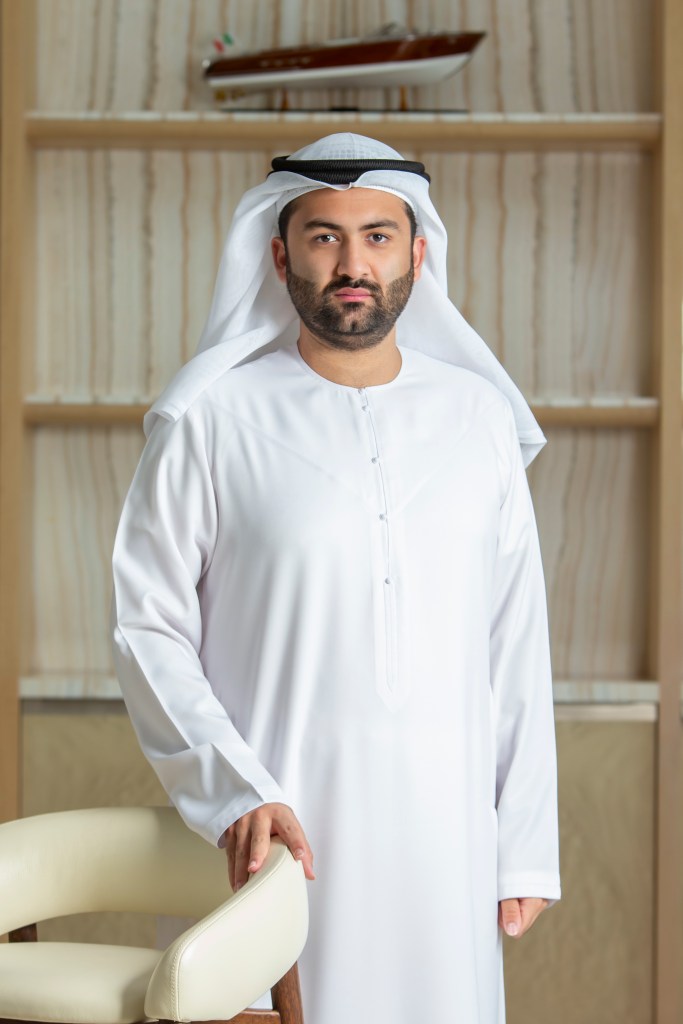
The scale of that achievement makes his view on the current geopolitical situation more than just another developer’s bullish take. He has built a business specifically designed to succeed in the part of the market where confidence is the product – and he has seen that confidence hold.
“What surprised me most wasn’t that activity continued – it’s how calm it was,” he says. “Buyers in the ultra-prime segment are not reacting to headlines. Over the past 45 days, we’ve recorded close to AED 1 billion in transactions. That’s not theoretical demand – that’s executed capital.”
One of the less-discussed dimensions of Dubai’s resilience is the speed at which its government moves. In many established Western markets, policy responses to external shocks can take months to materialise. In Dubai, the rhythm is measurably different. Regulatory clarity arrives quickly. Investor visa frameworks are adjusted to attract the right people. The infrastructure pipeline doesn’t pause. For a developer making long-horizon bets on where capital will flow next, that responsiveness is not merely a convenience – it is a core part of the investment case.
“Speed creates confidence,” Sajwani says. “In most markets, uncertainty lingers because decisions take time. Here, clarity comes quickly – and that changes how everyone behaves. As a developer, that means we don’t hesitate. We continue building, deploying, and planning. And globally, investors notice that. They’re not just investing in real estate … they’re investing in how a system responds under pressure. Dubai consistently answers faster than other markets. That’s a competitive advantage.”
That advantage is becoming increasingly visible in the global conversation about where serious capital belongs. For much of the past decade, Dubai’s pitch to international investors rested heavily on its tax efficiency – a compelling but ultimately limited argument in a world where many jurisdictions offer competitive fiscal regimes. The city has now, Sajwani argues, moved well beyond that narrative.
“This is one of the few places where capital can move at the same speed as ambition,” he says. “In most legacy markets, friction is the problem – regulation, timelines, approvals. Here, execution is fast. Capital today isn’t just chasing returns – it’s chasing environments where decisions can actually be implemented. Dubai has moved beyond the ‘taxefficient’ narrative. It’s now about velocity, clarity, and certainty. That combination is rare and that’s why capital keeps returning.”
The data supports the argument. According to the Dubai Land Department, the first half of 2025 saw AED 326 billion in real estate investments – a 39 per cent increase in value compared to the same period in 2024 – made by close to 95,000 investors. Office rents in the emirate rose 17 per cent year-on-year in 2024, driven by multinationals relocating their regional headquarters. In 2025 alone, more than 250,000 new companies were established in the UAE, bringing the total number of operating businesses to 1.4 million. This is not the profile of a market in retreat; it is the profile of a market in serious, sustained expansion.
For Sajwani, those statistics translate directly into opportunity – and into a very specific message for those investors who paused during the recent period of uncertainty.
“Pausing isn’t the mistake. Staying paused is,” he says. “The biggest risk in markets like this isn’t being wrong. It’s being late. By the time a market feels ‘safe’ again, pricing has already moved. Every cycle rewards the same behaviour: the people who act when it’s unclear, not when it’s obvious. So my message is simple. Don’t follow confidence, anticipate it.”
It is a message, he adds, that applies particularly to the ultra-prime segment that AHS Properties occupies. Dubai’s overall residential market is broad and increasingly mature, offering entry points across a wide range of price levels. But at the very top – in the AED 20 million-plus tier where AHS Properties operates, where 32-unit developments like the forthcoming Casa AHS offer Sky Villas and Sky Palaces with private infinity pools over the Dubai Water Canal, where penthouses and sky mansions at One Crescent look out across the Palm – supply is structurally constrained in a way that insulates pricing from the kind of downward pressure that affects the broader market.
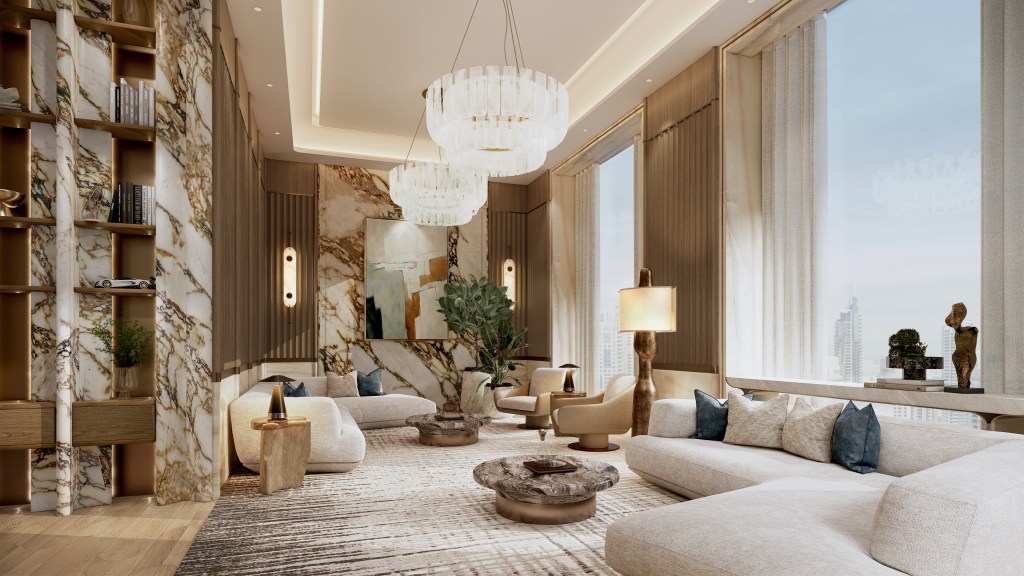
AHS Properties was named Dubai’s number-one developer for premium residential sales valued between $5 million and $10 million in 2024. Its projects – designed in collaboration with some of the most prestigious names in global architecture and interiors, including Killa Design, Hirsch Bedner Associates, and Fendi Casa – have consistently sold out before or shortly after launch. The pipeline is expanding: alongside the residential portfolio, AHS Properties has recently acquired a prime plot on Sheikh Zayed Road earmarked for a mixed-use development combining commercial, residential, hospitality and retail – a response to what Sajwani sees as a fundamental shift in how Dubai’s residents want to live.
He is, for now, keeping his conviction focused. When asked where he is placing his bets for the next 24 months, he is characteristically precise.
“Ultra-prime, but more importantly, ultra-selective,” he says. “The next phase of this market isn’t about volume. It’s about differentiation. The gap between average and exceptional assets is going to widen significantly. We’re focused on projects that feel like long-term legacy positions, not just developments. At the top end, buyers aren’t just purchasing real estate. They’re securing position … position globally, socially, and financially. That’s where my conviction sits.”
It is, in many ways, the same conviction that led Sajwani to launch AHS Properties in the first place: a belief that the most durable markets are not built on cycles but on consistency, and that the UAE has now assembled all the component parts that a truly durable market requires.
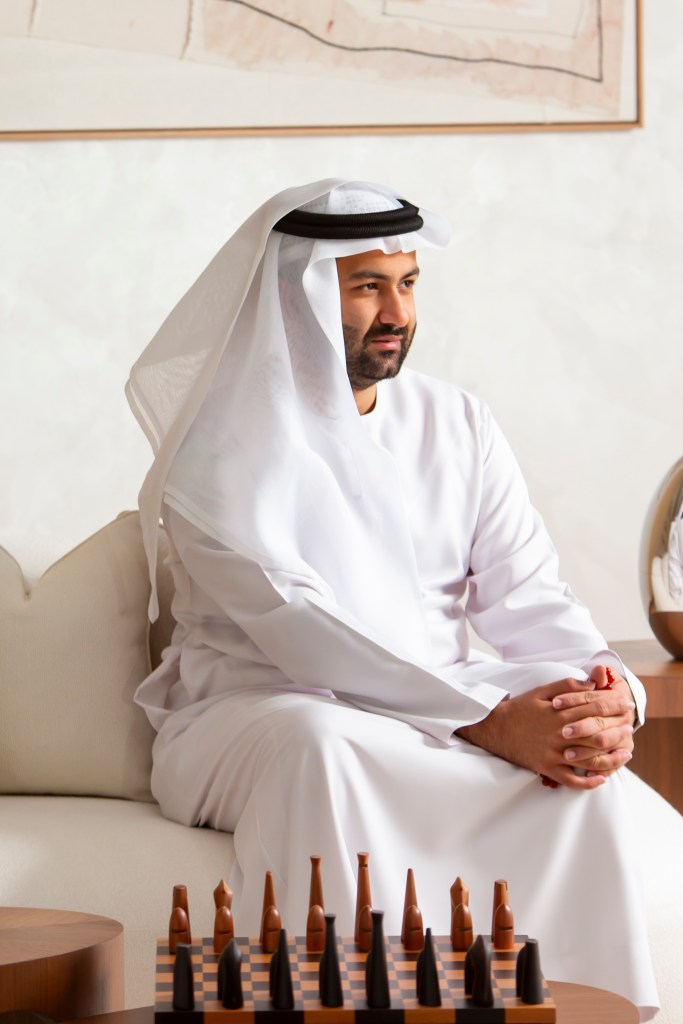
“A real market isn’t built on cycles. It’s built on consistency,” he says. “You need population growth, policy clarity, infrastructure, and trust in governance. Most cities have some of those. Very few have all of them working at the same time. Dubai does. But what really defines a durable market is execution. Vision is easy. Delivery is hard. Here, projects get built, timelines are met, and strategy translates into reality. That’s what makes it sustainable, not just attractive.”
For international investors still hesitating at the edge of a decision, Sajwani has one final thought. It is not a reassurance, exactly. It is something more challenging than that. “The window you’re waiting for doesn’t exist,” he says. “Markets don’t announce entry points. They move quietly, then suddenly. If you’re waiting for certainty, you’re positioning yourself behind the people who create it. The question isn’t ‘is this the right time?’ It’s ‘what happens if I’m late?’”
In a city that recorded more property sales in the first 290 days of 2025 than in the entirety of 2024, and where even a period of significant geopolitical tension failed to dent the conviction of the most serious capital in the world, it is a question that deserves an honest answer.
This article is part of the cover story for the Entrepreneur Real Estate Leaders May 2026 Edition.
There is a particular kind of confidence that only comes from having seen a market perform under pressure. Abbas Sajwani, the 26-year-old Founder and CEO of AHS Properties, has that confidence in abundance – and the numbers to back it up. In a city that recorded AED 917 billion in real estate transactions in 2025 alone, where residential sales prices surged by 20 per cent in a single year and where 130,000 new investors entered the market – up 55 per cent year-on-year – Sajwani has managed to carve out a position at the very apex of the market.
Founded in 2021, AHS Properties has grown its gross development value to more than $3.3 billion in less than five years, with a portfolio that stretches across the most coveted addresses in Dubai: Palm Jumeirah, Emirates Hills Sheikh Zayed Road, and the Dubai Water Canal. Projects such as One Crescent – a $250 million development that sold out within a week of launch – and Casa Canal with interiors by Fendi Casa, an $850 million statement of intent that shifted 80 per cent of its units within days, has made AHS Properties one of the most talked about names in ultra-luxury real estate globally. Sajwani has also just sold out AHS Tower, a Grade-A commercial building on Sheikh Zayed Road, marking the company’s expansion beyond the residential segment. Not bad for a development company only five years in operation.

Entrepreneur Middle East Staff
Entrepreneur Staff