Building Bridges: EU Ambassador to the UAE H.E. Lucie Berger Outlines Vision for Deeper Economic Cooperation
A new interview series by Entrepreneur Middle East featuring ambassadors to the UAE, exploring trade, investment, innovation, and the partnerships strengthening economic ties between nations and the region
You're reading Entrepreneur Middle East, an international franchise of Entrepreneur Media.
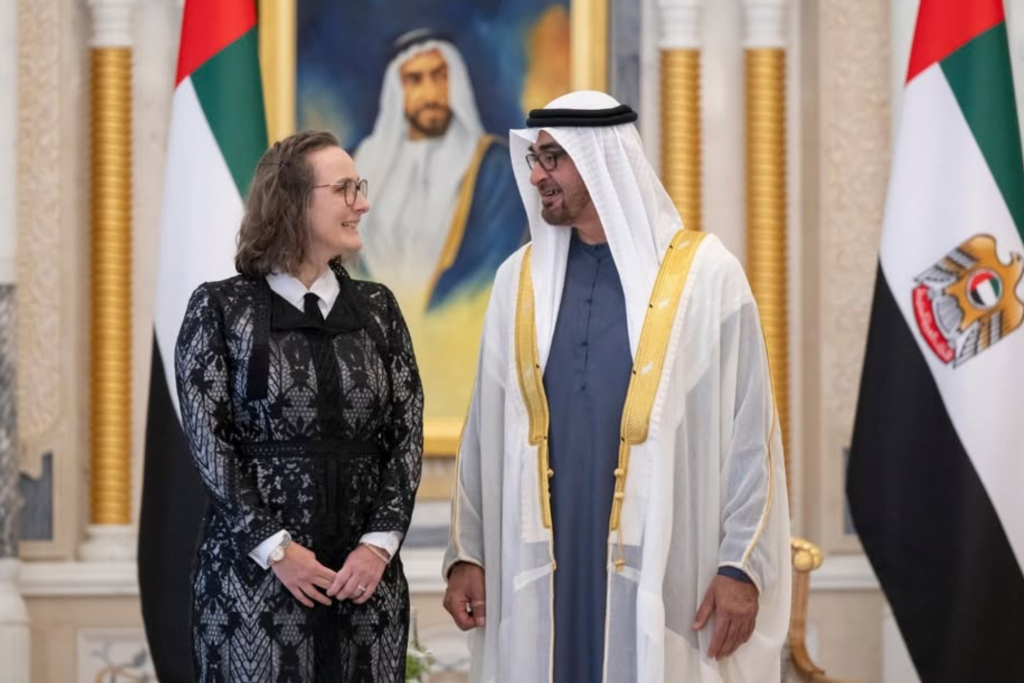
As the UAE continues to strengthen its position as a global hub for trade, investment, and innovation, its partnerships with major economic blocs are becoming increasingly important.
Among them, the European Union stands out as one of the UAE’s most significant strategic and economic partners. The EU is the UAE’s largest source of foreign direct investment, with investment reaching €186 billion, while bilateral services trade is valued at €39 billion.
The UAE is also the EU’s primary export destination in the Gulf and its largest investment partner in the region. It is therefore fitting that the inaugural edition of Building Bridges, Entrepreneur Middle East’s new interview series with ambassadors to the UAE, features H.E. Lucie Berger, Ambassador of the European Union to the United Arab Emirates.
In this conversation with Sarah Saddouk, Director of Innovation, Entrepreneur Middle East | Entrepreneur IMPACT. – BNC Media Group, H.E. Berger discusses the growing EU-UAE trade and investment ties, particularly following the launch of EU-UAE Free Trade Agreement negotiations. Alongside broader Strategic Partnership Agreement negotiations, these efforts can serve as a catalyst for stronger relations between the EU, the UAE, and the wider GCC.
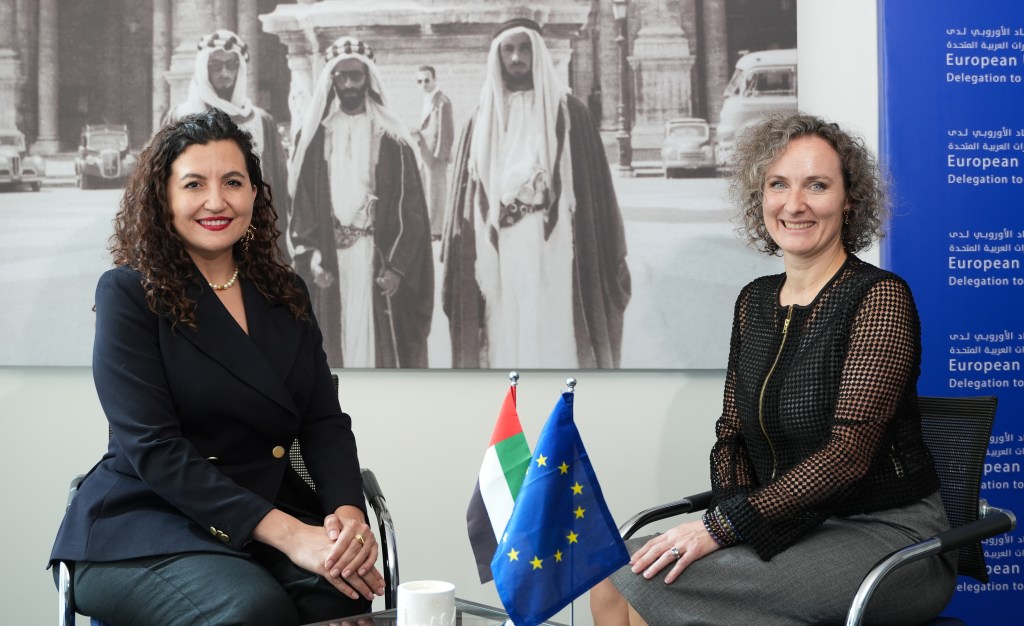
H.E. Berger, who took on the role of European Union Ambassador to the UAE in September 2023, highlights that recent geopolitical shifts have accelerated rather than delayed trade negotiations between the UAE and the EU.
“The free trade agreement is even more important today than it was before,” she says. “Since the launch of the negotiations, both sides have demonstrated a strong commitment to concluding the agreement in record time.
“Why is it so important now? We are living in turbulent times. A free trade agreement with the EU gives the UAE enhanced access to the world’s largest single market, comprising 450 million people. Through provisions such as investment facilitation, greater trade liberalization, and enhanced customs cooperation, it helps build economic resilience. Greater resilience means being better prepared for future challenges while creating a more attractive environment for investors.
“At the same time, the UAE is a global trade hub. A free trade agreement with the EU would further strengthen and solidify that position. It is therefore beneficial in both directions. Beyond its political significance, such an agreement would have a meaningful economic impact by supporting growth, encouraging investment, and strengthening resilience in both the UAE and the European Union.”
Looking ahead, H.E. Berger believes there are several practical areas where the UAE and the EU can deepen cooperation and unlock further economic value beyond the free trade agreement itself.
“One area where I believe significant potential can be unlocked is customs cooperation as it facilitates the movement of goods, builds trust, and supports higher trade volumes. As we work toward increasing trade exchanges through a free trade agreement, customs cooperation will be an important enabler of that growth.
“Investment is another key area. Much will depend on what we achieve through the free trade agreement and the priorities both sides set for future investment strategies. Renewable energy, in particular, presents considerable opportunities and could be further supported through the agreement, helping to unlock additional investment and cooperation.
“Public procurement is also important. If we can reach an agreement on procurement rules that facilitate greater participation of European companies in certain areas, that would encourage investment and deepen economic cooperation. While some sectors may be sensitive, public procurement touches many parts of the economy and could create meaningful opportunities for businesses on both sides.”
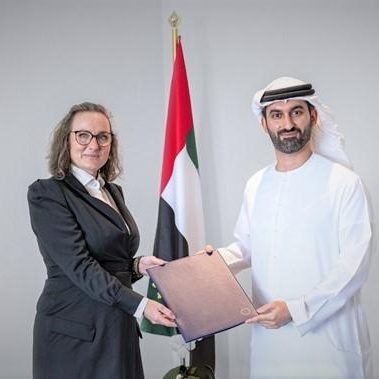
Beyond traditional trade, Berger sees some of the strongest opportunities for long-term UAE-EU cooperation emerging in advanced technologies, particularly artificial intelligence (AI) and renewable energy.
“AI is a major priority for both the EU and the UAE. We may approach it from different perspectives, but there is a strong recognition on both sides that while AI offers tremendous opportunities, it also comes with significant risks. This creates an opportunity for deeper cooperation, particularly around regulation and governance.
“Renewable energy is another area with enormous potential. The UAE has long been a regional leader in the sector, and we have worked closely together for many years. Looking ahead, I see strong opportunities for increased investment and joint projects in renewable energy, clean technologies, and the broader energy transition. A future free trade agreement could play an important role in accelerating those investments and unlocking further cooperation.”
As AI becomes a strategic priority for governments and businesses worldwide, the European Union is investing heavily in the infrastructure needed to support its ambitions.
“The UAE has positioned itself as one of the fastest adopters of AI across both the public and private sectors. By working together, we can not only strengthen our partnership but also help shape the global conversation around AI,” she says.
The European Union is accelerating its ambitions to become a global leader in artificial intelligence through its 2025 AI Continent Action Plan, which focuses on expanding computing infrastructure, improving access to data, developing AI skills, and encouraging wider adoption of AI technologies. The EU has already established a network of 19 operational AI Factories and 13 AI Factory Antennas linked to its supercomputing infrastructure, while plans for larger AI Gigafactories continue to advance across Member States.
To support innovation, the European Commission has also launched a Data Union Strategy aimed at increasing data availability and sharing for AI development. In parallel, it has proposed an AI Omnibus package designed to simplify regulations, reduce compliance costs, and provide greater legal certainty for businesses operating in the AI sector.
H.E. Berger explains that the EU’s planned network of AI Gigafactories is designed not only to expand computing capacity, but also to strengthen Europe’s long-term competitiveness in AI. At the same time, the initiative has attracted significant interest from UAE investors.
“We have a clear plan to increase Europe’s capabilities in artificial intelligence and to build the infrastructure needed for researchers, innovators, and companies to develop and scale AI technologies. Our ambition is for Europe to become a leading global hub for artificial intelligence,” she explains.
“When it comes to gigafactories, we are not talking about a single project. The plan is to establish around 10 AI gigafactories across the EU. Alongside that, we are investing in data centers and other critical infrastructure required to harness the full potential of AI.
“These projects will require significant investment. This is where partnerships become particularly important. In my view, leadership in AI cannot be achieved in isolation. The UAE has already built substantial expertise and infrastructure in this field. By partnering with countries such as the UAE, Europe benefits not only from investment, but also from valuable knowledge, experience, and innovation capabilities.”
In parallel, climate innovation and clean energy remain among the most active areas of cooperation between the UAE and the EU. According to H.E. Berger, both sides share a strong commitment to sustainability and have already established several mechanisms to support joint investments and knowledge exchange.
“We already work very closely together in this area because both the EU and the UAE are strongly committed to these priorities. Over the past three years, we have developed a number of initiatives focused on climate finance, building on the momentum of COP28 and the commitments made around climaterelated investments. We are also partnering with Alterra to bring together different funding mechanisms and identify projects where we can invest jointly.
“We are building on the experience of European institutions such as the European Bank for Reconstruction and Development (EBRD), which is already working actively with Emirati partners, including private-sector organizations, on renewable energy projects in regions such as Africa. The European Investment Bank is also a key partner in these efforts.
“Beyond renewable energy, water security is becoming an increasingly important area of focus, particularly ahead of the UN Water Summit taking place in the UAE later this year. We are exploring opportunities to develop joint projects and co-funding mechanisms to support water-related initiatives.
“We are also preparing to launch a new trans-Mediterranean renewable energy and clean technology initiative, which will include an investment platform. The Gulf countries are important partners in this effort. Given our shared neighboring regions, there is significant potential to combine our expertise, technology, and investment capabilities to support renewable energy development and sustainable growth together.”
Small and medium-sized enterprises form the backbone of both the UAE and European economies. H.E. Berger believes there is significant untapped potential for deeper collaboration, particularly in helping startups and SMEs access new markets, build partnerships, and commercialize innovation.
“SMEs account for more than 90% of the UAE’s economy and are equally important in Europe, especially when it comes to job creation. Supporting them is therefore a major priority for us. During periods of uncertainty, SMEs are often the most vulnerable, which makes it even more important to provide them with the right tools and opportunities.
“One of the key strengths of our partnership is market access. Beyond the opportunities that could be created through a future free trade agreement, we already offer a number of programs designed to facilitate cooperation between SMEs in the UAE and the EU.
“A good example is the Enterprise Europe Network, which helps businesses access the EU single market and connect with potential partners across Europe. The Sharjah Research, Technology and Innovation Park became the first UAE entity to join the network last year. Through it, companies can access information on European regulations, identify business opportunities, and connect with partners across a wide range of sectors.”
While trade, investment, and innovation often dominate discussions around UAE-EU relations, H.E. Berger believes that culture and people-to-people connections remain equally important in building lasting partnerships.
“During challenging times, initiatives such as Europe Day and European Month take on an even greater significance. They are not only celebrations of European culture, but also a demonstration of our confidence in the UAE, our belief in its resilience, and our commitment to this partnership.
“Being able to celebrate Europe Day and launch the EU Film Festival in Abu Dhabi and Ras Al Khaimah this year was particularly meaningful. It sent a clear message that our focus remains on the future, on cooperation, and on continuing to build together. Culture has a unique ability to bring people closer, build understanding, and create connections that go beyond politics and economics.
“Ultimately, strong partnerships are built not only through agreements and investments, but through the relationships between people. Cultural exchanges help strengthen those ties and create new opportunities for cooperation for years to come.”
As the UAE continues to strengthen its position as a global hub for trade, investment, and innovation, its partnerships with major economic blocs are becoming increasingly important.
Among them, the European Union stands out as one of the UAE’s most significant strategic and economic partners. The EU is the UAE’s largest source of foreign direct investment, with investment reaching €186 billion, while bilateral services trade is valued at €39 billion.
The UAE is also the EU’s primary export destination in the Gulf and its largest investment partner in the region. It is therefore fitting that the inaugural edition of Building Bridges, Entrepreneur Middle East’s new interview series with ambassadors to the UAE, features H.E. Lucie Berger, Ambassador of the European Union to the United Arab Emirates.

Tamara Pupic • Editor in Chief, Entrepreneur Middle East
Entrepreneur Staff
Tamara Pupic is the Editor in Chief of Entrepreneur Middle East.