LIVE FROM AI Everything Abu Dhabi 2026: Mistral AI’s Arthur Mensch on the Divide Between Open and Closed AI
BNC
You're reading Entrepreneur Middle East, an international franchise of Entrepreneur Media.
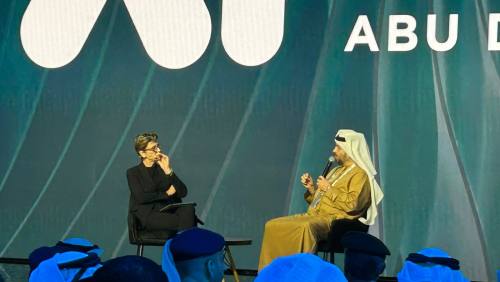
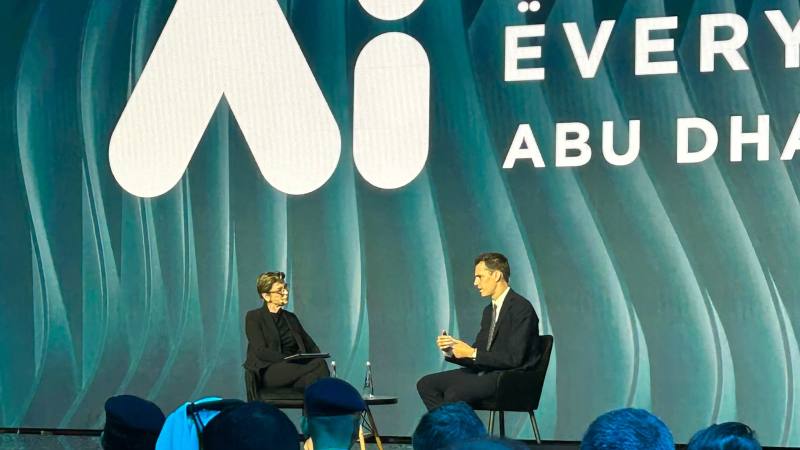
In a fireside chat titled “Sovereign, Open, Safe — Pick Two?”, CNN’s Becky Anderson opened the conversation with Arthur Mensch, founder and CEO of Mistral AI, by addressing the debate over AI safety and increasingly capable AI agents.
She pointed to a global market increasingly divided between open and closed AI systems, particularly across the US and China, before asking Mensch about Mistral AI’s position in that race and his assertion that its next model will “very significantly” close the performance gap.
“If you look at the end-to-end solution, there is no reason why you should pay the API markup for closed models,” Mensch said. “99% of the use cases that we deal with today can be addressed with open models. So there is really a change in the way the market views the business model of artificial intelligence.
“I think it’s very important for enterprises because they gain more control, more deployment options, and they can keep their IP and utilize it effectively. The shift is actually pretty brutal, and what we see in the open market is that we’re driving our growth pretty quickly. What we expect is that this will effectively going to challenge many of the closed models that are out there.”
Turning to Europe’s position in the global AI race, Anderson asked whether the continent can demonstrate that sovereign, open and safe AI is possible—or risk falling further behind the US and China. Mensch rejected the idea that Europe cannot compete, pointing to its existing technology leaders and arguing that AI sovereignty is becoming increasingly important worldwide. “The narrative that Europe cannot compete is simply not true. There are a lot of technological champions in Europe,” he said.
Comparing AI to electricity, Mensch argued that countries and companies need their own technology supply-chain strategies rather than becoming overly dependent on a single source. “That means hedging. Of course, you’re going to be using US technology when it works, but having uncorrelated suppliers in a world where you have a lot of uncertainty is actually very valuable.”
Mensch also pointed to growing alignment between Europe and the GCC as both regions seek alternatives to dependence on US and Chinese AI technology.
“Europe and the GCC region are very aligned in that respect as they need to secure AI supply on the human side and the IP side to produce their own models. Being able to have models that actually understand languages that are not English. And, of course, models that have strategic capabilities in defense and cybersecurity. And they need to be able to source those models in a way that is not dependent on the US administration’s manpower in particular,” he said.
“So, what that means is that on this specific technology, as well as on other strategic parts like defense, there’s a divergence of interest between these two regions that have been friends for centuries. Overall, there’s a common interest in building IT that is accessible outside of the US and Chinese borders.”
When asked whether the AI infrastructure boom can withstand a higher cost of capital, Mensch argued that financing costs are not the biggest challenge facing the sector. “The total cost of ownership for the cluster that you build spans over five years. Roughly, the capital cost is between 10% and 15%. So that means that the sensitivity to the rate is not that high. The biggest chunk of the total cost of ownership is in the CAPEX. I would not say that the cost of capital is very problematic in the CAPEX that we see on artificial intelligence. The truth is, which is still a little bit of a no-no, is the rate of adoption by enterprises. At the end of the day, the kind of deployment we are making depends on enterprises adopting the technology and creating growth. If it does not create growth, if it only replaces jobs, there is not going to be this abundance that we are building. And that drive of adoption is, for us, the only way in which we can make the infrastructure investments we have all the while actually be justified.”
Mensch positioned sovereign AI as Mistral AI’s core focus, arguing that enterprises increasingly need technology that gives them control over their deployments, intellectual property and costs rather than creating dependence on centralized AI providers. “It’s quite simple. We lead on sovereign AI. We bring technology that makes our customers sovereign. We empower our customers instead of making them dependent on us. It turns out that for an enterprise, most of the use cases showing a return on investment will involve core processes where you change an entire organization based on agents. Because this touches core processes, data, and IP, you’re not going to build it on public AI; you’re going to build it on sovereign AI technology. Therefore, we expect that the market is going to increase very significantly in that category of sovereign AI that we are building today to increase very significantly.”
Closing the conversation, Anderson asked what an organization must actually control before it can genuinely call its AI sovereign. Mensch pointed first to portability (the ability to move between infrastructure providers) before highlighting business continuity, affordability, IP control and what he described as “cultural sovereignty.”
“Models built in the U.S. are very English-centric, and they miss certain nuances found in many different parts of the world,” he said. “In the language space, in particular, we are finding that there’s always an effort to be made to make the model specifically good at a specific kind of Arabic, for instance. That aspect around interfaces, around understanding the cultural nuances of the country, is also super important, for states, of course, because they serve their citizens, but also for companies, because when they are building customer services, they need to understand the cultural nuances of their own customers.”
In a fireside chat titled “Sovereign, Open, Safe — Pick Two?”, CNN’s Becky Anderson opened the conversation with Arthur Mensch, founder and CEO of Mistral AI, by addressing the debate over AI safety and increasingly capable AI agents.
She pointed to a global market increasingly divided between open and closed AI systems, particularly across the US and China, before asking Mensch about Mistral AI’s position in that race and his assertion that its next model will “very significantly” close the performance gap.
“If you look at the end-to-end solution, there is no reason why you should pay the API markup for closed models,” Mensch said. “99% of the use cases that we deal with today can be addressed with open models. So there is really a change in the way the market views the business model of artificial intelligence.
“I think it’s very important for enterprises because they gain more control, more deployment options, and they can keep their IP and utilize it effectively. The shift is actually pretty brutal, and what we see in the open market is that we’re driving our growth pretty quickly. What we expect is that this will effectively going to challenge many of the closed models that are out there.”

Entrepreneur Middle East Staff
Entrepreneur Staff