As Children Bear the Costs of Conflict, Public Art Can Keep Their Stories Visible
Public monuments may continue to be encountered after particular events leave the headlines. Their meaning can depend on their design, location, and how communities respond to them. Local consultation and cultural context may therefore help determine whether a work becomes a place for remembrance, reflection, or public conversation.
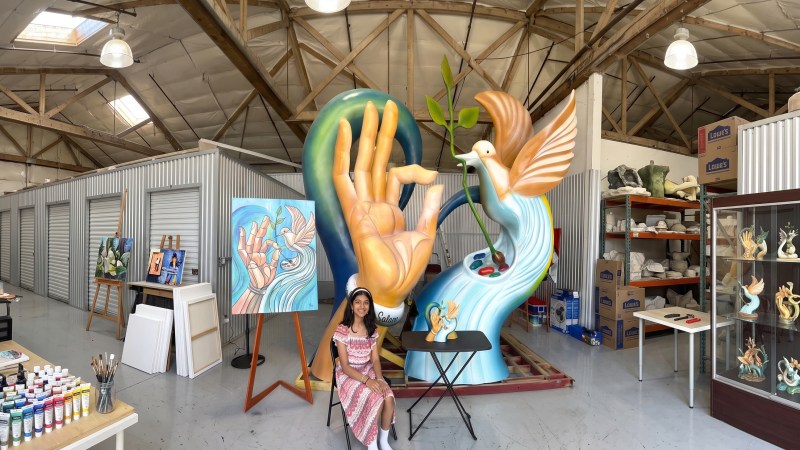
Zoya Eshwar
You're reading Entrepreneur Middle East, an international franchise of Entrepreneur Media.
At least 12.2 million children were reported killed, maimed, or displaced by conflicts in the Middle East and North Africa in less than two years, according to UNICEF figures released in July 2025. Such figures document the scale of suffering. They also raise a public question about how communities can acknowledge that suffering without allowing it to become another statistic that briefly enters then leaves the news cycle.
The challenge extends well beyond one region. UNICEF reported that more than 473 million children, over one in six worldwide, lived in conflict-affected areas in 2024. Public discussion understandably concentrates on diplomacy, humanitarian assistance, and security. Yet communities also need appropriate ways to remember those affected and express hopes that political language may struggle to convey.
Culture can contribute to that civic process without being assigned powers it cannot carry. UNESCO explains culture and creativity as contributors to intercultural dialogue, while its work in crisis settings treats culture as relevant to social cohesion and resilience. That framing suggests a measured role for public art. A monument cannot negotiate a ceasefire, but it can give people a physical setting in which to pause, gather, and consider the human consequences of conflict.
Public monuments may continue to be encountered after particular events leave the headlines. Their meaning can depend on their design, location, and how communities respond to them. Local consultation and cultural context may therefore help determine whether a work becomes a place for remembrance, reflection, or public conversation.
Ben Valenty, founder of the Global Peace Initiative, approaches monuments from that perspective. Established in 2003, the nonprofit develops large-scale peace monuments intended for public placement. Its current focus is a completed Middle East Peace Monument designed by young artist Zoya Eshwar. Valenty says the organization is now seeking an appropriate site in the Middle East, a decision that would require engagement with relevant local and institutional stakeholders.
According to Valenty, the decision to involve a young artist was meant to keep children at the center of the work’s message. The monument combines symbols associated with peace, including a hand extending an olive branch and a dove carrying one. Eshwar also painted the bronze surface, giving the sculpture qualities of both a monument and a painting. These choices represent the artist’s and organization’s intended symbolism, while viewers will ultimately form their own interpretations.
“We do not profess that our monument is going to solve these problems overnight,” Valenty says. “We think it could be a place where people find a few moments of solace, peace, and maybe hope.” His comments present a measured view of what cultural projects may contribute alongside broader political, legal, and humanitarian efforts to address violence.
Valenty says the public response to the organization’s earlier work helped shape that view. He recalls visitors gathering for vigils and forming personal connections with monuments dedicated to peace and remembrance. In his experience, those encounters showed how a monument’s meaning may continue to develop through the communities that gather around it.
Placement therefore deserves the same care as creation. From Valenty’s perspective, a Middle Eastern site should allow the work to be encountered as a shared invitation rather than a partisan statement. Consultation with local communities, cultural institutions, and public authorities could help determine whether a proposed setting supports that purpose and how the monument should be interpreted for visitors.
Amid figures as severe as UNICEF’s, no artwork should be asked to carry the burden of peacebuilding alone. Its contribution may be quieter and still worthwhile. A thoughtfully placed monument can preserve public attention, make space for grief, and remind visitors that children experience the consequences behind distant reports. The practical next step is to ensure that any host community has a meaningful role in deciding where, and how, that reminder belongs.
At least 12.2 million children were reported killed, maimed, or displaced by conflicts in the Middle East and North Africa in less than two years, according to UNICEF figures released in July 2025. Such figures document the scale of suffering. They also raise a public question about how communities can acknowledge that suffering without allowing it to become another statistic that briefly enters then leaves the news cycle.
The challenge extends well beyond one region. UNICEF reported that more than 473 million children, over one in six worldwide, lived in conflict-affected areas in 2024. Public discussion understandably concentrates on diplomacy, humanitarian assistance, and security. Yet communities also need appropriate ways to remember those affected and express hopes that political language may struggle to convey.
Culture can contribute to that civic process without being assigned powers it cannot carry. UNESCO explains culture and creativity as contributors to intercultural dialogue, while its work in crisis settings treats culture as relevant to social cohesion and resilience. That framing suggests a measured role for public art. A monument cannot negotiate a ceasefire, but it can give people a physical setting in which to pause, gather, and consider the human consequences of conflict.

Entrepreneur Middle East Staff
Entrepreneur Staff