Fine Art Should Not Be Separated from the Process
The future of collecting may not be a choice between art and experience. Understanding how something was made may deepen the meaning of the finished piece rather than distract from it.
Trifecta Design Studio
You're reading Entrepreneur Middle East, an international franchise of Entrepreneur Media.
The art world places its highest value on the finished object. A sculpture on a pedestal. A painting on a white wall. The frame, the lighting, the price tag. All of it points the viewer toward itself and away from what produced it.
For some forms of art, that may be enough. For a craft-based medium, something important can be lost.
The Art Basel and UBS Art Market Report found that the global art market grew 4% in 2025 to $59.6 billion. The US remains the largest market, with a 44% share. Sales at the top end slowed. In that environment, galleries and artists face pressure to differentiate what they offer, not just in the work itself but in how it reaches the collector.
Younger collectors are already shifting what they want from that experience. According to the Deloitte Art and Finance Report, next-generation collectors are prioritizing education, engagement, and market transparency over the transaction alone.
That shift is not unique to art. The Bain & Company luxury goods study found that consumer sentiment toward experiences is outgrowing tangible goods by 1.5 times in 2026, reflecting a shift from ownership to lived moments.
Glass is one of the mediums where that gap shows up most clearly. A finished piece on a wall or in a case can feel unattainable. The process that produced it is invisible.
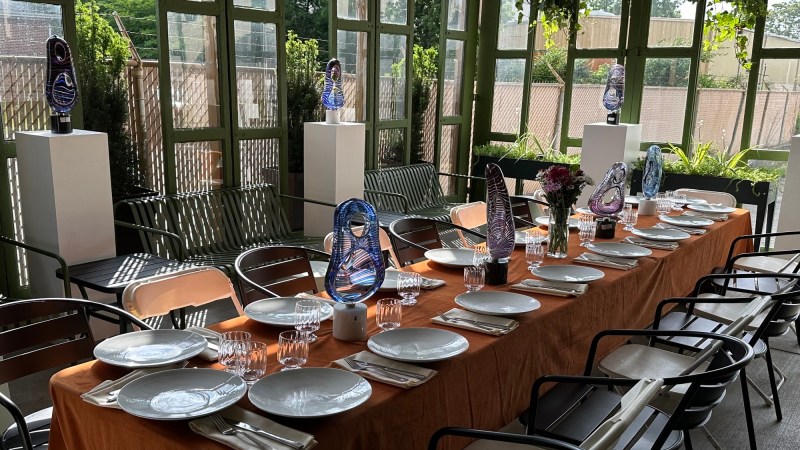
Travis Adams has spent more than a decade working in that process. He is the founder of Trifecta Design Studio, a glass art lounge, studio, and platform for contemporary artists. His view is that the art world has separated the finished object from the work that made it, and that the separation costs collectors as much as it costs artists.
“A finished piece on a white wall can feel intimidating,” Adams says. “When you see it being made, that changes. You stop looking at it as an object you are not allowed to touch and start understanding it as something that came out of real work.”
That work is not abstract. Glass is a demanding material. It is fragile, unpredictable, and dependent on timing and temperature. Adams describes a ratio that surprises most collectors.
“I had to break six pieces to make one,” he says. “People do not see that. When they do, the price starts to make sense.”
Adams argues that the disconnect is generational as much as it is aesthetic. The American glass collector base was built in the 1990s, during a boom in studio glass. Many of those collectors are now older, with full collections or works moving to the secondary market. The industry needs younger collectors to sustain it, and younger collectors are asking different questions.
They want to know how a piece fits into a modern home. They want to know how to display it, light it, and live with it. They want transparency about how it was made. Adams says the traditional white-wall gallery still has a place, but it does not answer those questions on its own.
The making experience answers them differently. Seeing glass gathered, shaped, and cut, with the heat, the movement, and the choreography, changes the collector’s relationship to the object. Adams describes the process as almost a ballet with fire. The finished piece becomes part of a story the collector has witnessed, not an object that arrived without context.
He sees the same principle at work beyond glass. Luxury brands, designers, and craftspeople face a similar question about how much of the process they are willing to show. Authenticity is not only the finished product. It is the expertise behind it.
There is a limit to how far that logic should go. Adams accepts commissions that work within his own conceptual voice, such as a specific color family or a piece designed for a particular space. He does not accept commissions that ask him to copy another artist’s work. He describes that as an educational issue, not a service issue.
“We do not copy other artists,” he says. “If that is what you want, go to them. There is a difference between working with a collector and copying someone else’s voice.”
What Adams argues for is not a rejection of the gallery model. It is a broader set of entry points. Galleries can create more opportunities for audiences to encounter the process. Artists can educate collectors about the material. Collectors can ask not only what a piece costs, but why it was made the way it was, and what that tells them about its value.
The industry can also build pathways for younger collectors rather than assuming the existing base will sustain it indefinitely. The numbers suggest that assumption is already under pressure.
The future of collecting may not be a choice between art and experience. Understanding how something was made may deepen the meaning of the finished piece rather than distract from it.
The question is whether the industry will treat the process as part of the product, or keep it behind the wall.
The art world places its highest value on the finished object. A sculpture on a pedestal. A painting on a white wall. The frame, the lighting, the price tag. All of it points the viewer toward itself and away from what produced it.
For some forms of art, that may be enough. For a craft-based medium, something important can be lost.
The Art Basel and UBS Art Market Report found that the global art market grew 4% in 2025 to $59.6 billion. The US remains the largest market, with a 44% share. Sales at the top end slowed. In that environment, galleries and artists face pressure to differentiate what they offer, not just in the work itself but in how it reaches the collector.

Entrepreneur Middle East Staff
Entrepreneur Staff