How Demand for Arabic Presentations Is Shaping Aidar Akmaev’s AI Platform NOXI
Built by product designer Aidar Akmaev, the free platform is finding an audience among professionals, founders, teachers, and students seeking presentations designed for real-world use.
Disclosure: Our goal is to feature products and services that we think you'll find interesting and useful. If you purchase them, Entrepreneur may get a small share of the revenue from the sale from our commerce partners.
You're reading Entrepreneur Middle East, an international franchise of Entrepreneur Media.

Artificial intelligence is becoming part of everyday work across the Middle East as organizations give more employees access to tools designed to improve productivity and reduce the time spent on routine tasks. Deloitte’s “2026 State of AI in the Enterprise” report found that access to approved AI tools among workers in the region increased by 50% over the previous year, rising from less than 40% to nearly 60%, while 66% of surveyed Middle East organizations reported efficiency gains from the technology.
Presentations are among the areas where AI promises to make work faster, but for Aidar Akmaev, the initial output often needed substantial editing. After years of preparing presentations for managers and investors, he experimented with the AI tools entering the market, only to find himself reworking their slides by hand before they could be presented at a professional meeting.
“They were fine for a quick draft. But once a deck went in front of leadership, I was back to doing it by hand. Slides looked like they came from one template, the numbers had no sources, and the PowerPoint file fell apart when a colleague opened it,” Akmaev says, adding that Arabic text sometimes ran in the wrong direction.
Those frustrations led Akmaev to begin building NOXI, free AI presentation generator, in Abu Dhabi in 2025. Drawing on nearly a decade of design experience, he developed the platform as a one-man team, all while working full-time as a senior product designer at VentureOne, the commercialization arm of the Advanced Technology Research Council.
“People need a deck they can actually present, not another draft,” he says. “I built it for the people I used to make decks for: a manager reporting to leadership, a founder facing investors, a teacher without a design team.”
NOXI can generate presentations from a prompt or an uploaded PDF, PowerPoint, Word or Excel file, with research citations added directly to the slides. The platform selects a layout suited to the material, with options including 12 chart types. Users can then edit each element manually or request changes through its AI assistant.
On the other hand, users can upload an existing company presentation for NOXI to learn its fonts, colors and layout patterns, allowing subsequent decks to follow the same template, while completed presentations can be exported as editable PowerPoint or PDF files or shared through a link.
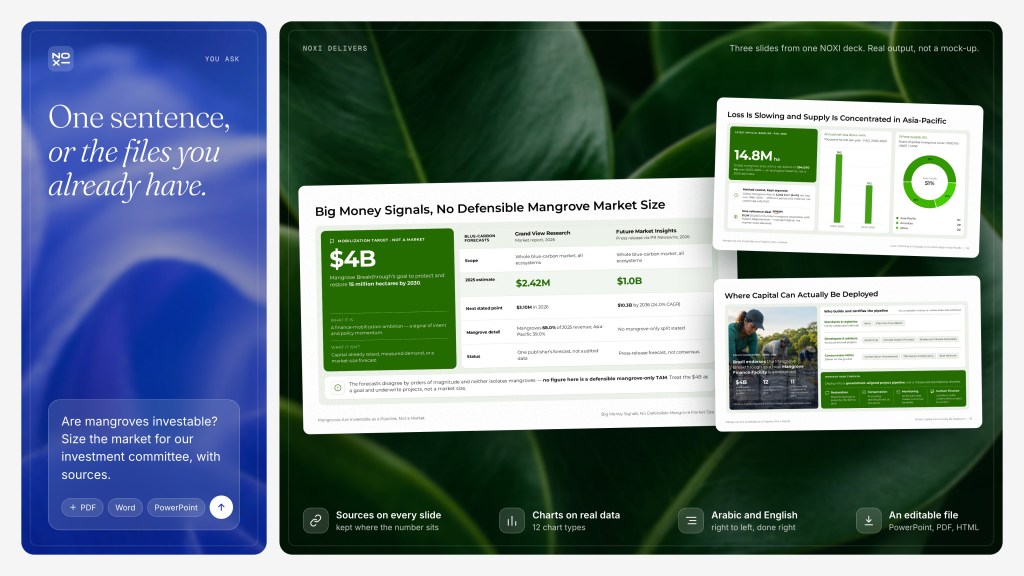
To better serve Arabic-speaking users, NOXI introduced its Arabic version in the first half of 2026, with layouts and typography designed for right-to-left text rather than simply translating slides created in English. To Akmaev’s surprise, Arabic accounted for close to 40% of new presentations by October, while Saudi Arabia and the UAE now account for a large share of the platform’s audience. “It changed my priorities. Arabic isn’t an extra language in the product anymore,” he says.
“What I’m working on now is the hardest part: Arabic and English in the same sentence, with names, numbers and terms,” Akmaev continues. “Translation can’t fix that, the layout has to.”
NOXI has now attracted more than 2,000 users with zero help from paid advertising. Its earliest users came through word of mouth among managers and teachers in Abu Dhabi, before search traffic became a larger source of growth.
“I’ve written more than eighty articles in Arabic about making presentations, plus guides in English, and people find them when they need help with a real deck,” Akmaev explains. “It also helps that NOXI is free, with no watermark and no card, so trying it costs nothing.”
Among those who have created a deck using NOXI, 47% have made a second and about 10% have made at least five, according to Akmaev. Meanwhile sign-ups increased 212% from August to September and October’s daily sign-up rate rose to more than twice September’s level.
Behind that growth remains a one-person operation, with Akmaev responsible for the product’s design, front end, back end, AI connections and export system. Pointing to two major challenges, he cites building an export engine that preserves each slide’s appearance, editability, and Arabic text direction in PowerPoint, and giving users the freedom to create and modify presentations beyond fixed templates, both of which required hundreds of small fixes.
While revenue is not his immediate priority, he expects NOXI’s future commercial model to focus on organizations seeking the platform for their teams. “Right now my goal isn’t revenue. It’s getting NOXI to as many people as possible and making sure it’s genuinely useful to them. At this stage that matters more than anything else,” he stresses. “Later, I expect the money to come from organizations, not individual users: companies that want NOXI in their own brand for their teams, and government bodies that need their data kept inside the UAE. The trade-off I’m making is speed: I’d rather release fewer features than compromise on the quality of the presentations.”
Akmaev also shares that he has already developed a prototype that runs without the cloud, addressing a concern he sees as central to serving organizational users: “Companies and government bodies need to know where their data goes.”
Looking ahead, Akmaev is focusing on improving presentation quality and speed, strengthening data security and refining Arabic support, while keeping his plans flexible as advances in AI change what the platform can deliver.
Artificial intelligence is becoming part of everyday work across the Middle East as organizations give more employees access to tools designed to improve productivity and reduce the time spent on routine tasks. Deloitte’s “2026 State of AI in the Enterprise” report found that access to approved AI tools among workers in the region increased by 50% over the previous year, rising from less than 40% to nearly 60%, while 66% of surveyed Middle East organizations reported efficiency gains from the technology.
Presentations are among the areas where AI promises to make work faster, but for Aidar Akmaev, the initial output often needed substantial editing. After years of preparing presentations for managers and investors, he experimented with the AI tools entering the market, only to find himself reworking their slides by hand before they could be presented at a professional meeting.
“They were fine for a quick draft. But once a deck went in front of leadership, I was back to doing it by hand. Slides looked like they came from one template, the numbers had no sources, and the PowerPoint file fell apart when a colleague opened it,” Akmaev says, adding that Arabic text sometimes ran in the wrong direction.

Kristine Erika Agustin • Startup Editor, Entrepreneur Middle East
Kristine Agustin is a Startup Editor at Entrepreneur Middle East, covering startups, founders and developments... Read more