From a Fast-Food Counter to a Global Halal Council: How Habib Ghanim Built Halal Label on Trust
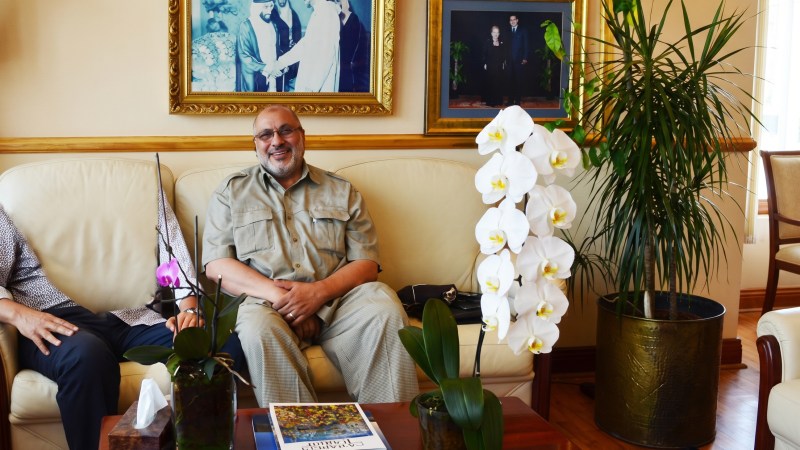
Habib Ghanim
You're reading Entrepreneur Middle East, an international franchise of Entrepreneur Media.
In the early 1970s, eating halal in the United States often meant relying on guesswork. Halal stores were scarce, and many young Muslims bought kosher meat because it excludes pork, even though it lacks the Islamic blessing spoken over each animal. For students arriving from abroad, even a simple fast-food order could raise questions about what was really on the plate.
One such student, newly arrived from The Gambia, recalls asking repeatedly at a fast-food counter whether the hamburger contained pork, since the word “ham” suggested to him that it might. Unable to get a clear answer, he ordered fish instead. The experience reflected a wider challenge Muslim consumers faced at the time in knowing what their food contained.
That student was Habib Ghanim, who went on to found the USA Halal Chamber of Commerce, a US halal certification body. He also sits on the executive committee of the World Halal Council and chairs its membership committee. Now semi-retired, he still takes part in certification decisions and travels to international halal meetings.
Ghanim was born and raised in The Gambia, in a trading family of Lebanese descent that valued independence. When he left for the United States in the early 1970s, his plan was to study, graduate, and return home to open a business of his own.
Food remained a practical problem. As students, Ghanim and friends from school and the World Bank pooled their money to buy a whole cow, kept it in a freezer, shared the meat, and cooked from it each month. “Nobody was selling halal meat, so we made our own arrangement,” he says. He met his wife at school in 1975, and after a few years back in The Gambia running a well-digging business, the family resettled in the US.
The turning point came when a delegation of Muslim buyers from Singapore, which required proof of halal status for imports, was looking for poultry products. Ghanim connected them with a large Maryland poultry plant, whose owner agreed on one condition. A Muslim had to perform the slaughter, so at the beginning Ghanim did it himself.
On weekends, he drove two or three hours to reach the plant before its 6 a.m. shift, supervised the slaughter, and then returned to his regular job. He later suggested the plant certify the whole bird so it could sell halal breasts, legs, and wings too. Recognition from Singapore followed. “I did not set out to become a certifier,” Ghanim says. “There was a need for someone to verify that the process met halal requirements, so I took on that responsibility.”
For years, the work stayed part-time, and Ghanim says he often paid his helpers from the fees and kept little for himself. Many companies knew almost nothing about halal at the time. “We had to educate them before we could certify them,” he says. In 1999, he joined certifiers in Jakarta to form the World Halal Council, which grew from about 40 members to roughly 150 and continued after a split over who should lead it.
Ghanim explains the principles behind his work as credibility, verification, and traceability. Certificates pass through a five-member decision committee that must agree unanimously, and he says each one can be traced back to who audited what. A recent audit finding over undocumented internal checks reinforced the point. He initially resisted it, but his son persuaded him to accept it. “If it isn’t written down, you can’t prove it happened,” Ghanim says.
Today, his children run much of the management part of the business. His son Aly serves as quality manager, and Ghanim says Aly is more technical than he is. His daughter was among the first women to work in the halal industry and graduated from Halal Academy in the UAE. He also points to a once-small plant that, in his account, is now one of the largest halal operations, with its own mosque.
Decades after his first question about what was on his plate, Ghanim’s focus remains on the systems that allow consumers to answer that question with confidence. He believes a halal label is only as reliable as the evidence behind it, from ingredient checks to the records that show who approved each certificate. “Credibility, verification, and traceability are what give the label its meaning,” he says. “That is the standard I hope the next generation carries forward.”
In the early 1970s, eating halal in the United States often meant relying on guesswork. Halal stores were scarce, and many young Muslims bought kosher meat because it excludes pork, even though it lacks the Islamic blessing spoken over each animal. For students arriving from abroad, even a simple fast-food order could raise questions about what was really on the plate.
One such student, newly arrived from The Gambia, recalls asking repeatedly at a fast-food counter whether the hamburger contained pork, since the word “ham” suggested to him that it might. Unable to get a clear answer, he ordered fish instead. The experience reflected a wider challenge Muslim consumers faced at the time in knowing what their food contained.
That student was Habib Ghanim, who went on to found the USA Halal Chamber of Commerce, a US halal certification body. He also sits on the executive committee of the World Halal Council and chairs its membership committee. Now semi-retired, he still takes part in certification decisions and travels to international halal meetings.

Entrepreneur Middle East Staff
Entrepreneur Staff