Najwa Zebian’s New Book Explores the Hidden Cost of People-Pleasing at Work (and in Life)
‘The One Who Broke You Can’t Heal You’ explores the seven types of bonds that shape human relationships.
You're reading Entrepreneur Middle East, an international franchise of Entrepreneur Media.

2026 marks a decade since Najwa Zebian self-published her first book, a collection of poetry and prose titled Mind Platter. Since then the Lebanese Canadian has gone on to author six books of poetry and self-development, exploring themes like building a sense of home within oneself, overcoming conditioning, embracing change, and personal reinvention.
In a world where, as per the World Health Organization’s (WHO) 2025-26 reports, over one billion people globally have a diagnosable mental health condition, Zebian’s best-selling work has been able to transcend boundaries and help many across the globe take steps toward helping themselves.
But through the course of all her prior publications, Zebian says she realized there is one facet of human relationships that can often be a detriment to complete emotional healing: unhealthy attachments.
“I did so much work on helping people learn how to let go and recognize the people who are good for them and those who aren’t. I also did so much work on educating people on how to stop abandoning themselves. And I realized over the years that one of the biggest struggles people had was: How do I validate what I experienced? How do I move on from somebody who hurt me so much? How does one put endings to stories that logically you know are over, but you’re still ruminating over them because you never got the validation or the apology? I struggled with that in my own life for many years. And when I asked myself how I was able to move on from people who didn’t apologize to me, the answer was in big, bold letters: the one who broke you can’t heal you. The same person who gave you pain can’t be the person who takes that pain away. So this was naturally the book that needed to be written.”
Launched officially in August 2026, and currently available for purchase worldwide, including in the UAE via Amazon Prime with same-day delivery, The One Who Broke You Can’t Heal You dissects what Zebian calls “the myth of closure”, and the seven types of bonds that she believes shape human relationships: namely convenient, trauma, toxic, forced, enabling, transactional, and healthy bonds.
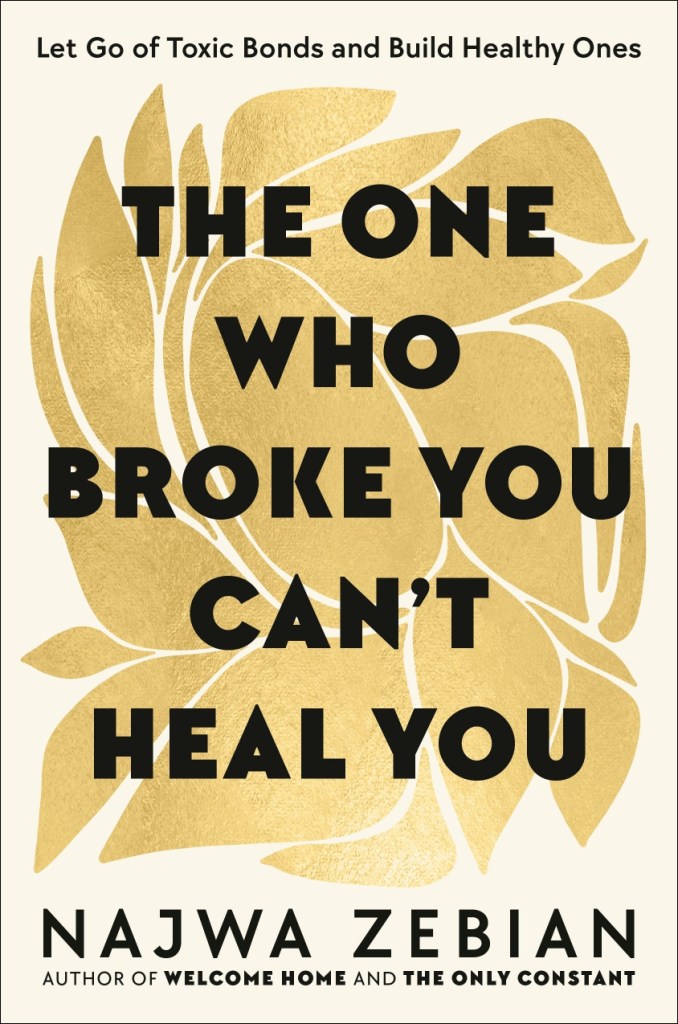
When I ask Zebian, who is preparing for the US leg of her book tour when she joins me over Zoom, if there are any bonds that are particularly prevalent in the business ecosystem, it elicits from her an immediate nod. “A lot of business relationships end up being very transactional or, in some cases, convenient,” she says.
“Some people will keep you around as an employee, an intern, or an ally because you add something to them. But they don’t really value you to the point where they’re willing to pay you more or make you a permanent part of their team. As long as you’re offering these services, they’re willing to accept them. But the moment you require something in return, like a testimonial, a raise, or a longer business commitment, they’re going to say, ‘Well, I never asked you to do all of that.’ I’ve also noticed that sometimes people in the same field reach out to you, and you genuinely think they like your work and value you as a person. But when you finally meet them, it turns out to be transactional.”
Zebian then adds that there is another equally prevalent workplace bond that needs to be addressed: the toxic kind. “When I talk about trauma bonds, I’m very aware that they can exist in workplace settings as well. Sometimes you look up to your superiors, and they can sense certain vulnerabili ties in you as a young employee or intern. They might play on those vulner abilities to get you so attached to them and their validation that you no longer feel like you’re making decisions for yourself. Your main goal becomes making them happy. I’ve seen trauma bonds in workplaces, and they’re very difficult to break, both professionally and in relationships outside of work.”
Now, Zebian’s insights open up the conversation to what the broader research and studies on workplace behavior show. A September 2026 report by WHO, which revealed that 60% of the global population is currently employed, highlights that “safe and healthy working environments are not only a fundamental right but are also more likely to minimize tension and conflicts at work and improve staff retention, work performance and productivity.”
On the flip side, however, is the reality of the matter: global analytics and advisory firm Gallup’s State of the Global Workplace 2026 report shows that global employee engagement fell to 20% in 2025, its lowest level since 2020, costing the world economy an estimated US$10 trillion in lost productivity.
But the findings paint an even more concerning picture for the MENA region, where only 14% of employees are engaged at work (i.e. emotionally connected, motivated, and committed toward work and the organization they work for), compared to the global average of 20%.
Furthermore, nearly half (48%) of employees in the region reported experiencing significant daily stress, while only 26% were classified as thriving in life, compared to 34% globally. While much can be discussed about how leadership traits and workplace norms contribute to these statistics, Zebian, who has always focused on the self, advises employees to take charge of their own emotional states. “I think it’s important to be conscious of the decisions you’re making for yourself versus those you’re making because you feel pressured or because you feel like you have to,” she says.
“If you feel that unless you go out of your way to be that stellar person in your work place, you’re going to miss out on opportunities or be punished some how, even indirectly, that’s something to pay attention to. When the decisions you’re making are more fear-based and about pleasing the people you work with, that’s a pretty good sign that you’re sacrificing yourself for somebody else to be happy. So ask yourself a simple question: Am I making this decision out of my own conviction that it’s the right thing to do? Or am I making it because I’m afraid there will be consequences if I don’t? That can give you a pretty good indication of whether you’re with people who are taking advantage of you or people who value your contributions.”
RELATED: Influence With Intention: Inside Rouhana El Hage’s Mission to Build a More Meaningful Creator Economy

“I think healthy workplaces and business partnerships have very clear expectations,” Zebian adds.
“There shouldn’t be passive-aggressive behavior where you have to figure everything out on your own. If you’re feeling confused about your role, where you’re headed, or what your future looks like in a workplace, that’s a pretty good sign that you need to start asking questions. I know that’s scary, but asking questions will give you clarity on where you stand. And sometimes clarity itself is scary because you might get an answer you don’t want. If you’re looking for more stability and clarity, you might need to decide whether to shift careers or change workplaces. Sometimes we don’t ask questions because we’re afraid of the answers, but seeking clarity is ultimately what’s going to put the responsibility on you to decide what you need to do next.”
However, despite deploying discern ment towards understanding one’s workplace culture and co-workers, many still have to deal with the reality of navigating professional relation ships with individuals who may not share the same level of emotional awareness.
Indeed, for employees who have spent considerable time under standing their own emotional patterns and behaviors, dealing with colleagues or superiors who appear unwilling to acknowledge their own shortcomings can become an equally exhausting exercise.
Zebian, however, cautions against unknowingly taking responsi bility for a co-worker’s emotional state. “I think the focus needs to be on yourself and the way you deal with them. Don’t let your goal be to change them or bring to their awareness how unhealed they are,” she says. “Your goal should be to manage not reacting in a way that is only going to hurt you at the end of the day. Your job isn’t to fix someone you work with. You might recognize that they’re very ego-driven in their decisions, that they only care about their own opinions, or that they have a very black-and-white vision of how things should work. But your job is to ask yourself, where do I fit into that?”
To better understand one’s own role within a rigid or toxic working environment, Zebian offers advice directly from her book. “In The One Who Broke You Can’t Heal You, I talk about how some people can be like walls. No matter what you do, you feel like you’re hurting yourself trying to get them to listen to you. You’re throwing yourself against a wall. Other people can be like mirrors, where when you express yourself, they reflect that back to you. If you’re dealing with someone who’s more like a wall, instead of constantly hitting yourself against it, maybe try leaning on it.”
“But if they continue to dismiss, criticize, or minimize your opinions, you have to reconsider whether that’s someone you want to deepen a working relation ship with. I know it’s harder when it’s a boss or a superior, but you still have to ask yourself: Is this an environment I want to continue being part of if it doesn’t value my opinions, my creativity, or my input? Is that something I want for myself?”
This topic draws the conversation towards a pivotal discussion within Zebian’s book: dealing with closure, or rather the lack of it. While the concept of closure at work versus outside it will most certainly look different, it is an often overlooked and undiscussed aspect of busi ness relationships.
“In the workplace or in business partnerships, when somebody makes a decision that ends up hurting you, waiting for acknowledgment from them, HR, or your colleagues that this person was toxic to you is going to keep you in the mud of that toxicity. What you need to do is recognize that this was hurtful behavior, that you didn’t deserve it, and perhaps respond by saying, ‘That was really hurtful, and that’s not OK.’ You set a boundary, but then you leave it there. Now, if something unethical or inappropriate happens in the workplace, you absolutely can and should report it. But don’t rely on the outcome to feel validated in what you went through. You know what you experienced, so don’t let someone else’s decision minimize that experience or give you permission to feel it.”
Zebian also emphasizes that trusting one’s own experiences and finding validation within oneself is a process that can help individuals develop a stronger sense of self, instinct and integrity within the workplace, and in life in general. “Integrity means doing the right thing whether people are watching or not. You are who you say you are, and you live by your values. Part of that integrity is not allowing people to dictate who you are or how much of a right you have to feel the pain of what they did to you. Is it painful when the world around you doesn’t see you for who you are? Absolutely. But you no longer need to fight so hard for others to see you the way you know yourself to be. You rest in the knowledge that you are who you say you are.”
For Zebian, unpacking and identifying this sense of integrity has been closely tied to her own journey of self-discovery, both personally and profession ally. “Some people find who they are by going deep within and asking, who am I without the labels? Who am I without what the world has defined me as? And some people figure out who they are by figuring out who they’re not, by trying so hard to fit into different roles, please everybody around them, and follow paths that others have told them are right for them, only to realize that those paths are dead ends because they don’t resemble who they really are.”
Zebian admits that her own journey involved a combination of both approaches, including years of people-pleasing and making decisions based on others’ expectations. “And what was missing from all of those paths was me,” she says. “Once I figured out who I am and who I’m not, that integrity came together. I know what I bring to the table, the skills I have, the things that set me apart, and even the things within me that are considered flaws. And I’m at peace with all of those things.”
It is this understanding of herself that has also shaped the professional decisions Zebian makes today, particularly when it comes to relationships that no longer serve her growth. “When you’re able to cut bonds with people professionally who are only willing to see you as someone who fits into a role they need, who aren’t willing to encourage you to grow or value you on a human level, does it hurt? Yes, it does. But it frees you from this constant hamster wheel that has no end. You’re trying so hard to fit into somebody else’s plan that you forget about yourself.”
“I’ve quit many jobs in my life. If there’s a job that doesn’t align with me, I’m not staying there. If there’s a colleague who talks to me in a way that makes me feel like nothing I have to say or offer adds value, I’m not working with that person anymore. Those are the kinds of decisions I’ve had to make, but I’m so much more liberated as a result.”
2026 marks a decade since Najwa Zebian self-published her first book, a collection of poetry and prose titled Mind Platter. Since then the Lebanese Canadian has gone on to author six books of poetry and self-development, exploring themes like building a sense of home within oneself, overcoming conditioning, embracing change, and personal reinvention.
In a world where, as per the World Health Organization’s (WHO) 2025-26 reports, over one billion people globally have a diagnosable mental health condition, Zebian’s best-selling work has been able to transcend boundaries and help many across the globe take steps toward helping themselves.
But through the course of all her prior publications, Zebian says she realized there is one facet of human relationships that can often be a detriment to complete emotional healing: unhealthy attachments.

Aalia Mehreen Ahmed • Senior Features Editor, Entrepreneur Middle East
Entrepreneur Staff
Senior Features Editor at Entrepreneur Middle East and host of Anchored Echoes, with nearly seven... Read more