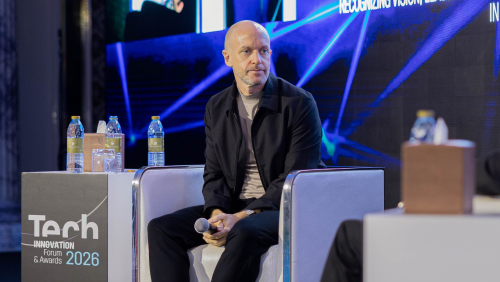
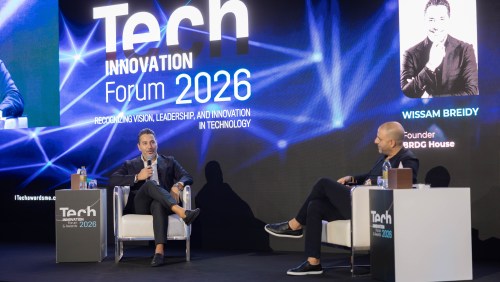
The Tech Innovation Forum 2026 Recap: Haider Khan, CEO, Bayut and dubizzle, and CEO, Dubizzle Group MENA
“You can build something really awesome, but if you can’t sell it, there’s a problem.”
You're reading Entrepreneur Middle East, an international franchise of Entrepreneur Media.
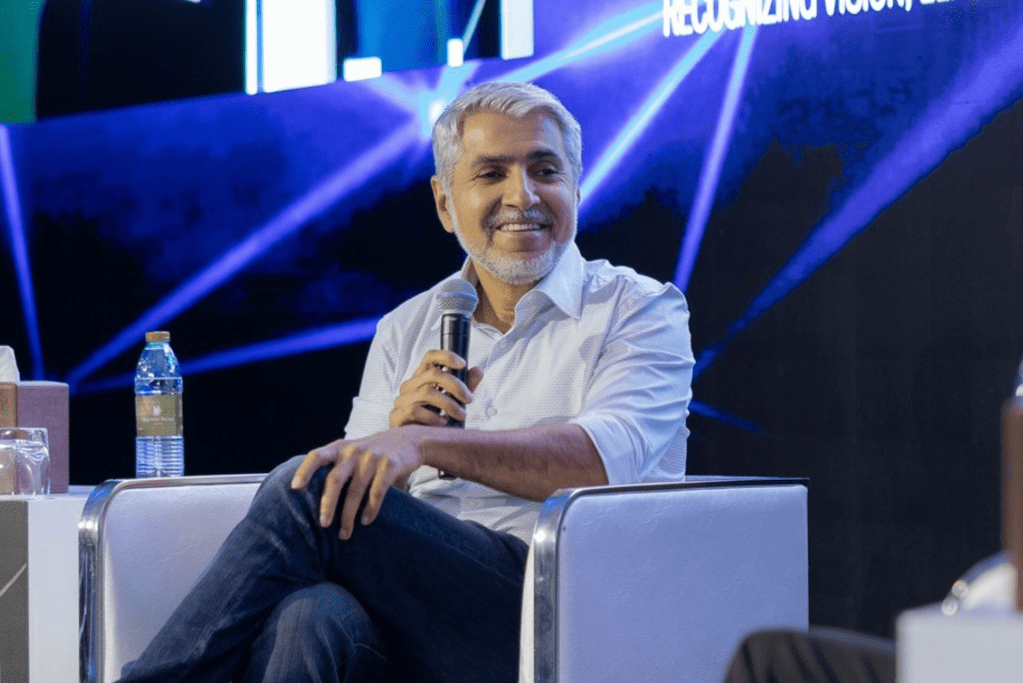
In his roles as the CEO of Bayut and dubizzle and CEO of Dubizzle Group MENA, Haider Ali Khan today helms companies whose platforms span property, cars, classifieds and jobs, with dubizzle alone listing more than 20,000 cars a month and attracting over 300,000 job seekers daily, while Bayut connects millions of property seekers and real estate professionals across the UAE as part of a group that has attracted more than US$450 million in investment. In 2021, dubizzle went one step further in becoming a part of its user base’s day-to-day vernacular with the introduction of ‘dubizzle it’: a brand catchphrase that turned the online classifieds platform into a verb, essentially meaning to list, sell or find something through the platform. But in a trajectory reminiscent of many inspiring entrepreneurial tales, Khan’s story too had humble beginnings. “The early days were at an office that was probably a little bit smaller than this stage that we’re sitting on, with just a couple of people,” he told the audience at Entrepreneur Middle East’s Tech Innovation Forum 2026, held on September 17 at Habtoor Palace.
The fireside chat, moderated by Wissam Younane, CEO of BNC Publishing [the media house behind Entrepreneur Middle East], offered a deep dive into Khan’s career so far, his decision-making processes, and his companies’ growth strategies. But what underscored the entire conversation was the element of curiosity that has quietly defined Khan’s business journey – evident right from his life-changing decision to step away from a 15-year-long tech career in the US and move to the UAE in 2014. “I was pretty well-placed. I was doing well in the US, but a part of me also felt that more can be done,” he said. “I think this is interesting because in the corporate world, you get up to a certain point. Probably not the case everywhere, but what I largely saw was that it can become fairly stagnant in terms of creativity. I felt that there’s more that can be done, so I came to Dubai. Originally, I was born in Pakistan, so it is close to home. There was this little business that was founded by my brothers. It was called Bayut. What I was told was, in our industry, we’re in general classifieds or marketplaces. You don’t challenge incumbents. I think that’s something that was interesting because all my life, I’ve just chased challenges. I thought that was an interesting challenge, so I just came here and I’ve been here since, just focused on trying to grow the business.”

While the wealth of tech-related knowledge he’d amassed up until that point held Khan in good stead from a product-improvement angle, he self-admittedly had to spend a considerable amount of time learning the ropes when it came to sales and marketing. “I have an engineering mindset, which is to get into the problem and understand things at the leaf level. At such a stage you have little to no revenue, and yet have a vision that you want to achieve something. Coming from engineering, I was never really into sales or understanding sales. But once you start managing sales, you understand that there’s a whole separate side to this world. You can build something, but if you can’t sell it, that’s where the game changes. For me personally, getting acquainted with sales and trying to understand how to run sales, and then marketing and building a brand over time, were unknown things to me. They were interesting and challenging, but also unknown territory when I came here.”
That inquisitiveness to do better is ultimately what laid the foundation for Bayut’s growth. Six years after he joined Bayut, in 2020, Bayut and dubizzle eventually came under the same group following the merger of their parent companies, Emerging Markets Property Group (EMPG) and OLX Group, which combined their MENA and South Asia operations to form a Dubai-based company valued at AED3.6 billion (US$1 billion), giving it unicorn status.
“Look, the only thing I knew when I came here was I saw what was available in the market, and I felt we could generally do a lot better than this, purely from a technology point of view,” Khan told the audience. “The part that I did not know was that, again, as I said earlier, you can build something really awesome, but if you can’t sell it, there’s a problem. In my heart, in my mind, I was well-in-tuned with the fact that we can build something way better than what’s available. The journey of actually going and then trying to sell that and make a space in a market that’s already crowded, that’s been a very learning and rewarding experience as well, but it’s not been an easy journey by any means yet.”
It therefore came as little surprise that Khan’s advice to budding entrepreneurs incorporated the need to build “a commercial mindset” while simultaneously trying to solve an existing, unaddressed problem. “I think there’s a lot of money that’s gone into tech and building tech, and you hear about the one out of hundreds or thousands of stories that are successful. But if you’re going to build a good business, you have to solve a problem, you have to solve it better than somebody else is solving it, and there needs to be a commercial angle,” he reiterated. “A lot of times when I meet people, I think the commercial angle comes in later, and that’s fine. That’s how the industry has evolved over the years, where you throw money at a problem, let people solve it and say the money will come. But if you can have that commercial mindset early on, I think it generally helps. When times get tough, nobody looks at your top line; people start looking at your bottom line.”

The success of Bayut and dubizzle has, in many ways, been reflective of the UAE’s own tale of success. Khan, in turn, noted that the country itself, and Dubai in particular, has been his North Star. “I think the inspiration for all of us, frankly, has been Dubai. That’s what’s allowed us to build these businesses,” he said. “The pace at which Dubai has grown over the last three or four years is just remarkable. The market went, if you go back to 2019 or prior years, it’s almost tenfold growth in a matter of a few years. You just don’t see that happening. So, to me, ‘dubizzle it’ is a byproduct of ‘Dubai-it’. When the government is supportive, legislation is supportive, infrastructure is good, there’s always opportunity. And it’s difficult to find that many spots in the world where you can get a combination of these together.”
Operating at the intersection of that growth and the consumers participating in it has also afforded Bayut and dubizzle another advantage: an enormous volume of data that can offer an early glimpse into how demand is shifting. “Usually we’re leading indicators because a lot of searches start on the platform,” Khan explained. “We can see how demand is shifting very early because consumers use our platform. We can gauge early patterns in terms of what’s happening and whether it’s going up or down, or what the shifts within the market are – if somebody is going to be looking for villas more than apartments. With dubizzle, we can also triangulate because we have other categories, so we can see what kind of cars are moving, where there’s probably a shortage in supply, those kinds of things. So, yes, we do get a lot of those trends.”
And as artificial intelligence increasingly reshapes how technology businesses operate, Khan believes the value of that data extends well beyond identifying consumer trends. Indeed, Dubizzle Group’s investment in AI began well before the current generative AI boom, with an emphasis on ensuring that the data driving its platforms could itself become a competitive advantage. “I think we started investing in AI about five, six years ago,” Khan said. “What I mean by that is not necessarily building LLMs or anything like that, but we have a fairly large, disproportionate team in terms of making sure that our data is clean, understanding our data and protecting our data. Because I think in this day and age, as a business, what do you have that protects you from being replaced easily? It’s the data that you have, and how well you can put a wall around it and make use of it and build your own proprietary models.”
But for all the possibilities AI presents, Khan also offered a reminder that technological adoption and consumer readiness do not necessarily evolve at the same pace. “Initially, a few years ago, I thought it’s a good productivity tool. I still believe that,” Khan said. “I think within businesses we’ve started to optimize things in terms of AI. In terms of the usage from consumers, we don’t see a huge shift. Humans don’t change habits very quickly. Anytime, whether you’re using any social platform or whatever, even when Facebook changes their interface, people don’t like it. As we introduce these tools, what we see is the adoption is pretty small. It’s increasing, but it’s fairly small. We also are fundamentally challenged with—even if we produce things fast—humans don’t adopt them as fast. As a platform, we have to manage that balance: don’t release too many things because they’re just going to go to waste.”
One aspect of Khan’s leadership that has reflected that same sense of balance is the decision to partner with and invest in up-and-coming UAE-based proptech startups that align with Bayut and dubizzle’s collective vision. Two of these have included investments in Tern, a rental rewards platform, and Takeem, a rent guarantee platform, both of which took place over the summer this year. In April last year, Dubizzle Group also acquired Property Monitor, a leading UAE-based real-estate market intelligence platform. “I think there are plenty of good businesses around. We’ve acquired a couple and invested in a few, so we’re constantly looking for those opportunities,” Khan said. “We took over Property Monitor, we’ve invested in Tern, which is using credit cards to pay your rent—I think that’s a fabulous solution if it can be scaled—and there’s Takeem, which is helping landlords get insurance. We look for these kinds of businesses because we have the consumer universe with us. We look for good founders, number one, who are executors and builders, and then we can back them financially as well as with the consumer base that we have. That’s mutually beneficial for us.”
As the conversation drew to a close, Khan’s parting words once again highlighted the need to stay curious while emphasizing the need for founders to build with purpose. “I think for those of you who are on this journey, what I’ve realized over the years is that we are kind of configured as we grow up to look for a job, find the best job and be the best at it. But when you can spread your wings a little bit and take risks early on in life, when you don’t have a lot of responsibilities, and try to live it out a little bit louder than you otherwise would and do your own thing, it is such a rewarding experience. It genuinely opens up your view of the world and how it works. So I would encourage people to be builders, to be really, really good at executing and building stuff. Frankly, when we look for people, the only quality that I look for is: can we find people who are builders, who can build stuff, who have built stuff? So try to be a bit more adventurous early on if you can. And it’s never too late. I started pretty late myself.”
RELATED: The Human Capital Question: Can Businesses Achieve Sustainability Goals Without Investing In People?
In his roles as the CEO of Bayut and dubizzle and CEO of Dubizzle Group MENA, Haider Ali Khan today helms companies whose platforms span property, cars, classifieds and jobs, with dubizzle alone listing more than 20,000 cars a month and attracting over 300,000 job seekers daily, while Bayut connects millions of property seekers and real estate professionals across the UAE as part of a group that has attracted more than US$450 million in investment. In 2021, dubizzle went one step further in becoming a part of its user base’s day-to-day vernacular with the introduction of ‘dubizzle it’: a brand catchphrase that turned the online classifieds platform into a verb, essentially meaning to list, sell or find something through the platform. But in a trajectory reminiscent of many inspiring entrepreneurial tales, Khan’s story too had humble beginnings. “The early days were at an office that was probably a little bit smaller than this stage that we’re sitting on, with just a couple of people,” he told the audience at Entrepreneur Middle East’s Tech Innovation Forum 2026, held on September 17 at Habtoor Palace.
The fireside chat, moderated by Wissam Younane, CEO of BNC Publishing [the media house behind Entrepreneur Middle East], offered a deep dive into Khan’s career so far, his decision-making processes, and his companies’ growth strategies. But what underscored the entire conversation was the element of curiosity that has quietly defined Khan’s business journey – evident right from his life-changing decision to step away from a 15-year-long tech career in the US and move to the UAE in 2014. “I was pretty well-placed. I was doing well in the US, but a part of me also felt that more can be done,” he said. “I think this is interesting because in the corporate world, you get up to a certain point. Probably not the case everywhere, but what I largely saw was that it can become fairly stagnant in terms of creativity. I felt that there’s more that can be done, so I came to Dubai. Originally, I was born in Pakistan, so it is close to home. There was this little business that was founded by my brothers. It was called Bayut. What I was told was, in our industry, we’re in general classifieds or marketplaces. You don’t challenge incumbents. I think that’s something that was interesting because all my life, I’ve just chased challenges. I thought that was an interesting challenge, so I just came here and I’ve been here since, just focused on trying to grow the business.”
While the wealth of tech-related knowledge he’d amassed up until that point held Khan in good stead from a product-improvement angle, he self-admittedly had to spend a considerable amount of time learning the ropes when it came to sales and marketing. “I have an engineering mindset, which is to get into the problem and understand things at the leaf level. At such a stage you have little to no revenue, and yet have a vision that you want to achieve something. Coming from engineering, I was never really into sales or understanding sales. But once you start managing sales, you understand that there’s a whole separate side to this world. You can build something, but if you can’t sell it, that’s where the game changes. For me personally, getting acquainted with sales and trying to understand how to run sales, and then marketing and building a brand over time, were unknown things to me. They were interesting and challenging, but also unknown territory when I came here.”

Aalia Mehreen Ahmed • Senior Features Editor, Entrepreneur Middle East
Entrepreneur Staff
Aalia Mehreen Ahmed is the Senior Features Editor at Entrepreneur Middle East. She is an... Read more