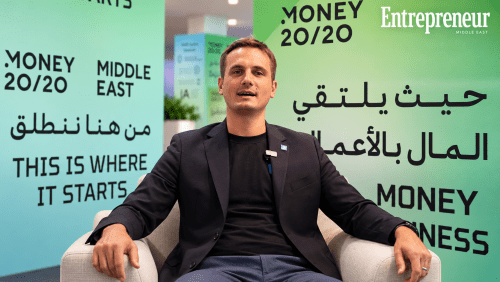
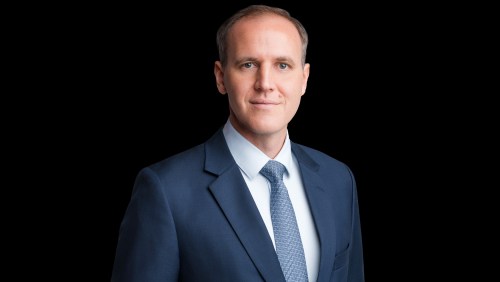
The Finance Frontier 2026: Mahmoud Abu Ebeid, Co-founder and CEO, Global Software Solutions Group
Mahmoud Abu Ebeid, Co-founder and CEO of Global Software Solutions Group (GSS Group), shares how artificial intelligence, Open Finance, and digital transformation are reshaping financial services while reinforcing trust, resilience, and innovation across the banking sector.

Entrepreneur Middle East
You're reading Entrepreneur Middle East, an international franchise of Entrepreneur Media.

Mahmoud Abu Ebeid’s approach to financial technology is shaped by his background in engineering: an emphasis on systems, structure, and long-term foundations.
A civil engineering graduate of the American University of Sharjah, Abu Ebeid spent the early part of his career working in a field where complex projects required careful planning and coordination, which later influenced how he viewed technology’s role in finance.
Mahmoud has also pursued executive courses at Harvard Business School, further strengthening his leadership philosophy and global perspective on innovation, governance, and sustainable growth. He has also completed the Fintech Course from Harvard VPAL.
In 2021, he left engineering to co-found Global Software Solutions Group (GSS Group), a UAE-headquartered enterprise solution provider in the banking and financial services sector, working on areas including digital banking, payment modernization, Open Finance, artificial intelligence (AI), and cloud transformation.
Today, the company works with 25 financial institutions and supports millions of financial transactions daily across the UAE.
As CEO and co-founder of GSS Group, Abu Ebeid believes leadership in finance today is no longer about simply managing change, but about anticipating and shaping it. As technology reshapes the industry, he says financial institutions are already competing on speed, intelligence, trust, and the ability to innovate continuously.
“I believe technology has fundamentally changed the role of leadership. Artificial intelligence, Open Finance, real-time payments, and cloud technologies are not simply digital initiatives; they are redefining how economies function and how value is created. Yet, despite all this innovation, one principle remains unchanged: finance is built on trust,” he stresses.
“As leaders, our responsibility is to ensure that innovation strengthens trust rather than compromises it. That means combining technological ambition with strong governance, regulatory discipline, and an unwavering commitment to customer confidence,” Abu Ebeid adds. “Every platform we build, every financial institution we support, and every innovation we introduce is guided by a single philosophy: technology should make finance more inclusive, more intelligent, more resilient, and ultimately more human.”
While technology is changing how financial institutions deliver services, Abu Ebeid believes the process cannot come at the expense of the trust built over decades. He argues that the challenge for financial leaders is finding a balance between adopting new capabilities and maintaining the systems that customers and regulators rely on.
“Financial institutions have earned public trust over decades, and that trust cannot be sacrificed in the pursuit of speed. Equally, institutions that fail to innovate risk becoming irrelevant. Our role is to help bridge these two realities,” he explains. “At GSS Group, we modernize financial institutions without disrupting the foundations that make them resilient.”
Rather than replacing existing systems entirely, Abu Ebeid says successful transformation requires integrating new technologies with existing operations.
“Our experience supporting more than 25 financial institutions has demonstrated that successful transformation is not about replacing legacy systems overnight. It is about creating an intelligent evolution where innovation integrates seamlessly with existing operations while improving efficiency, customer experience, and long-term competitiveness.”
Beyond technology, he also points to talent as a critical part of transformation. For Abu Ebeid, the success of digital initiatives depends not only on the platforms being built, but also on the engineers, specialists, and teams responsible for implementing them.
“Technology alone does not transform organizations,” he emphasizes. “People do.”
“By bringing together world-class engineers, architects, and domain experts, we help our clients accelerate innovation while maintaining the confidence of regulators, customers, and shareholders,” he says.
GSS Group’s approach is built on three pillars: diversification, talent development, and disciplined execution. For Abu Ebeid, these areas are essential to building a company that can adapt to market changes while maintaining long-term growth.
Since its establishment, GSS Group has also been involved in several initiatives supporting the UAE’s financial infrastructure, including the country’s National Payment Systems Strategy (NPSS), a roadmap to modernize the country’s payment infrastructure, and the Central Bank of the UAE’s Financial Infrastructure Transformation (FIT) Program.
“We are privileged to work alongside the Central Bank of the UAE and leading financial institutions and national initiatives across the UAE, contributing to an ecosystem that is becoming a global benchmark for innovation,” Abu Ebeid says.
“What makes the region exceptional is not only its investment in technology but also its willingness to embrace collaboration between regulators, financial institutions, fintech innovators, and technology partners.”
In terms of capital, Abu Ebeid believes the focus has shifted from simply moving money to improving how it moves. Technology now determines how efficiently, securely, and intelligently financial resources can flow across markets and institutions.
“Capital has always powered economic growth. Today, technology determines how efficiently, securely, and intelligently that capital moves,” Abu Ebeid says.
He believes the UAE’s financial ecosystem has evolved through collaboration between regulators, banks, fintech companies, and technology providers, with continued investment in digital infrastructure helping create an environment where financial innovation can develop alongside strong regulatory standards.
“Our ambition extends beyond delivering successful projects. We want to contribute to a financial ecosystem that is more connected, more inclusive, and better prepared for the future,” he states. “As a national UAE-based company, we also see it as our responsibility to develop local talent, support national priorities, and help position the region as a global center for financial innovation.”
“We are not simply building technology for the financial sector, we are helping build the future infrastructure of trust, opportunity, and economic growth,” he adds.
Looking ahead, Abu Ebeid expects the next phase of financial services to be shaped by technologies such as AI, Open Finance, real-time payments, and embedded finance. Together, he says, these developments will create a more connected financial ecosystem where services become increasingly seamless and personalized.
“We are committed to building the platforms, talent, and capabilities that allow financial institutions to innovate faster, operate smarter, and compete confidently in an increasingly digital global economy,” he declares. “The future of finance will not be defined by individual institutions, it will be defined by connected ecosystems. That is where the greatest opportunities lie.”
RELATED: The Finance Frontier 2026: Mohamed ElEtreby, CEO, National Bank of Egypt (NBE)
Mahmoud Abu Ebeid’s approach to financial technology is shaped by his background in engineering: an emphasis on systems, structure, and long-term foundations.
A civil engineering graduate of the American University of Sharjah, Abu Ebeid spent the early part of his career working in a field where complex projects required careful planning and coordination, which later influenced how he viewed technology’s role in finance.
Mahmoud has also pursued executive courses at Harvard Business School, further strengthening his leadership philosophy and global perspective on innovation, governance, and sustainable growth. He has also completed the Fintech Course from Harvard VPAL.

Entrepreneur Middle East Staff
Entrepreneur Staff