State of AI 2026 Report: 10 Facts Every Leader Needs to Know
The State of AI 2026 also profiles the six kingpins of AI, ten charts that define where the technology stands, a deeper look at the intersection of AI across various sectors including healthcare, cybersecurity, construction, and finance, along with a candid look at the challenges ahead, from chip supply to impact on jobs.
You're reading Entrepreneur Middle East, an international franchise of Entrepreneur Media.
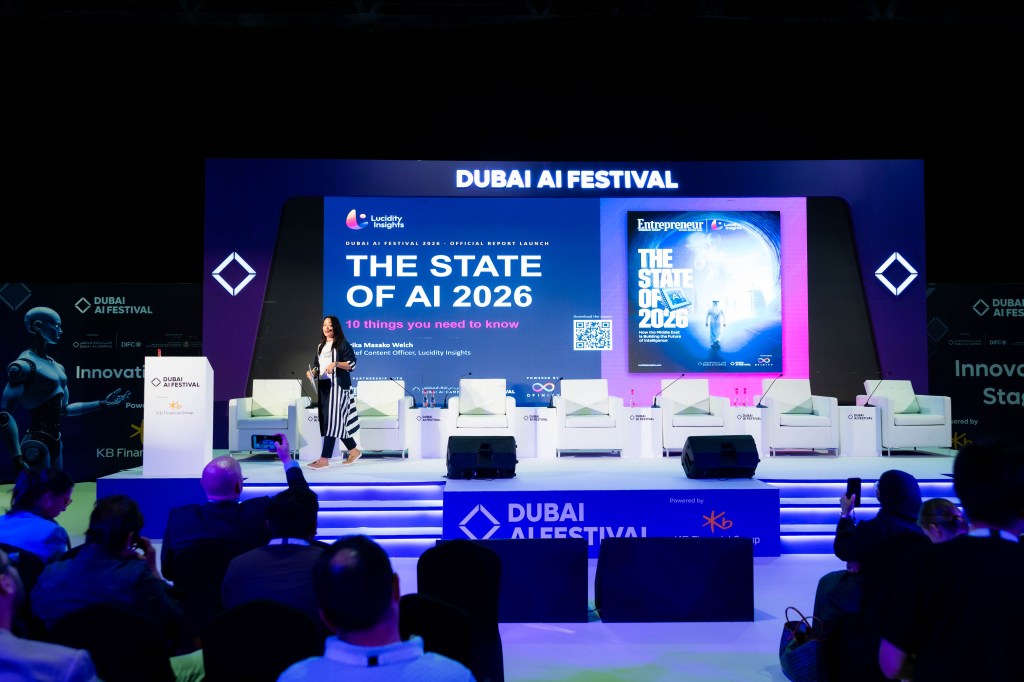
The State of AI 2026 Report, the official publication of the Dubai AI Festival, launched on October 27, 2026, with a keynote by Erika Welch, Chief Content Officer at Lucidity Insights. Developed by Lucidity Insights in collaboration with Dubai AI Campus, powered by the DFINITY Foundation and distributed by Entrepreneur Middle East, the 100-page report tracks AI’s evolution worldwide and the new AI power corridor being built in the UAE and Saudi Arabia.
“Twelve months ago, the question was whether artificial intelligence would reorganize the global economy,” Welch told the audience. “That question is settled. The one that remains is far more interesting: who is organized to capture it, and how fast?”
From the report, she hand-picked ten facts that answer it.
AI can do far more, for far less
AI agents now fix 96% of real-world software bugs on SWE-bench Verified, the industry’s standard coding test. In late 2023, the best systems managed 4%. The caveat she explained was that when METR asked maintainers to review AI fixes that had passed, they would have rejected about half. The takeaway? AI can draft solutions, but humans must still sign off.
Cost has collapsed at the same time. GPT-3.5-level AI cost about US$20 per million tokens when ChatGPT launched in November 2022. By October 2024, it cost US$0.07, more than 280 times cheaper. When capability rises and cost collapses together, autonomy stops being a demo and becomes a procurement decision.
Financed like railways, powered like nations
AI companies raised US$226 billion in Q1 2026 alone, more than in all of 2025. OpenAI’s single US$122 billion round took more than half of it. Amazon, Alphabet, Microsoft and Meta – today’s hyper-scalers – are projected to spend more than US$720 billion of capital expenditure this year, nearly five times their 2023 spend. Welch explained that AI is no longer financed like software; AI is now being built and financed like power grids and railways.
That capital has produced the fastest-scaling companies in history. Anthropic’s ARR rose from about US$1 billion in 2024 to US$65 billion by August 2026. Its coding tool, Claude Code, went from zero to US$2.5 billion in annualized revenue in nine months. NVIDIA became the first company ever to pass a US$5 trillion market value.
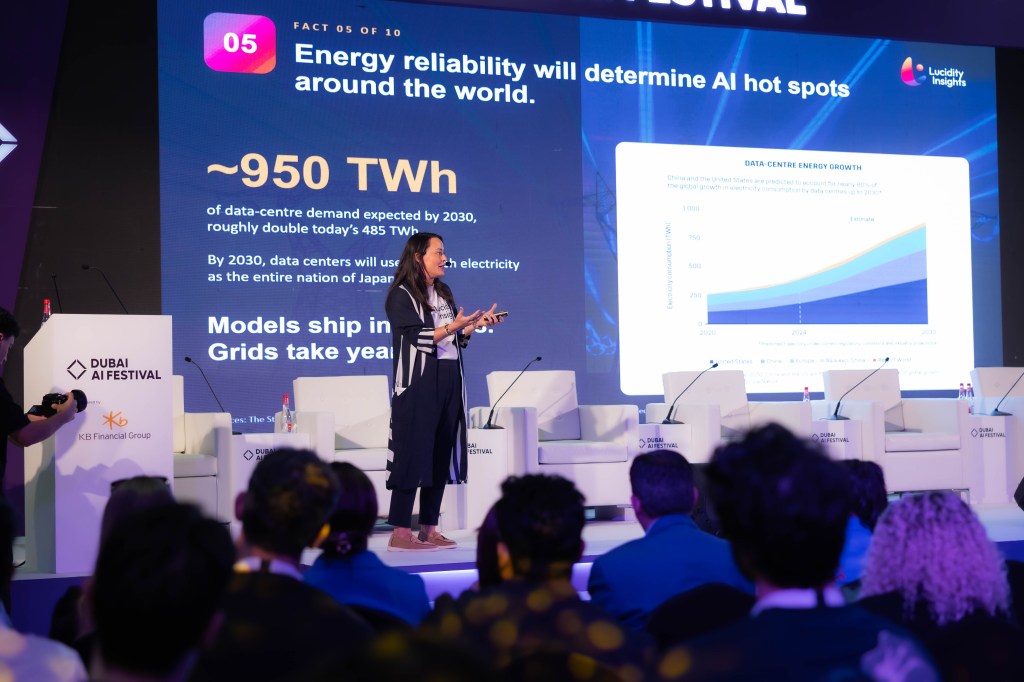
The emerging constraint, Welch explained, is electricity. Data centers used about 485 TWh in 2025, and the IEA expects roughly 950 TWh by 2030, slightly more than Japan uses today. While the world uses more energy to become AI-first societies, the challenge is that AI models ship in months, while energy grids take years to build out. Welch noted that this might be a competitive advantage for Gulf countries, which are quickly building out AI-ready energy grids at record speed.
AI Impact also means AI Risk
The most human proof point comes from healthcare, where AI is catching cancers where human doctors are missing them. Sweden’s MASAI trial, covering more than 100,000 women, found that AI-supported screening detected 80.5% of breast cancers, against 73.8% for standard reading by two radiologists. In September 2026, Insilico Medicine dosed the first patient in a Phase III trial of a drug developed entirely led by generative AI.
AI also cuts the other way. In 2025, attackers exploited software flaws on average seven days before a patch existed, according to Google’s Mandiant. Inside enterprises, machine identities such as bots, agents and APIs now outnumber humans by about 109 to one. Welch explained that these identifies must also be secured.
Three gaps defining AI 2026
Adoption is no longer the story; impact is. Welch explained that nine in ten organizations use AI regularly, but only 6% attribute 5% or more of their earnings to it. The gap is widening by company size: 40% of billion-dollar firms are scaling AI agents, up from 27%, while smaller firms remain at 22% with no change since 2025. The gap is widening by geography too, with AI use at 27.5% in the Global North and 15.4% in the Global South.
The difference, the report finds, is not access to models. It is the willingness to redesign work flows and companies around them.
Why Dubai is the place to be
At the top of the global adoption map sits the UAE. According to Microsoft’s AI Diffusion Report, released in September 2026, more than 70% of working-age adults in the United Arab Emirates use AI, the highest rate in the world, ahead of Singapore at 63% and more than double the United States at 31% and Saudi Arabia at 30%.
Dubai is turning that lead into an operating model. In late April 2026, His Highness Sheikh Hamdan bin Mohammed bin Rashid Al Maktoum, Crown Prince of Dubai, directed the emirate’s government and private sector to move to agentic AI within two years. Within about six weeks, the UAE committed to moving 50% of government services to agentic AI and launched an 80,000-person training program for government employees. Dubai also set out plans to support 295,000 companies to adopt AI within the same timeframe.
“Where others set ambitions, Dubai set deadlines,” Welch said.
The ecosystem is following. Dubai AI Campus at DIFC set a target of 500 AI companies by 2028. It now hosts 505, two years early, and those companies have created more than 2,020 jobs. For global AI firms, Dubai is a launchpad to the Middle East, Africa and South Asia.
Read the full report
The State of AI 2026 also profiles the six kingpins of AI, ten charts that define where the technology stands, a deeper look at the intersection of AI across various sectors including healthcare, cybersecurity, construction, and finance, along with a candid look at the challenges ahead, from chip supply to impact on jobs. Printed copies were distributed at the session, but the digital edition is available at lucidityinsights.com/reports.
“If 2023 was the year of awakening, 2024 the year of acceleration, and 2025 the year of AI agents, then 2026 is the year of reckoning,” Welch said. “The race is well underway.”
The State of AI 2026 Report, the official publication of the Dubai AI Festival, launched on October 27, 2026, with a keynote by Erika Welch, Chief Content Officer at Lucidity Insights. Developed by Lucidity Insights in collaboration with Dubai AI Campus, powered by the DFINITY Foundation and distributed by Entrepreneur Middle East, the 100-page report tracks AI’s evolution worldwide and the new AI power corridor being built in the UAE and Saudi Arabia.
“Twelve months ago, the question was whether artificial intelligence would reorganize the global economy,” Welch told the audience. “That question is settled. The one that remains is far more interesting: who is organized to capture it, and how fast?”
From the report, she hand-picked ten facts that answer it.

Entrepreneur Middle East Staff
Entrepreneur Staff