FII Innovators Spotlight: How Argon Mechatronics Is Bringing Affordable Robotics to Smaller Businesses
“Our biggest challenge was proving that we could ship, not just build. With our technology deployed, our focus is now on scaling and helping our customers achieve their goals of greater efficiency and productivity.”
You're reading Entrepreneur Middle East, an international franchise of Entrepreneur Media.
This story is part of an Entrepreneur Middle East series spotlighting the five winning startups of the third edition of the FII Innovators Pitch, organized by the Future Investment Initiative (FII) Institute in partnership with MIT Solve. Selected from 1,321 applications across 90 countries, the winning startups were recognized for developing innovative technologies that address global challenges.

One needn’t be a tech aficionado to know that robots are slowly but surely becoming an integral part of the business ecosystem. Estimated to grow from US$106.69 billion in 2026 to $223.28 billion by 2032, the global robotics market is on an upward trajectory that is only expected to keep rising given the increasing use of automation in manufacturing, growing demand for faster and more efficient operations, wider adoption of robots in healthcare and logistics, and improvements in robotic sensors and artificial intelligence (AI). But when it comes to the deployment of these robots, Zaib Husain, founder and Board Chair of US-based Argon Mechatronics, says that she and the startup’s Board Director, Amir Husain, noticed a concerning pattern. “Industrial robots were built for the world’s largest automakers: expensive, single purpose, and dependent on specialist integrators to install and reprogram. But most manufacturers and research labs are small or mid-sized, and their work changes every few months. They were priced out of automation or stuck with a robot that could only do one job.”
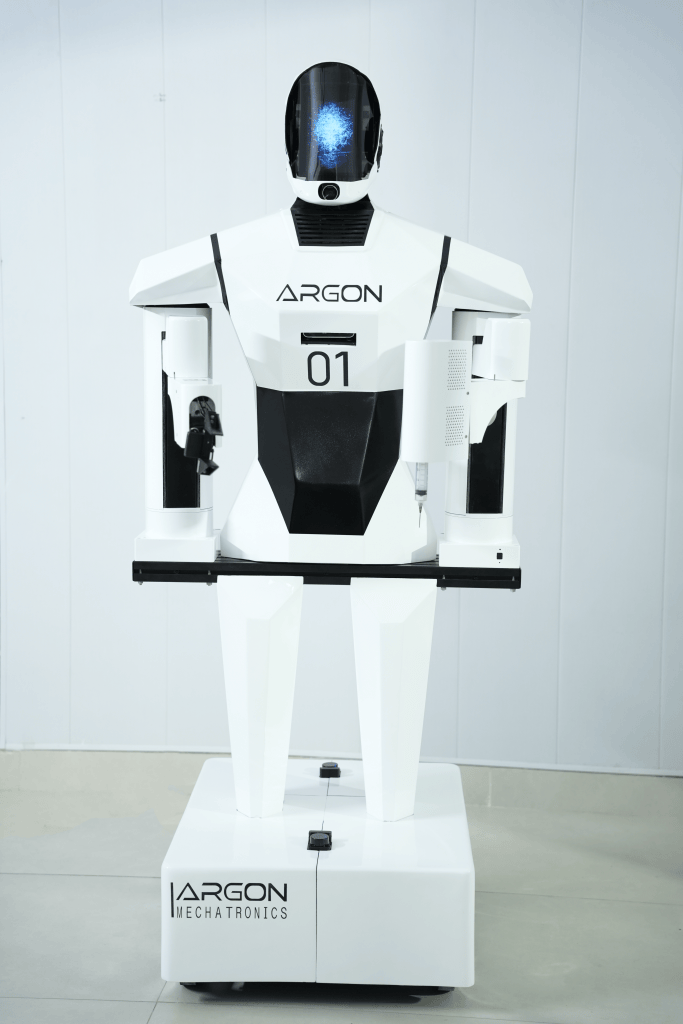
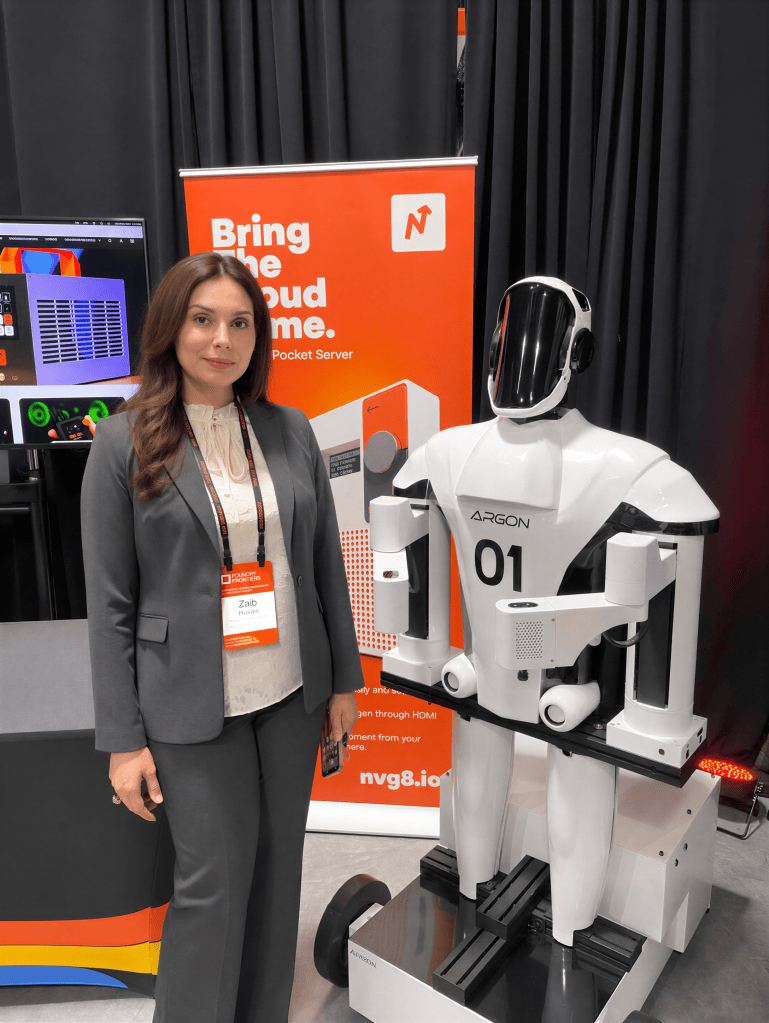
“We started Argon Mechatronics in 2024 to build robots that are precise, easy to use, and affordable,” she explains. “Our first product, the Argon SCARA, is a benchtop robotic arm with swappable toolheads, so the same arm can pick and place, dispense, 3D print, laser engrave, or mill, among many other applications. Our debut humanoid, Argon One pairs two of those arms with a mobile base so it can carry work between stations on a lab or factory floor. We’ve integrated computer vision and AI into our software for an even more seamless automation process.”
Husain then adds that there are two pressing matters that continue to affect the industry: a shortage of skilled workers and the high cost of automation. “Deloitte and The Manufacturing Institute project that US manufacturers could need 3.8 million new workers between 2024 and 2033, and that 1.9 million of those jobs could go unfilled,” she elaborates. “Labs face the same squeeze: highly trained scientists spend hours on repetitive tasks like dispensing and sample prep. When it comes to the challenge of access, The International Federation of Robotics notes that most manufacturers are small and medium-sized companies, and that high upfront costs and low production volumes have historically kept them from automating.”
As such, Husain notes that Argon addresses both challenges. “The Argon SCARA starts at around $10,000, sits on a benchtop, and runs on standard G-Code and one-click predefined tasks, so teams can put it to work without a large integration project. When the work changes, the customer can just swap out the toolhead instead of buying a new robot. And the impact extends beyond accessibility. Global studies estimate $8.5 trillion in potential annual revenue losses for manufacturers by 2030 under traditional automation models. Similarly, automation in pharma could save nine to 12 months in development timelines and generate up to $400 million in additional net present value (NPV) through earlier access and lower costs for each new drug. Argon helps make these gains more accessible through affordable, flexible robotics.”
Argon Mechatronics’ technology has already been implemented at the University of Mississippi School of Pharmacy, where researchers use its robots to test drug formulations and accurately measure and dispense different doses of medication into individual blister packs. Having initially funded the startup’s development themselves, the founders secured investment from Moneta Ventures in July 2026, marking an important step toward scaling the business. However, securing funding for hardware-based startups comes with its own challenges. “Hardware is harder to fund than software. It takes more capital and more time to move from prototype to product, and investors know a robot has to work in the real world, not just in a demo. Our biggest challenge was proving that we could ship, not just build. With our technology deployed, our focus is now on scaling and helping our customers achieve their goals of greater efficiency and productivity.”
Part of the team’s efforts towards the startup’s next stage of expansion has been aided by its win at the third edition of the FII Innovators Pitch. “We launched both our products at FII8 in Riyadh in 2024, so returning to FII as a pitch winner feels like coming full circle,” Husain says. “It’s a real validation of the team’s work and our journey, and we want to use this platform to meet strategic partners in the Kingdom and the wider MENA region who can host deployments, and investors who understand hardware and the longer runway it takes to scale manufacturing. FII also gives us an incredible launch point for international expansion beyond our home market in Texas.”
Indeed, Husain notes that Saudi Arabia’s rapidly expanding industrial sector presents significant opportunities for Argon Mechatronics. With the Kingdom’s National Industrial Strategy targeting approximately 36,000 factories by 2035, and its Future Factories Program aiming to help 4,000 factories adopt automation and advanced manufacturing technologies, the demand for affordable and flexible robotic solutions is expected to grow. “However, we see three openings for Argon,” she says.
“First, new and growing manufacturers that need precision automation sized for mixed, changing production rather than a single high-volume line. Second, pharmaceutical and life sciences; where the Kingdom is investing in local production and where our dispensing and lab automation work already applies. Third, education and workforce training. KSA is investing heavily in technical skills, and an affordable, programmable robot is an ideal tool for training the next generation of engineers.”
And even though Husain’s sights are set on Argon Mechatronics’ current set of goals for now, the founder already has a plan in motion for the startup’s long-term ambitions. “We want local partners: industrial operators for pilots, distributors and integrators who can support customers on the ground, and universities for research and training programs. Our goal is thus to leave FII with concrete next steps: partnership conversations, and relationships that support our next phase of growth.”
‘TREP TALK: Zaib Husain, founder and Board Chair of Argon Mechatronics, on why great leadership means trusting the right people
My biggest lesson is that a founder’s job changes as the company grows, and having the right people alongside for the journey makes all the difference. This year we appointed Lainey Corliss as CEO, so we can focus on customer success and revenue while also building our long-term strategy, partnerships, and governance. We have also built out our advisory board and leadership team with people who bring in a diverse range of industry experience. On shared vision, we keep it fundamental. Every product decision goes back to three words: precise, intuitive, and accessible. When the team agrees on those, people can make good decisions. Investing in people means trusting them; the right hires don’t need to be managed closely. They need clear goals, ownership of real outcomes, and the room to deliver.
This story is part of an Entrepreneur Middle East series spotlighting the five winning startups of the third edition of the FII Innovators Pitch, organized by the Future Investment Initiative (FII) Institute in partnership with MIT Solve. Selected from 1,321 applications across 90 countries, the winning startups were recognized for developing innovative technologies that address global challenges.
One needn’t be a tech aficionado to know that robots are slowly but surely becoming an integral part of the business ecosystem. Estimated to grow from US$106.69 billion in 2026 to $223.28 billion by 2032, the global robotics market is on an upward trajectory that is only expected to keep rising given the increasing use of automation in manufacturing, growing demand for faster and more efficient operations, wider adoption of robots in healthcare and logistics, and improvements in robotic sensors and artificial intelligence (AI). But when it comes to the deployment of these robots, Zaib Husain, founder and Board Chair of US-based Argon Mechatronics, says that she and the startup’s Board Director, Amir Husain, noticed a concerning pattern. “Industrial robots were built for the world’s largest automakers: expensive, single purpose, and dependent on specialist integrators to install and reprogram. But most manufacturers and research labs are small or mid-sized, and their work changes every few months. They were priced out of automation or stuck with a robot that could only do one job.”
“We started Argon Mechatronics in 2024 to build robots that are precise, easy to use, and affordable,” she explains. “Our first product, the Argon SCARA, is a benchtop robotic arm with swappable toolheads, so the same arm can pick and place, dispense, 3D print, laser engrave, or mill, among many other applications. Our debut humanoid, Argon One pairs two of those arms with a mobile base so it can carry work between stations on a lab or factory floor. We’ve integrated computer vision and AI into our software for an even more seamless automation process.”

Aalia Mehreen Ahmed • Senior Features Editor, Entrepreneur Middle East
Entrepreneur Staff
Senior Features Editor at Entrepreneur Middle East and host of Anchored Echoes, with nearly seven... Read more