FII Innovators Spotlight: FII Innovators Spotlight: How Nevomo Is Turning Ordinary Wagons Into Self-Driving Vehicles
“Rail is the most sustainable way to move goods and people, yet it keeps losing market share to trucks because it is slow, inflexible and expensive to operate for smaller volumes.”
You're reading Entrepreneur Middle East, an international franchise of Entrepreneur Media.
This story is part of an Entrepreneur Middle East series spotlighting the five winning startups of the third edition of the FII Innovators Pitch, organized by the Future Investment Initiative (FII) Institute in partnership with MIT Solve. Selected from 1,321 applications across 90 countries, the winning startups were recognized for developing innovative technologies that address global challenges.

When a team of engineers came together in 2017 to explore the idea of ultra-high-speed transportation, they soon realized that building an entirely new transport network from scratch would require enormous investments and decades of work. This led them to a simpler yet ambitious question: what if the future of transportation could be built around the railway infrastructure that already exists? “That question became MagRail: a magnetic propulsion and passive levitation technology that can be retrofitted onto existing railway tracks,” says Ben Paczek, founder and Chief Development Officer at Warsaw‑based transportation startup, Nevomo.
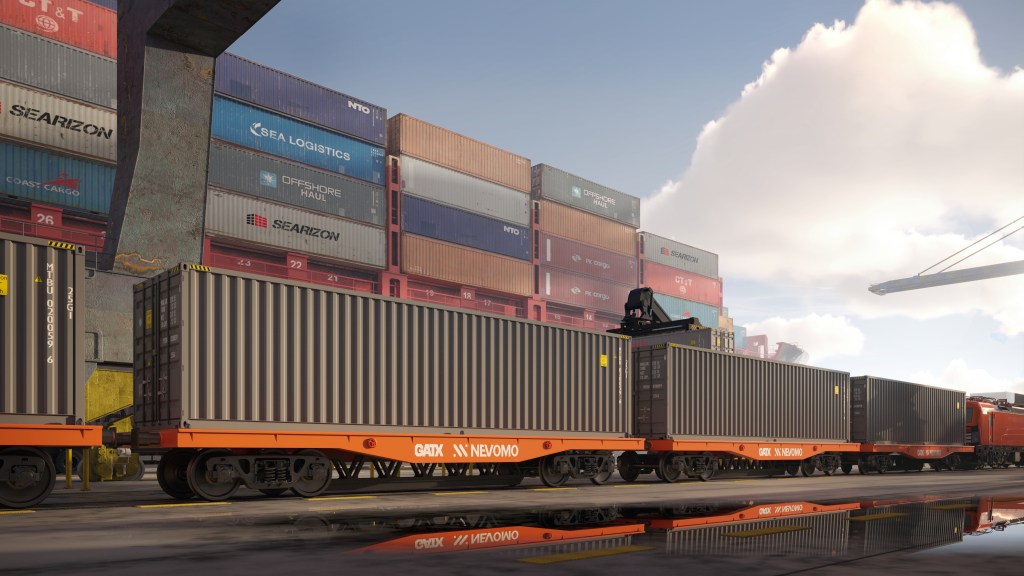
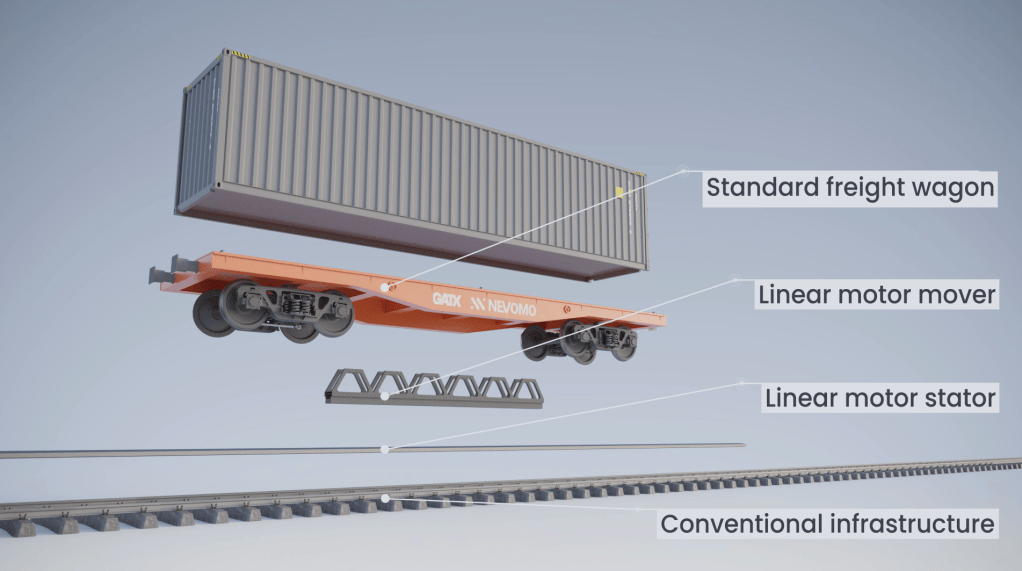
Paczek explains that the gap he and his team wanted to address was a clear one. “Rail is the most sustainable way to move goods and people, yet it keeps losing market share to trucks because it is slow, inflexible and expensive to operate for smaller volumes. Our first commercial product, the Cargo MagRail Booster, turns individual freight wagons into autonomous, self-propelled units that can move without a locomotive at speeds of up to 160 km/h. Combined with AI-powered logistics, it gives operators the flexibility of a truck with the efficiency and carbon footprint of rail.”
The scale of this “capacity and flexibility problem” is particularly evident in Europe, says Paczek. “In Europe, rail still carries only around one-sixth of inland freight, even though the EU aims to increase rail freight traffic by 50% by 2030 and to double it by 2050. At the same time, building new lines is slow and capital-intensive almost everywhere in the world.”
For Nevomo, addressing this gap means making better use of existing railway infrastructure rather than building entirely new networks. “Our linear motors are installed between the rails, and the wagons get a compact set of components that lets them move autonomously and contactlessly,” Paczek adds. “This removes the locomotive bottleneck in ports and terminals, increases throughput on existing track and enables a fully electric, automated operation.”
But the issue Nevomo addresses isn’t unique to Europe. As the startup’s team soon found out, courtesy its participation and subsequent victory at the FII Innovators’ pitch this year, Saudi Arabia too is a promising market. “Saudi Arabia is one of the most exciting rail and logistics markets in the world right now,” Paczek says. “Under Vision 2030 and the National Transport and Logistics Strategy, railways receive the largest share of transport investment, and the Kingdom aims to raise rail’s share of transport to around 30%. Projects such as the Saudi Landbridge, which will link the Red Sea with the Arabian Gulf, new logistics corridors connecting Gulf ports with the interior, and future GCC rail links create exactly the kind of environment where new technology can be built in from day one rather than retrofitted later.”
All of this points towards three specific opportunities, according to the founder. “First, market access: large ports, industrial cities and logistics zones need automated, high-throughput wagon handling – a direct fit for the MagRail Booster. Second, partnerships: we want to work with Saudi Arabia Railways, port operators and industrial players to run pilot deployments and adapt the technology to the region’s climate and operational needs. Third, long term growth: we see the Kingdom as a potential regional hub for Nevomo, including local engineering, assembly and service capabilities that support localisation goals and serve the wider Middle East.”
Apart from its endeavors in and ambitions for the Kingdom, the startup has also made significant progress in testing and commercializing its technology. “We have validated the technology on our test track in Nowa Sarzyna, Poland, where in 2023 we performed the world’s first tests of magnetic levitation on existing railway infrastructure, reaching 135 km/h. In October 2025 we signed our first commercial contract with Deendayal Port Authority in India, one of the country’s largest ports. In 2026 our team was also named a finalist of the European Inventor Award by the European Patent Office, recognising the patents behind MagRail.”
On the other hand, Nevomo’s funding journey has been supported by a mix of private investment and public grants, including backing from EIT InnoEnergy and entrepreneur Jacques Berrebi’s family office, although securing capital for infrastructure technology remains challenging. “The biggest challenge for a company like ours lies in the fact that rail is a conservative, highly regulated sector, certification and procurement take time, and many investors prefer asset-light software models with faster returns. Hardware also needs more capital upfront for prototypes, test tracks and pilots.”
However, Paczek believes that investor expectations are increasingly focused on tangible results. “Today, investors look for proof of commercial traction rather than just a promising technology – signed contracts, paying customers, a clear path to scale and strong unit economics.”
Paczek also adds that for hardware and infrastructure startups like Nevomo, turning successful trials into large-scale commercial operations requires not only significant investment, but also trust and the right strategic partnerships. To gain all of that, and propel his startup into its next phase of scaling, the founder believes the FII will prove to be a doorway to the right connections. “FII gives us direct access to decision-makers who shape infrastructure and logistics investments across the Middle East and beyond: sovereign and institutional investors, rail and port operators, and industrial groups,” he says. “Our goals are concrete – to secure growth capital for scaling deployments, to start pilot projects with partners in Saudi Arabia and the GCC, and to build relationships that open new markets in Asia and Europe. We have already been active in the region, presenting at trade fairs in Saudi Arabia and the UAE, and FII is the natural next step to turn those conversations into projects.”
‘TREP TALK: Ben Paczek, founder and Chief Development Officer of Nevomo, on why building a deep-tech startup is a marathon, not a sprint
“My biggest lesson is that a deep-tech company is a marathon, and you can only run it with people who believe in the destination. In the early days we were a small group of enthusiasts with a bold idea. As we grew, I learned that passion alone is not enough – you need to hire people who are better than you in their fields, give them real ownership and trust them to make decisions.
“Investing in people also means being honest about the journey. Building infrastructure technology involves setbacks, long testing cycles and pivots, like our shift from a pure hyperloop vision to MagRail on existing tracks. Explaining the ‘why’ behind every major decision helped us keep the team aligned even when the plan changed. Finally, a shared vision has to be simple enough for everyone to repeat. For us it is: making rail faster, smarter and more sustainable using the infrastructure that already exists. When an engineer, a salesperson and an investor can all explain that in one sentence, you know the team is moving in the same direction.”
RELATED: The Business of Dreams: Simon Squibb on Entrepreneurship, Building Trust, and Taking Risks
This story is part of an Entrepreneur Middle East series spotlighting the five winning startups of the third edition of the FII Innovators Pitch, organized by the Future Investment Initiative (FII) Institute in partnership with MIT Solve. Selected from 1,321 applications across 90 countries, the winning startups were recognized for developing innovative technologies that address global challenges.
When a team of engineers came together in 2017 to explore the idea of ultra-high-speed transportation, they soon realized that building an entirely new transport network from scratch would require enormous investments and decades of work. This led them to a simpler yet ambitious question: what if the future of transportation could be built around the railway infrastructure that already exists? “That question became MagRail: a magnetic propulsion and passive levitation technology that can be retrofitted onto existing railway tracks,” says Ben Paczek, founder and Chief Development Officer at Warsaw‑based transportation startup, Nevomo.
Paczek explains that the gap he and his team wanted to address was a clear one. “Rail is the most sustainable way to move goods and people, yet it keeps losing market share to trucks because it is slow, inflexible and expensive to operate for smaller volumes. Our first commercial product, the Cargo MagRail Booster, turns individual freight wagons into autonomous, self-propelled units that can move without a locomotive at speeds of up to 160 km/h. Combined with AI-powered logistics, it gives operators the flexibility of a truck with the efficiency and carbon footprint of rail.”

Aalia Mehreen Ahmed • Senior Features Editor, Entrepreneur Middle East
Entrepreneur Staff
Senior Features Editor at Entrepreneur Middle East and host of Anchored Echoes, with nearly seven... Read more