Nine Surprising Charts That Show How Dubai’s Economy Absorbed the 2026 Shock
Dubai’s resilience is not a story of avoiding disruption. It is a story of keeping people, companies, capital and commerce moving when disruption arrives.
Opinions expressed by Entrepreneur contributors are their own.
You're reading Entrepreneur Middle East, an international franchise of Entrepreneur Media.
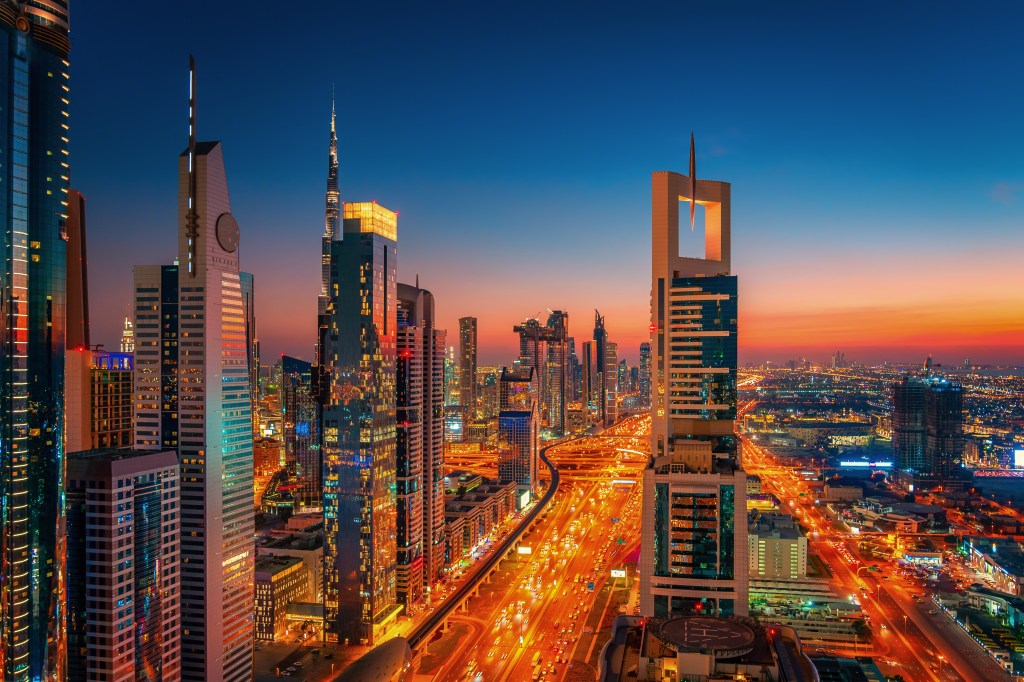
When people call an economy “resilient,” they often mean that its headline numbers did not fall. That is too narrow. A resilient economy can take a hit, redirect activity and restore normal functions before temporary disruption becomes lasting damage.
Dubai offers a live case study. Last year, the city was ranked the third safest city in the world, according to the Numbeo Safety Index. In 2026, a regional war broke out. The war interrupted aviation, altered shipping routes and tested business confidence. As of publication of this article, the latest officially confirmed incident identified in public reporting was the interception of an Iranian drone over UAE territorial waters on August 31, 2026. That doesn’t mean Dubai is fully back, though the streets are packed and the city hums with activity.
Over the past few months Lucidity Insights has been speaking to startup founders and investors here in the region that are revealing real on-the-ground data that is illuminating Dubai’s true recovery arc, by sector, by customer-type, by consumer behavior trends. Data was gathered from across the market, showcasing what has happened in real-time. It tells an interesting story about what kept expanding, what found another route and what recovered quickly – and what areas are still struggling as we wrap up Q3 2026.
For entrepreneurs, understanding Dubai’s recovery and where the data points can make the difference between the start of your growth story or the end. Of course, all companies have been facing some shocks in this black swan event: whether via a supplier failing to deliver, logistics costs rising, customer demand changing or capital deployment slowing as investors adjust their risk and evaluation metrics. Dubai’s experience points to seven practical dimensions of resilience— economic growth in the face of uncertainty, talent retention and population growth, continued business formation, real estate valuations holding, trade optionality, investor conviction, and identifying the pillars of economy driving Dubai’s recovery.
1. Growth slowed, but it did not surrender its lead
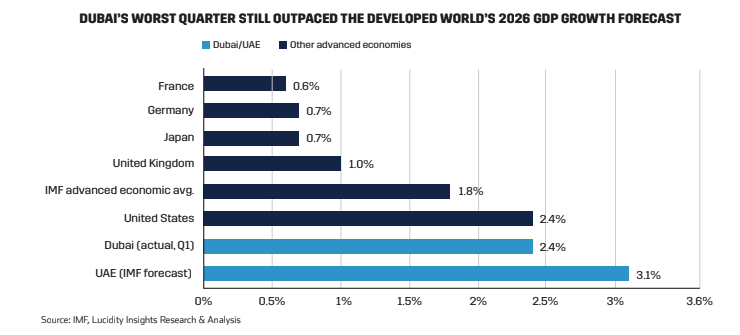
Let’s put the impact of the regional geopolitical conflict in context. Dubai’s economy grew 2.4% in the first quarter of 2026. In an ordinary year, that figure might look modest beside the city’s ambitions. In context, it is striking: even that slower quarter exceeded the full-year 2026 growth forecast for every G7 economy, while the International Monetary Fund still expects the wider UAE economy to grow 3.1% for the year.
The useful lesson is not that Dubai escaped the shock. It is that no single engine had to carry the entire economy. A broad base of trade, finance, real estate, tourism, logistics and professional services created room for weakness in one area without forcing the whole system into collapse.
Founders can apply the same principle at company level. Resilience is stronger when revenue, suppliers and acquisition channels are diversified before a crisis—not improvised after one begins.
2. The population kept voting with its feet
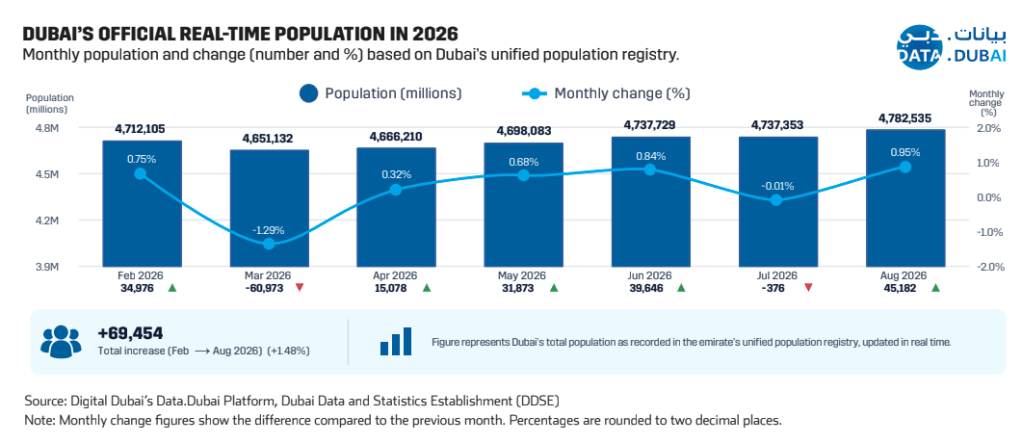
Economic confidence is difficult to measure in real time. Population movement is one of its clearest proxies. Despite predictions of an expatriate exodus, Dubai’s population has grown by 70,430 between February and August 2026.
That does not mean every resident or business felt secure. It means the aggregate decision to live, work and build in Dubai remained positive, and grew under conflict. People are not just consumers; they are employees, founders, renters, homebuyers and sources of demand. Continued population growth supports the economic flywheel even while external conditions remain unsettled.
For business leaders, the chart is also a reminder to distinguish sentiment from behavior. Anxiety can dominate headlines while applications, relocations, hiring and purchases tell a more grounded story.
3. New company formation accelerated when caution seemed more likely
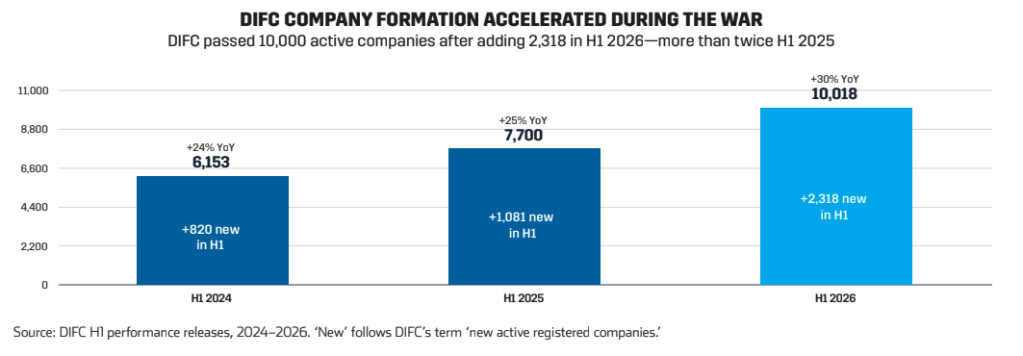
The most counterintuitive signal may come from the Dubai International Financial Centre. DIFC added 2,318 active companies in the first half of 2026, compared with 1,081 in the first half of 2025. Its total active-company base rose past 10,000 for the first time, up 30% year on year.
Company formation is a forward-looking act. Executives make it because they expect access to customers, capital, talent and regulation to justify the cost of establishing a presence. The pace of new registrations therefore says something that a confidence survey cannot: firms were committing resources, not merely expressing optimism.
This is where institutional consistency becomes a competitive advantage. During uncertainty, businesses place a premium on jurisdictions where incorporation, licensing, banking and dispute resolution continue to function predictably.
4. Trade reached a record even as shipping patterns were radically rearranged
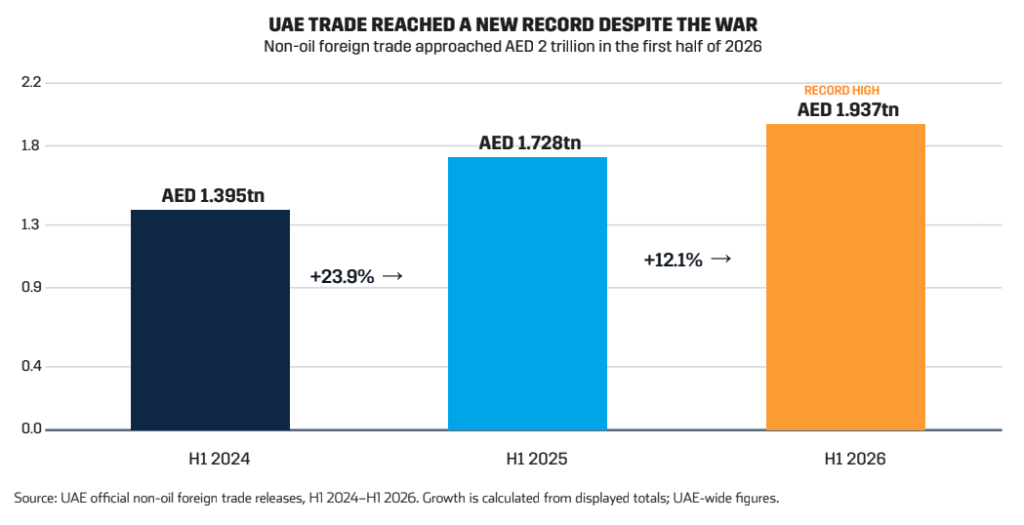
In the first half of 2026, UAE non-oil foreign trade reached AED 1.937 trillion—12.1% above the same period in 2025 and 39% above H1 2024. The number is surprising because it coincided with severe disruption at Jebel Ali, where container volumes fell by more than 90% as vessels avoided the Strait of Hormuz.
This is indication of how quickly the UAE’s trade systems adapted. Traffic shifted toward Fujairah, Khor Fakkan and other ports outside the Strait of Hormuz. The result was not frictionless, but it demonstrated a crucial form of resilience: spare pathways. Capacity distributed across multiple ports allowed commerce to reroute instead of simply stop.
Every scaling company needs its equivalent. A second supplier, alternate payment rail, backup fulfillment partner or geographically distributed team may appear inefficient in calm periods. In a crisis, optionality becomes productive infrastructure.
5. Property transactions cooled from a record—but still held Dubai’s second highest total value
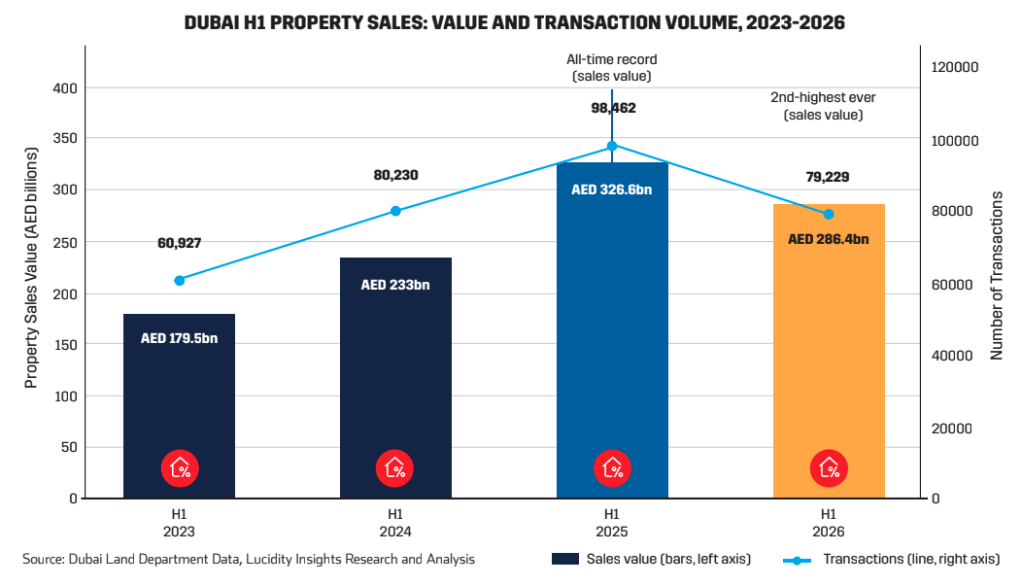
Dubai property transactions fell from 98,462 in H1 2025 to 79,229 in H1 2026, while sales value declined from AED 326.6 billion to AED 286.4 billion. Read alone, that looks like a straightforward slowdown. Read over a longer horizon, H1 2026 still delivered the second-highest first-half sales value on record.
The top end of the market was even more revealing. Sales of homes priced above US$10 million increased from 255 to 296 (+16%), and their combined value rose from US$4.4 billion to US$5.1 billion.
Resilience does not require every segment to move in the same direction. Here, transaction volume normalized after an exceptional year while high-conviction buyers increased their exposure. Entrepreneurs should read markets in layers: averages can obscure which customers are retreating, which are holding and which are leaning in.
6. A payroll shock appeared quickly—and faded quickly
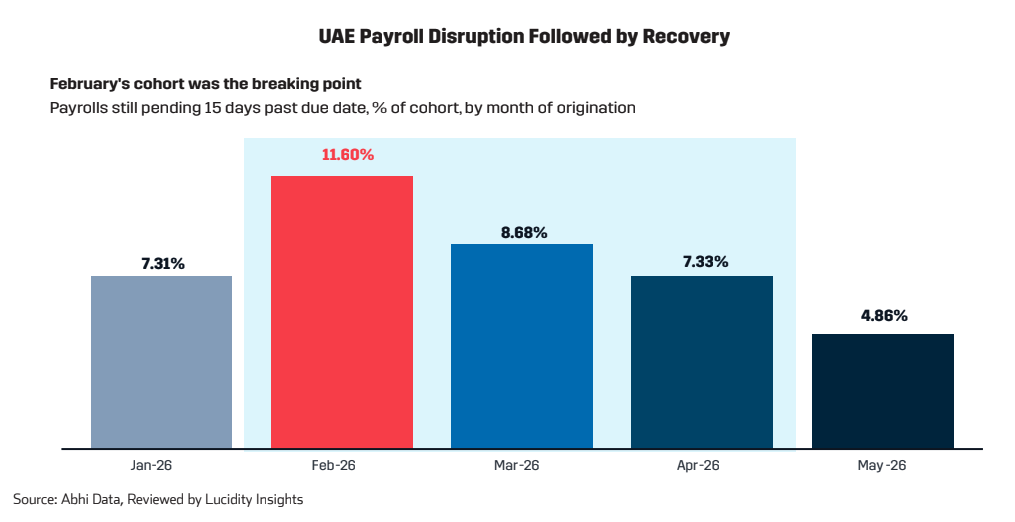
Macroeconomic resilience eventually has to show up in everyday operations. Payroll data from Abhi, an embedded finance and fintech platform providing earned wage access, showed how its UAE blue- and grey-collar workforce customers were paid (98% of who make less than AED 5,000 per month). In February, 11.6% of the monthly payroll cohort remained pending more than 15 days past due, up from 7.3% in January.
By April, there was a full recovery to January baselines, and in May, that measure had fallen further to a healthy 4.86%. The momentary spike particularly affected workers with limited financial buffers; but its duration is what policy-makers were keeping a close eye-on. The data suggests a sharp disruption to payment processing rather than a prolonged breakdown in employer liquidity or labor-market function. By April, delayed payments reduced to pre-conflict baselines.
Recovery speed is an underused management metric. Leaders often monitor whether something failed, but not how long the organization took to restore service. Time-to-recovery belongs on the dashboard alongside growth and profitability.
7. Resident demand recovered faster than visitor spending
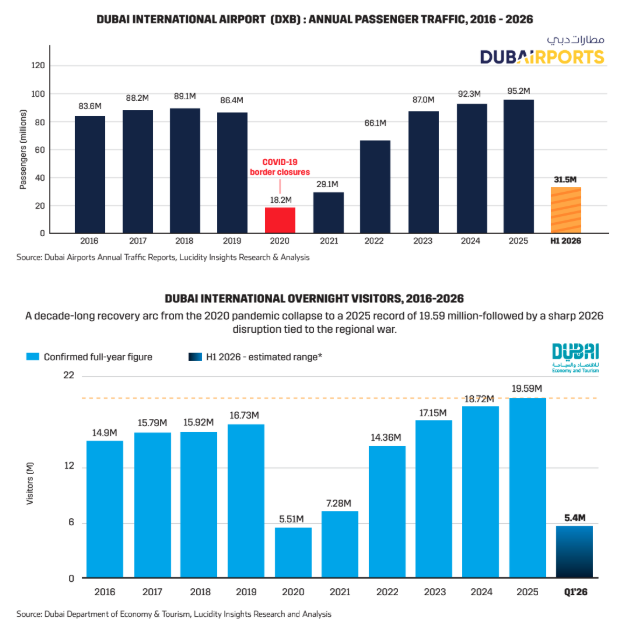
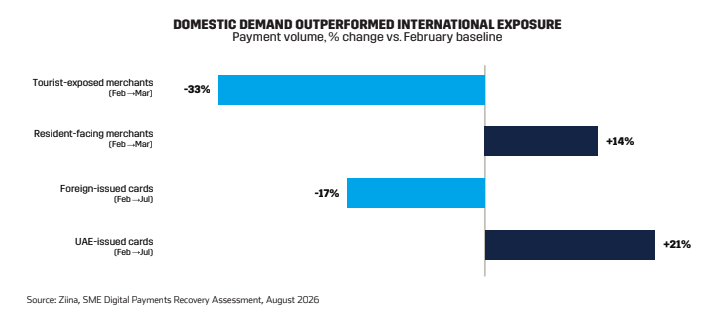
Taken together, these three charts point to an uneven recovery, with the clearest evidence of a rapid rebound coming from businesses serving the people who live, work and play in the city. Ziina, a Dubai-based fintech company providing mobile payments to consumers and businesses in the UAE. In Ziina’s merchant sample, payment volume at resident-facing businesses rose 14% from February to March, while tourist-exposed merchants recorded a 33% decline. A separate comparison through July reinforces that divide: payments using UAE-issued cards were 21% above February’s baseline, while foreign-issued-card payments remained 17% below it. That suggests local consumption provided an early source of support for everyday retail, dining, services and the delivery businesses around them.
The parts of the economy that are impacted by a drop in tourism, will likely take some time to recover. What we know, is that this is not a repeat of the pandemic. Q1 2026 and H1 2026 airport and overnight visitor figures show that 2026 full year tourism figures will land somewhere between Dubai’s 2022 and 2023 levels. More recent DET figures show hotel occupancy recovering from 36% in March to 66% in August, still only 89% of its August 2025 level; but recovery is well underway.
The real resilience story is adaptation
These nine charts grouped into seven themes, do not argue that Dubai was untouched. Aviation and tourism absorbed a serious blow, port activity was displaced, property volumes eased while valuations remained high, and payroll delays briefly jumped. Resilience is not invulnerability. The pace of recovery differs across sectors and customer groups.
What the data does show is an economy with multiple ways to absorb pressure. Growth remained positive; residents continued to arrive; companies continued to establish themselves; trade found alternate routes; high-value capital stayed engaged; and operational stress receded.
For entrepreneurs, the broader lesson is simple: durability is built from options. Diversified demand, reliable institutions, redundant infrastructure, mobile capital and fast feedback loops may look like separate advantages. Under pressure, they become one system.
The strongest economies—and the strongest companies—are not those that never get knocked off course. They are the ones designed to find another route.
RELATED: Perception vs Reality: How War Is Reshaping Startup Capital in the Middle East
When people call an economy “resilient,” they often mean that its headline numbers did not fall. That is too narrow. A resilient economy can take a hit, redirect activity and restore normal functions before temporary disruption becomes lasting damage.
Dubai offers a live case study. Last year, the city was ranked the third safest city in the world, according to the Numbeo Safety Index. In 2026, a regional war broke out. The war interrupted aviation, altered shipping routes and tested business confidence. As of publication of this article, the latest officially confirmed incident identified in public reporting was the interception of an Iranian drone over UAE territorial waters on August 31, 2026. That doesn’t mean Dubai is fully back, though the streets are packed and the city hums with activity.
Over the past few months Lucidity Insights has been speaking to startup founders and investors here in the region that are revealing real on-the-ground data that is illuminating Dubai’s true recovery arc, by sector, by customer-type, by consumer behavior trends. Data was gathered from across the market, showcasing what has happened in real-time. It tells an interesting story about what kept expanding, what found another route and what recovered quickly – and what areas are still struggling as we wrap up Q3 2026.

Erika Masako Welch • Chief Content Officer, Lucidity Insights
Erika Masako Welch is the Chief Content Officer of Lucidity Insights.