Infographic: The Gaming Industry

Opinions expressed by Entrepreneur contributors are their own.
You're reading Entrepreneur Middle East, an international franchise of Entrepreneur Media.
Recent innovations and advancements in technology have all contributed to the enhancement of the video game experience. Sound cards, graphic cards, faster CPUs, and 3D graphic accelerators are some of the notable improvements that we owe to the gaming industry, for what we know today as our modern personal computers. The gaming industry though, growing silently, is expected to drive revenues up to US$90.07 billion in 2020. International video game revenue was estimated to be around $80 billion in 2014, which is more than double the revenue of the international film industry in 2013. The market leading the race worldwide were China, the US and Japan- their respective revenues from gaming in 2016 were $24.27 billion, $23.46 billion and $12.43 billion.
The gaming industry has come a long way from their 70’s and 80’s video arcade games. Today we speak of eSport Markets, Social Gaming, MMOGs (massively multiplayer online games), and Mobile Gaming. The eSport Markets consists of professional players competing in a multiplayer video game. Some competitions such as The International, League of Legends, Dota etc., all provide live broadcasts of the competition. Throughout his recorded eSport career, Peter Dager, a 25 year-old gamer, earned $2.62 million, making him one of the most paid players of all time.
The segment itself is still growing at a 40% annual rate- revenues for 2015 were $325 million and projected to reach $1 billion by 2019. The number of eSports enthusiasts and occasional viewers is estimated to reach 230 million, a steep increase from the 71.5 million people in 2013. In terms of region, Asia is by far the biggest holder of market share in eSports, followed by the US and Europe. Asia also dominates the social gaming segment, with $2.27 billion in revenues and 500 million active monthly users while its US counterpart generates $1.8 billion. Zynga (Poker Game), King.com (Candy Crush), Nexon, and Supercell are only some of the most famous company in that area.
MMOG itself is expected to grow from $24.4 billion in 2014 to nearly $31 billion by 2017. Who isn’t familiar with Blizzard’s World of Warcraft? As an example, their subscription base grew almost a ten-fold: 1.5 million subscribers in 2005 to 12 million in 2010. The importance of mobile gaming can’t be ignored. Going hand in hand with the smartphone revolution, and as of 2016, the mobile gaming revenue increased to reach 12.1 billon Euros, and taking on 17% of total gaming revenue worldwide. 2016 saw the introduction of upgraded accessories (Oculus Rift, HTC Vive, and PlayStation VR headsets etc.) and software, offering consumers more choice and diversity and more accessibility.
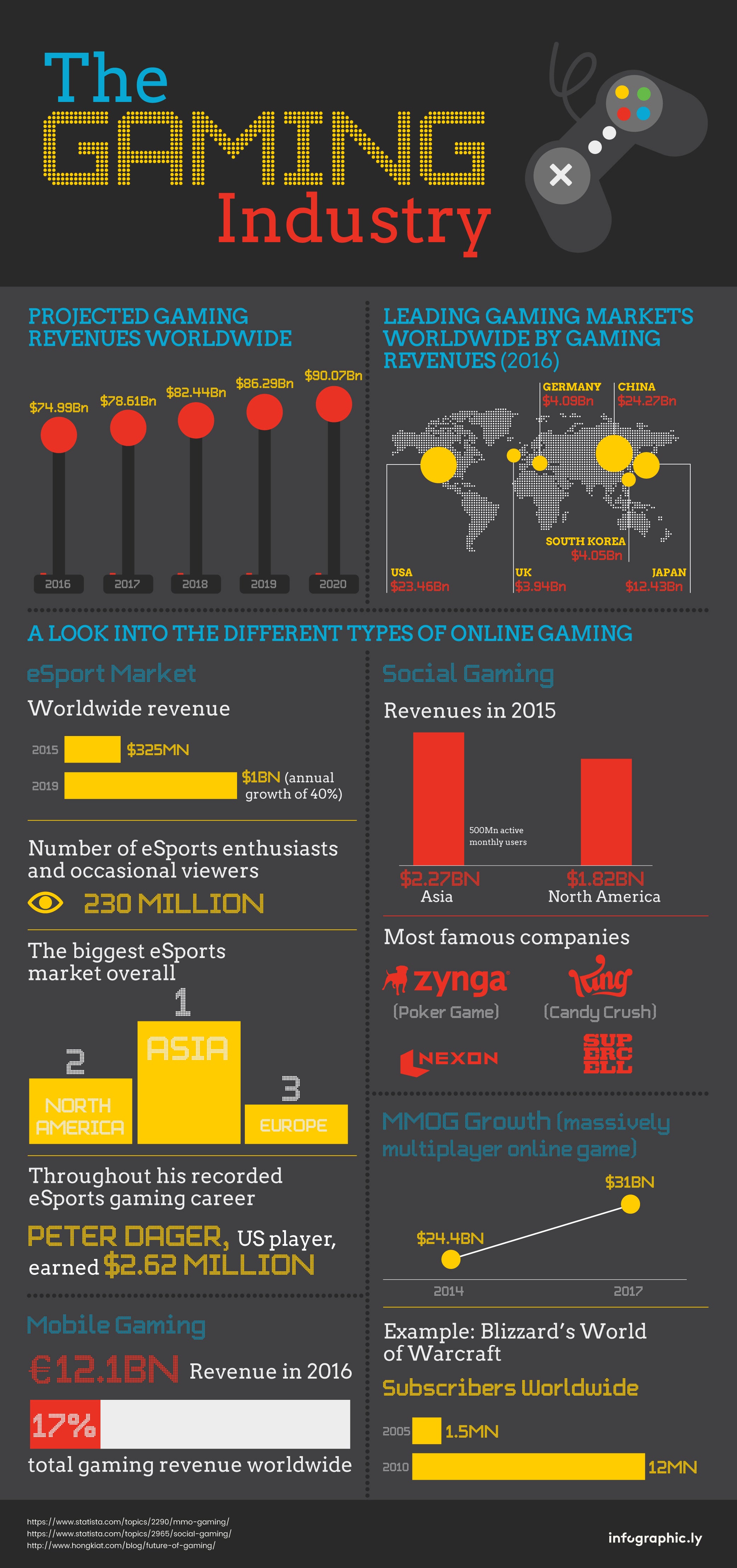
Recent innovations and advancements in technology have all contributed to the enhancement of the video game experience. Sound cards, graphic cards, faster CPUs, and 3D graphic accelerators are some of the notable improvements that we owe to the gaming industry, for what we know today as our modern personal computers. The gaming industry though, growing silently, is expected to drive revenues up to US$90.07 billion in 2020. International video game revenue was estimated to be around $80 billion in 2014, which is more than double the revenue of the international film industry in 2013. The market leading the race worldwide were China, the US and Japan- their respective revenues from gaming in 2016 were $24.27 billion, $23.46 billion and $12.43 billion.
The gaming industry has come a long way from their 70’s and 80’s video arcade games. Today we speak of eSport Markets, Social Gaming, MMOGs (massively multiplayer online games), and Mobile Gaming. The eSport Markets consists of professional players competing in a multiplayer video game. Some competitions such as The International, League of Legends, Dota etc., all provide live broadcasts of the competition. Throughout his recorded eSport career, Peter Dager, a 25 year-old gamer, earned $2.62 million, making him one of the most paid players of all time.
The segment itself is still growing at a 40% annual rate- revenues for 2015 were $325 million and projected to reach $1 billion by 2019. The number of eSports enthusiasts and occasional viewers is estimated to reach 230 million, a steep increase from the 71.5 million people in 2013. In terms of region, Asia is by far the biggest holder of market share in eSports, followed by the US and Europe. Asia also dominates the social gaming segment, with $2.27 billion in revenues and 500 million active monthly users while its US counterpart generates $1.8 billion. Zynga (Poker Game), King.com (Candy Crush), Nexon, and Supercell are only some of the most famous company in that area.