Would You Trust AI With Your Life? Philips’ Peter Skillman On The Future Of Healthcare At LEAP 2026
At LEAP 2026 in Riyadh, Philips’ Peter Skillman speaks to Entrepreneur Middle East about AI in healthcare, the importance of human judgment, and why trust and transparency will determine how far the technology can go.
LEAP 2026
Opinions expressed by Entrepreneur contributors are their own.
You're reading Entrepreneur Middle East, an international franchise of Entrepreneur Media.
AI is rapidly becoming part of the healthcare conversation, promising to make clinical workflows faster, more efficient and, in some cases, more accessible. But when a patient’s health is at stake, the question becomes more complicated: how much decision-making should we really hand over to machines?
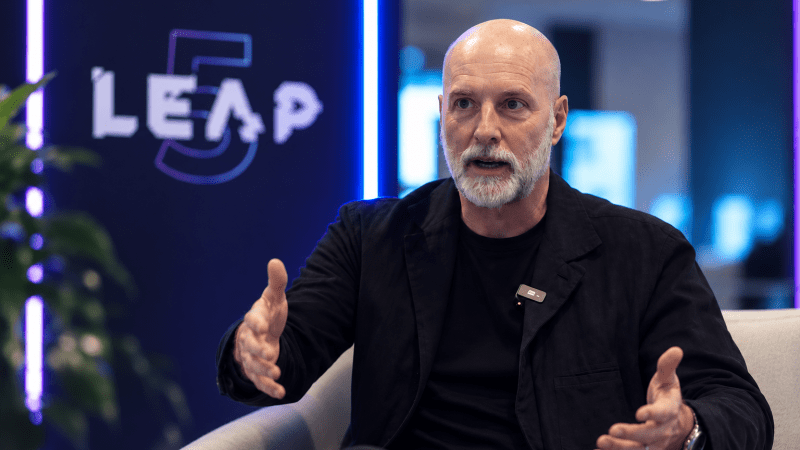
Speaking to Entrepreneur Middle East at LEAP 2026 in Riyadh, Peter Skillman, Global Head of Design at Philips, argues that the future of AI in healthcare will depend as much on trust and transparency as it does on technological capability.
For Skillman, the conversation around AI cannot simply focus on what the technology is able to do. It also has to consider how clinicians and patients experience it, understand it and ultimately decide whether to trust the recommendations it produces.
AI is already being integrated into clinical workflows across healthcare systems, helping professionals process information, identify patterns and manage increasingly complex workloads. Yet Skillman believes that the most important medical decisions must continue to involve human judgment.
That is particularly true in situations where the consequences are significant. While AI can assist clinicians by surfacing relevant information or helping them make sense of large amounts of data, the technology should not become a black box that simply produces an answer without explaining how it got there.
Transparency, he suggests, will be critical to adoption. If clinicians are expected to act on an AI-generated recommendation, they need to understand the reasoning behind it. Patients, too, are increasingly likely to want clarity around how technology is influencing decisions about their treatment.
This places design at the center of the AI healthcare conversation. The challenge is not only to build sophisticated systems, but to make those systems understandable, intuitive and useful within real-world clinical environments.
Skillman also points to the potential of technology to expand access to healthcare beyond traditional hospital settings. Tools such as tele-ICUs, wearable monitoring and mobile imaging are creating opportunities to deliver sophisticated clinical support to patients who may not otherwise have easy access to specialist care.
That shift could be particularly significant as healthcare systems around the world face growing pressure to serve larger populations while managing costs, staffing constraints and rising expectations around quality of care.
Rather than requiring every patient to physically enter a highly specialized medical facility, technology can increasingly bring elements of that expertise closer to them. Remote monitoring can allow clinicians to track patients continuously, while connected technologies can help medical teams intervene earlier when something begins to change.
In Saudi Arabia, Skillman sees a significant opportunity to build the infrastructure and partnerships required to support the next generation of healthcare innovation. The Kingdom’s wider investment in digital transformation and technology creates an environment in which new healthcare models can potentially be developed at scale.
But the success of those models will depend on more than simply adopting global technologies. Localized infrastructure, partnerships and an understanding of the specific needs of patients and healthcare providers in the market will all play a role in determining how effectively new solutions are implemented.
The broader question, then, is not whether AI will become part of healthcare. In many ways, that transition is already underway. The more important question is how the technology is designed, governed and integrated into the relationships between clinicians and patients.
For Skillman, technology should ultimately remain a tool in service of people rather than becoming the end goal itself. The measure of success is not how advanced the AI becomes, how many processes it automates or how sophisticated the underlying technology appears.
It is whether the technology helps clinicians make better decisions, gives patients greater access to care and ultimately improves lives.
As AI becomes increasingly embedded in healthcare, that distinction may become one of the most important ones the industry has to make.
AI is rapidly becoming part of the healthcare conversation, promising to make clinical workflows faster, more efficient and, in some cases, more accessible. But when a patient’s health is at stake, the question becomes more complicated: how much decision-making should we really hand over to machines?
Speaking to Entrepreneur Middle East at LEAP 2026 in Riyadh, Peter Skillman, Global Head of Design at Philips, argues that the future of AI in healthcare will depend as much on trust and transparency as it does on technological capability.
For Skillman, the conversation around AI cannot simply focus on what the technology is able to do. It also has to consider how clinicians and patients experience it, understand it and ultimately decide whether to trust the recommendations it produces.

Mina Vucic • Director of Production and Multimedia, BNC Publishing
Entrepreneur Staff
Mina Vucic is the Director of Production and Multimedia at BNC Publishing, the media house... Read more